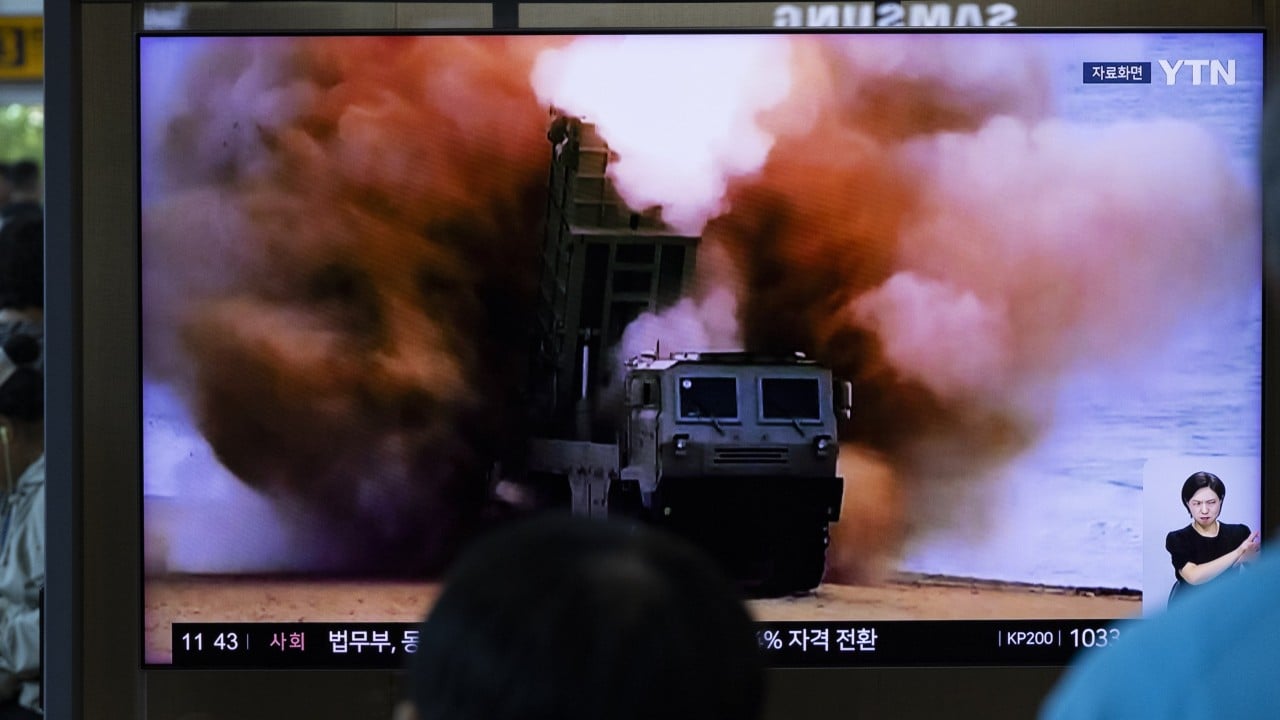
The operational efficacy of the M142 High Mobility Artillery Rocket System (HIMARS) does not stem from weaponized novelty, but from a precise convergence of rapid mobility, distributed logistics, and real-time sensor-to-shooter integration. Traditional towed and heavy tracked artillery systems rely on massed fire and sustained volume, accepting high counter-battery risk to secure force concentration. HIMARS inverted this model by prioritizing survivability through minimal occupation time and high-precision strike capability, reducing the volume of ammunition required to neutralize a target by orders of magnitude.
Understanding the system requires breaking down its operational profile into three distinct phases: signal-to-fire velocity, dispersed deployment logistics, and counter-battery risk management.
Signal-to-Fire Velocity and Tactical Command Networks
The combat utility of precision rocket artillery depends entirely on the latency of the kill chain. A mobile launcher targeting a high-value static asset—such as a command post, ammunition depot, or concentration area—must execute the firing mission before target location error (TLE) degrades or before enemy electronic warfare (EW) intercepts the targeting feed.
The kill chain follows a five-stage linear progression:
- Target Acquisition: Unmanned Aerial Systems (UAS), signals intelligence (SIGINT), or space-based synthetic aperture radar (SAR) identify coordinates and verify target signatures.
- Data Digitization and Transmission: Tactical software processes raw coordinates into fire control data. Tactical data networks transmit encrypted packet bursts directly to the launcher's Fire Control System (FCS).
- Point Occupation and Solution Calculation: The three-person crew receives the mission while in a concealed staging area, maneuvers to a designated launch point, and aligns the launcher automatically using internal inertial navigation systems (INS) supplemented by GPS.
- Munition Discharge: The launcher executes the salvo. Rocket motors ignite, leaving the pod within seconds.
- Immediate Displacement: The vehicle disengages its stabilizing jacks and drives away before the incoming trajectory can be back-calculated by hostile counter-battery radar systems.
The bottleneck in this sequence is rarely the vehicle itself; it is the time required to authorize a strike and pass targeted data down the command hierarchy. When sensor-to-shooter networks are fully integrated, total latency drops below five minutes. This speed nullifies the operational value of enemy soft-skinned support assets operating within a 15-to-80-kilometer window from the Forward Line of Own Troops (FLOT).
Dispersed Logistics and Pod-Based Ammunition Handling
Tracked self-propelled howitzers and conventional rocket launchers require extensive manual labor to reload, requiring crews to handle individual artillery shells or exposed rocket tubes. This design slows throughput and forces reload operations into static concentrations easily spotted by enemy aerial reconnaissance.
HIMARS bypasses manual ammunition handling through factory-sealed rocket pods. The M142 chassis carries a single launch pod containing six Guided Multiple Launch Rocket System (GMLRS) rockets or one Army Tactical Missile System (ATACMS) short-range ballistic missile.
This architectural choice introduces specific operational tradeoffs:
- Minimal Footprint: Reloading requires a single Resupply Vehicle (RSV) equipped with an integrated boom crane. The crew inserts a pre-loaded pod directly into the launcher cage, completing the cycle in under ten minutes with minimal personnel.
- Geographic Dispersion: Ammunition storage points do not need to be massive forward supply depots. Pods are dispersed across hidden cache points along key transportation corridors.
- Volume Limitations: A single truck carrying six rockets delivers lower saturation capacity compared to legacy systems like the BM-27 Uragan or BM-30 Smerch. Saturation volume is deliberately traded for operational mobility and precise impact distribution.
The primary vulnerability shifts from the launcher to the logistics chain. High-intensity consumption drains rocket pods faster than standard supply lines can transport them. Maintenance of heavy transport trucks and the securing of concealed ammunition caches become the defining operational constraints governing launcher availability.
Counter-Battery Survivability and Electronic Warfare Degradation
The survival of the M142 hinges on "shoot-and-scoot" doctrine combined with a low radio-frequency footprint during transit. Counter-battery radar detects incoming projectiles in flight, calculates the ballistic arc, and projects the origin point back to the source. Because GMLRS rockets follow a predictable initial trajectory, enemy radar will locate the firing site within seconds of launch.
Survivability is achieved purely through speed differential.
An M142 crew completes a launch salvo, stows the launcher, and accelerates away from the launch point in less than two minutes. Hostile counter-battery responses typically require:
- Radar detection and point estimation: 30 to 60 seconds
- Signal transmission to an automated battery: 60 to 120 seconds
- Flight time of counter-battery shells: 90 to 180 seconds
By the time incoming artillery shells impact the launch site, the vehicle is hundreds of meters outside the lethal blast radius.
The operational bottleneck shifts when facing advanced Electronic Warfare capabilities. GMLRS weapons rely on dual-mode guidance: GPS coupled with an internal Inertial Navigation System (INS). Dense radio-frequency jamming environments degrade the GPS receiver, forcing the missile to rely exclusively on INS for terminal guidance.
While INS is immune to external jamming, system drift increases Target Location Error proportionally with distance traveled. If GPS signal lock is lost immediately after launch, the circular error probable (CEP) expands, turning a strike that would normally land within a few meters into a wider-area dispersion impact. To maintain precision, fire control units must adapt by calculating precise drop-zone parameters or integrating anti-jamming antenna arrays onto the munition frames.
Strategic Allocation of Low-Volume Precision Strikes
Because precision munitions are expensive and production capacity is finite, using them against tactical frontline units creates a negative cost-exchange ratio. Maximizing system value requires strict target prioritization focused on operational-level assets that degrade the enemy's structural cohesion.
Key high-yield target categories include:
- Command and Control Nodes: Eliminating divisional staff shelters disrupts unit coordination, creating command vacuums across wide sectors.
- Ammunition Storage Sites: Striking centralized depots induces localized supply collapse, dropping frontline artillery output across entire operational axes.
- Integrated Air Defense Systems (IADS): Neutralizing long-range radar units opens corridors for tactical aviation and medium-altitude strike drones.
- Concentrated Logistics Bottlenecks: Targeting railhead transfer points and pontoon bridges freezes armored maneuver units in place due to fuel exhaustion.
Deploying HIMARS as frontline field artillery degrades its primary strategic advantage. The weapon acts as an operational interdiction tool, designed to break enemy supply chains and staff networks well behind the active engagement zone.
Deploy HIMARS units strictly in decentralized, two-vehicle firing sections tied into automated sensor networks. Maintain constant movement between distributed ammunition caches, restrict launch operations to single-pod salvos, and execute immediate displacement vectors perpendicular to known enemy radar axes to preserve launcher survivability.