The media is choking on its own indignation again.
The standard narrative surrounding Donald Trump and Marco Rubio attending a UFC event while geopolitical tensions simmer is as predictable as it is shallow. They call it "unserious leadership." They claim it’s a dereliction of duty. They point at the flashing lights of the Octagon and contrast them with the sterile, somber rooms where "real" diplomacy supposedly happens.
They are wrong. They are fundamentally misreading the mechanics of modern power.
Traditional political analysis operates on the delusion that leadership is a 24-hour performance of visible anxiety. If there is a crisis, the leader must be seen behind a desk, forehead furrowed, surrounded by stacks of paper that no one actually reads. This isn't governance; it’s theater for the mid-wit.
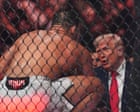
What the critics missed in Miami wasn't a lack of focus. It was a masterclass in high-leverage presence.
The Myth of the Somber Statesman
We have been conditioned to believe that the efficacy of a leader is directly proportional to how miserable they look during a global crisis. This is the "Jimmy Carter Fallacy." It posits that if you aren't wearing a cardigan and looking exhausted by the weight of the world, you aren't working.
History suggests otherwise.
Leadership isn't about the hours spent staring at a wall in the Situation Room while waiting for a mid-level bureaucrat to finish a briefing. It is about the projection of strength, the cultivation of specific networks, and the refusal to be pinned down by the enemy's timeline.
When Trump and Rubio sit cageside, they aren't just watching two men trade calf kicks. They are signaling. They are telling adversaries that the American machine does not grind to a halt because a hostile foreign power decided to walk away from a table. They are demonstrating that they operate on their own terms, not the frantic, reactive schedule of the 24-hour news cycle.
Cultural Capital is the New Hard Power
The UFC isn't just a sport anymore. It is the town square for a massive, global demographic that traditional politicians have completely alienated. It is the nexus of the "Manosphere," the creator economy, and a raw, meritocratic energy that transcends borders.
By showing up, Trump and Rubio are performing an act of cultural arbitrage. They are bypassng the gatekeepers of the legacy media to speak directly to a base that values physical courage and unapologetic Americanism.
Contrast this with the "serious" alternative: a staged press conference in a windowless room where a spokesperson reads prepared remarks about "deep concern." Which one projects vitality? Which one commands the attention of the 18-to-34-year-old male demographic that actually fights the wars the "serious" people start?
Diplomacy Fails Because the Process is Broken
The critique hinges on the idea that "Iran talks failed."
Let’s be brutally honest about the nature of these negotiations. Diplomacy with ideological hardliners doesn't fail because a Senator went to a fight. It fails because the underlying incentives are misaligned. The "serious" crowd believes that if we just sit in a room long enough and use the right jargon, we can bridge the gap between Western liberalism and a revolutionary theocracy.
That is a fantasy.
Real-world negotiations are dictated by leverage. Sometimes, the most powerful move you can make in a negotiation is to leave the room and go do something else. It signals that you are not desperate for a deal. It demonstrates that your life and your nation’s trajectory are not tethered to the whims of the person across the table.
I have watched corporate executives blow nine-figure deals because they were too eager to stay in the room. They thought "presence" meant "proximity." They were wrong. Presence means being the person who doesn't need the deal.
By prioritizing a public appearance at a massive cultural event over the optics of a failing diplomatic process, these leaders are reclaiming the leverage of the "walk-away."
The Situational Awareness of the Octagon
There is a technical term for what critics are doing: Category Error.
They are viewing a UFC event through the lens of "leisure." They should be viewing it through the lens of asymmetric networking. Who else is at these events?
- Tech billionaires.
- Media moguls.
- Global athletes with more reach than a dozen Prime Ministers.
- The next generation of cultural disruptors.
A four-hour UFC main card provides more opportunities for high-level, informal intelligence gathering and relationship building than a month of formal dinners in D.C. In the formal setting, everyone is guarded. Everyone has a script. At ringside, the scripts disappear.
If you think a politician isn't working just because they don't have a briefcase in their hand, you don't understand how the world actually turns. Power is brokered in the gaps between the official schedule.
The High Cost of the "Serious" Aesthetic
The obsession with "serious leadership" has led us to a place where our leaders are paralyzed by optics. They are so afraid of looking "unserious" that they become ineffective. They prioritize the process over the result.
Imagine a scenario where a CEO spends all night in the office during a stock dip, micromanaging every department. The board loves the "commitment." The employees hate the interference. The stock keeps falling because the CEO is too close to the problem to see the solution.
Now imagine the CEO who, during that same dip, goes to a high-profile industry gala, secures a partnership with a competitor over a drink, and returns the next morning with a solution that actually moves the needle.
The critics would crucify the second CEO for being "unserious." But only the second CEO actually saved the company.
Dismantling the "People Also Ask" Delusions
The public often asks: "Shouldn't the President be focused on national security 24/7?"
The answer is: No. Focus is a finite resource. A leader who is constantly "on" is a leader who is prone to cognitive fatigue and reactionary decision-making. The demand for 24/7 visible focus is a demand for poor judgment. We need leaders who can compartmentalize, who can step back, and who can engage with the world as it is, not as the beltway wants it to be.
Another common query: "What message does this send to our allies?"
It sends the message that America is not a neurotic mess. It sends the message that we are confident enough in our systems and our strength that we don't need to hyperventilate every time a diplomatic track hits a snag. Confidence is contagious. Neuroticism is a weakness that allies fear and enemies exploit.
The Brutal Reality of Global Attention
We live in an attention economy.
The "serious" leadership model is a relic of a time when there were three TV channels and the public had the patience for an hour-long policy lecture. That world is dead.
If you want to lead in 2026, you have to go where the attention is. You have to dominate the digital landscape. You have to be comfortable in the chaos of the crowd.
The critics are mad because Trump and Rubio have figured out the cheat code. They have realized that 15 seconds of a walk-out video at a UFC event generates more engagement and projects more "strength" than a thousand white papers on Middle Eastern stability.
Is it vulgar? To the old guard, yes.
Is it effective? Undeniably.
The Pivot to the New Reality
Stop looking for leadership in the places that haven't produced a win in thirty years.
The sterile rooms, the rehearsed handshakes, and the "serious" frowns have given us decades of stagnant diplomacy and managed decline. The disruption we are seeing—the move toward raw, populist, and highly visible engagement—is a correction.
It is a recognition that the old ways are exhausted.
If you are offended by a leader at a cage fight, you are likely the same person who thinks a LinkedIn post is "activism." You are prioritizing the shadow over the substance.
The world is changing. Power is migrating from the institution to the individual. Influence is migrating from the press room to the arena. You can whine about the "loss of decorum," or you can wake up and realize that the rules of the game have been rewritten while you were busy checking the optics.
Diplomacy didn't fail because of a UFC event. Diplomacy failed because it’s a broken system being run by people who are terrified of the very energy that fills that arena in Miami.
The Octagon is real. The boardroom is a simulation.
Choose your fighter.