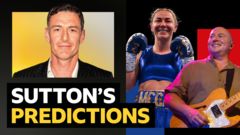
The air in the television studio smells of industrial-grade coffee and the faint, ozone tang of high-voltage lighting. It is a sterile environment designed to produce hot takes, but for Chris Sutton, it is a laboratory of reputation. Every Friday, the ritual begins. He sits before a spreadsheet of fixtures, a digital ledger of impending triumphs and looming disasters, and attempts to do the impossible: quantify the unquantifiable.
Predicting the Premier League is not a science. It is an act of public vulnerability. You are essentially standing in a town square, shouting your guesses about the future, and waiting for several thousand people to tell you exactly how stupid you are on Monday morning.
This week, the stakes carry a different weight. Across from the former striker sits Molly "Meatball" McCann. She is not a pundit. She is a force of nature from the world of mixed martial arts, a woman who has spent her life navigating the razor’s edge between victory and physical consequence. Alongside her, Tim Browne of The Boo Radleys brings the perspective of a man who understands the strange, rhythmic patterns of pop culture.
It is a clash of instincts. Sutton relies on the cold data of expected goals and defensive structures. McCann relies on the "vibe"—that intangible, gut-level feeling that tells a fighter when a momentum shift is coming before the crowd even sees it.
The Weight of the Badge
Consider the plight of the modern football fan. We treat these predictions like gospel or heresy, forgetting that the men and women making them are just as susceptible to the sport’s inherent madness as we are. Sutton knows this better than most. He has felt the grass under his boots; he has lived through the seasons where the ball simply refuses to go into the net.
When he looks at a fixture like Liverpool versus Nottingham Forest, he isn't just seeing names on a screen. He is seeing the ghost of past collapses. He is weighing the fatigue of international travel against the adrenaline of a home crowd. McCann, however, sees the fighter's spirit. She looks for the underdog who has been backed into a corner, the team that is tired of being the punchline.
"It’s about who wants it more when the lungs are burning," she might say, though her eyes say it much louder. In the Octagon, if you predict a move incorrectly, you lose a tooth or a title. In the studio, you lose your dignity. Both require a certain brand of courage.
The Rhythm of the Unpredictable
Tim Browne watches this exchange with the detached curiosity of a songwriter. He knows that football, like a hit record, requires a hook. It requires a bridge that builds tension until the stadium—or the chorus—explodes. The Boo Radleys understood how to capture a moment in time, and Browne sees the Premier League through a similar lens.
Is a team "Wake Up It's Beautiful" or are they a one-hit wonder destined for the relegation scrap?
The beauty of this specific gathering is the collision of worlds. You have the analytical rigidity of the professional athlete, the raw, emotional intelligence of the fighter, and the creative intuition of the musician. They are all trying to solve the same puzzle: How do you account for the human element?
How do you predict the moment a defender’s concentration snaps because of a personal tragedy he hasn't shared with the press? How do you factor in the sudden, inexplicable burst of confidence that transforms a struggling striker into a god for ninety minutes?
You can’t.
That is the lie of the prediction business. We pretend there is a logic to it because the alternative—that we are all just watching beautiful, chaotic entropy—is too terrifying to acknowledge. We want to believe the world makes sense. We want to believe that if we study the stats long enough, we can see the future.
The Invisible Pressure
McCann’s presence changes the energy of the room. When she talks about Everton, it isn't just a sports take; it’s a confession of faith. To be a fan is to be in a constant state of voluntary heartbreak. She carries the hopes of her city in her fists, and she sees the players on the pitch as extensions of that same local pride.
Sutton often plays the villain, the realist who tells you your team is going to lose because their midfield is a sieve. It is a lonely role. He is the person at the party telling you that your car’s transmission is about to go. He’s usually right, but nobody thanks him for it.
Yet, when he sits with McCann and Browne, the cynicism softens. He is reminded that football isn't just a series of tactical shifts. It is a story we tell ourselves.
The predictions fly.
Manchester City is viewed as a relentless machine, a cold equation that Pep Guardiola has solved. But even machines have friction. Even the best-laid plans can be undone by a heavy touch or a referee’s momentary lapse of reason. McCann looks for the "glitch" in the machine. She wants the chaos. She wants the moment where the script is torn up and the underdog finds a way to win through sheer, bloody-minded refusal to lose.
The Symphony of the Saturday Afternoon
As the recording continues, the differences between these three people start to blur. They are all chasing the same high. They are all looking for that split second where the world stands still—the moment the ball leaves the foot and begins its long, curving arc toward the top corner.
Browne sees it as a crescendo.
McCann sees it as a knockout blow.
Sutton sees it as a statistical inevitability.
They argue over the mid-table clashes, the games that the casual viewer might ignore but the true believer finds essential. These are the games where the real drama happens—the desperate fight for a single point that might mean the difference between staying in the light or falling into the financial abyss of the Championship.
The stakes are invisible to the eye but heavy on the heart. A manager’s job hangs in the balance. A young player’s career is either forged in the fire or extinguished in the rain. We call it "entertainment," but for the people on that pitch, it is survival.
The Final Reckoning
By the time the cameras stop rolling, the predictions are set in stone. They are uploaded to the internet, where they will be dissected, mocked, and occasionally praised. Sutton will go home and wait for the results to roll in, knowing that by Sunday evening, he will either be a genius or a fraud.
There is no middle ground in the world of the Oracle.
McCann will return to the gym, her mind already shifting back to the physical reality of the cage. Browne will return to the world of melody and metaphor. But for one afternoon, they were all united by the strange, addictive gravity of the English game.
We watch these three people because they represent the different ways we all process the world. We use logic to protect ourselves, emotion to connect ourselves, and art to explain ourselves.
When the whistle blows on Saturday, none of the talk matters. The spreadsheets are useless. The "vibes" are irrelevant. There is only the ball, the grass, and the twenty-two humans trying to find a way through the noise.
The predictions are just a way to pass the time until the real magic starts. They are the map, but they are never the journey. As the lights in the studio dim and the coffee grows cold, the truth remains: we don't watch because we know what’s going to happen.
We watch because we don't.