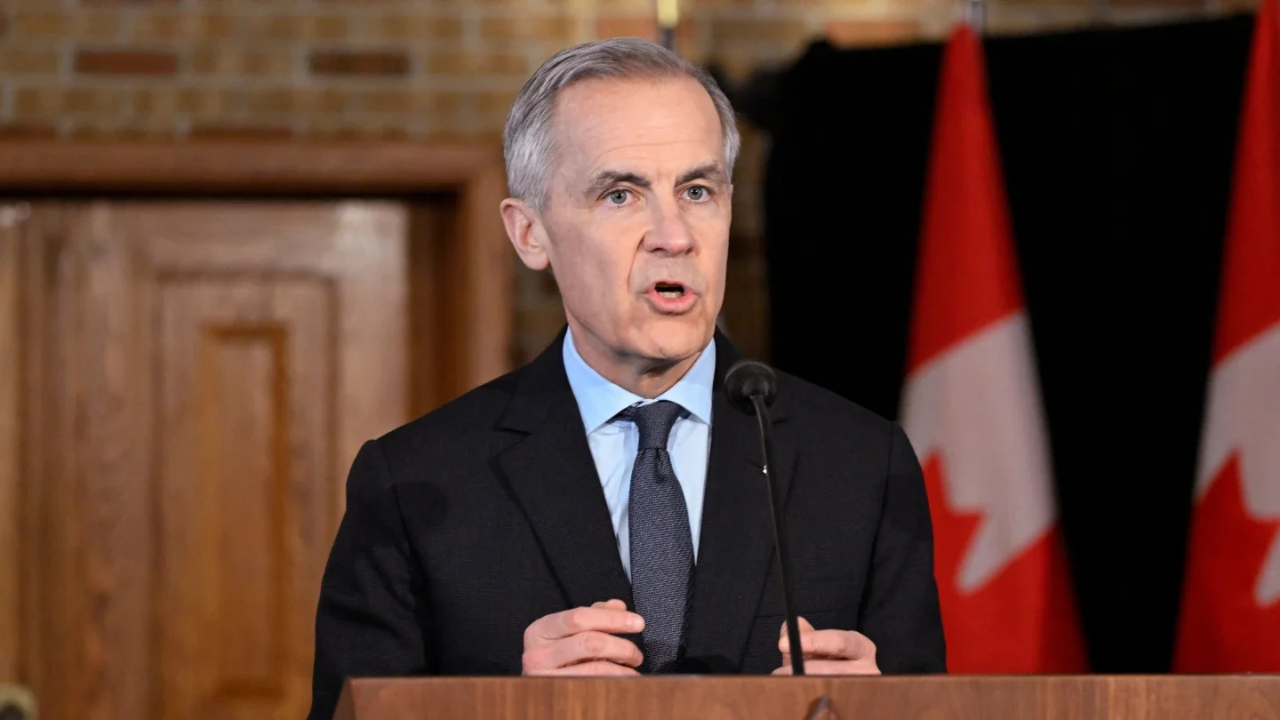
Canada and the United States are quietly clearing the logjams in their bilateral trade negotiations even as Prime Minister Mark Carney aggressively courts major Asian economies to break Ottawa’s historic reliance on Washington. While diplomatic readouts frame this dual-track strategy as routine economic statecraft, the reality on the ground is far more calculated. Ottawa is using the prospect of deep Asian market integration as direct diplomatic pressure at the North American negotiating table, attempting to secure ironclad protections against American protectionism before the next round of continental trade reviews turns hostile.
For decades, the Canadian economy operated on a single, unassailable premise: geography is destiny. When roughly three-quarters of your exports flow south across a single undefended border, diversification is usually a talking point reserved for campaign trails and white papers, rarely an operational mandate. That calculus shattered when American trade policy swung hard toward unilateral tariffs, aggressive industrial subsidies, and a transactional view of long-standing alliances. The current push out of Ottawa represents a fundamental break from decades of quiet continentalism, driven by a former central banker who views supply chain concentration not as a mark of efficiency, but as an acute systemic risk. You might also find this similar article insightful: The Quiet Stampede That Will Decide Your Retirement.
The Anatomy of the Washington Breakthrough
To understand why negotiations with Washington are suddenly showing movement after months of friction, you have to look at what actually happens when supply chains stall. Progress in Canada-US trade talks rarely comes from sudden ideological alignment. It comes from mutual pain.
American manufacturers, particularly in the automotive, aerospace, and clean energy sectors, rely on Canadian critical minerals, aluminum, and intermediate components to qualify for domestic tax credits and avoid crippling production delays. When retaliatory measures or border bottlenecks threaten that flow, lobby groups in Michigan, Ohio, and Pennsylvania pick up the phone. The recent narrowing of differences between Ottawa and Washington reflects a pragmatic recognition on both sides that a full-blown North American trade war inflicts immediate, measurable damage on American industrial output just as much as it hurts Canadian exporters. As extensively documented in recent reports by The Wall Street Journal, the results are significant.
Yet the progress remains fragile. Washington’s negotiating posture continues to demand strict alignment on external tariffs—specifically targeting Chinese electric vehicles, steel, and solar components—as the price of admission for frictionless North American market access. For Ottawa, matching American tariffs on Chinese goods was a necessary concession to keep the southern border open, even though it instantly triggered retaliatory agricultural tariffs from Beijing on Canadian canola and pork.
This is the exact trap Carney is trying to engineer his way out of. If Canada simply mirrors American trade barriers without building alternative commercial outlets, it absorbs all the collateral damage of Washington's geopolitical rivalries while receiving zero guarantees that the next American administration won't slap tariffs on Canadian softwood lumber, dairy, or steel anyway.
Why Asia Is the Real Pressure Valve
When Carney boards a plane for Tokyo, Seoul, Singapore, or New Delhi, the trip is about far more than photo opportunities and memorandums of understanding. It is an exercise in building commercial optionality.
Consider the sheer structural shift required to move the needle on Canadian trade statistics. Even a massive surge in exports to the Indo-Pacific will not replace the United States as Canada’s primary customer in our lifetimes. The gravitational pull of the world’s largest consumer market sitting right next door is simply too strong. However, in trade negotiations, you do not need to replace your biggest customer to gain bargaining power. You only need to prove that you have other buyers willing to pay market rates for your most prized assets.
Asia’s industrialized economies have an insatiable, long-term appetite for precisely what Canada possesses in abundance:
- Liquefied natural gas (LNG) shipped directly from the British Columbia coast, bypassing the Panama Canal and offering Asian utilities a stable alternative to Middle Eastern and Russian supplies.
- Critical minerals including potash, uranium, lithium, and nickel, which are essential for Japanese and South Korean battery manufacturers trying to de-risk their own supply chains.
- High-protein agricultural commodities such as wheat, pulses, and canola, needed to secure food supplies across rapidly urbanizing Asian nations.
By accelerating export infrastructure on the West Coast and signing bilateral investment treaties across the Pacific, Ottawa is sending an unmistakable signal to Washington. If American lawmakers erect new "Buy American" walls or demand punitive concessions during continental trade reviews, Canadian energy and minerals will increasingly flow west toward Yokohama and Busan rather than south toward Houston and Detroit.
The China Complication
Pursuing Asian markets without getting burned requires walking a razor-thin geopolitical wire, largely because the biggest market in the region is also the most contentious. Any serious expansion in the Indo-Pacific forces Ottawa to confront the reality of Beijing’s economic gravity.
Over the past several years, diplomatic relations between Canada and China plunged into a deep freeze, marked by national security disputes, foreign interference probes, and tit-for-tat tariffs. Pretending that business can simply return to normal is a non-starter in Ottawa, where security hawks and Washington allies monitor every bilateral interaction. Instead, the current strategy relies on a China-plus-one approach tailored for a middle power.
Ottawa is concentrating its diplomatic capital on democratic, treaty-aligned Asian economies—specifically Japan, South Korea, and the member states of ASEAN—while keeping trade with China strictly compartmentalized to non-sensitive agricultural and consumer sectors. It is a calculated bet that regional middle powers share Canada’s exact dilemma: they rely on the American security umbrella, depend on Asian supply chains, and desperately want to avoid being crushed between two competing superpowers.
The Structural Bottlenecks Nobody Wants to Discuss
High-level diplomatic breakthroughs make for great headlines, but trade deals do not move shipping containers. Physical infrastructure, regulatory alignment, and domestic capital do. And this is where Ottawa’s grand strategy runs headfirst into uncomfortable domestic realities.
You cannot pivot to Asia if you cannot get your goods to the Pacific Ocean efficiently. For years, Canada’s West Coast supply chains have been plagued by severe vulnerabilities:
- Chronic labor disputes at the Ports of Vancouver and Prince Rupert that have repeatedly frozen billions of dollars in cargo.
- Extreme weather events, including atmospheric rivers and wildfires, that have washed out vital rail corridors through the Rocky Mountains.
- A multi-year regulatory approval process for mines, pipelines, and export terminals that routinely stretches past a decade, driving institutional capital toward jurisdictions with faster permitting timelines.
Asian institutional investors and sovereign wealth funds have shown genuine interest in Canadian infrastructure and energy assets, yet many remain skeptical of Ottawa’s ability to execute on schedule. During recent trade missions, foreign executives have repeatedly raised the same quiet objection: signing a trade agreement means very little if a proposed lithium mine or port expansion gets bogged down in ten years of overlapping federal and provincial environmental reviews.
Furthermore, Canadian businesses themselves suffer from a deeply ingrained risk aversion. Decades of easy access to the American market—where the language is the same, the legal systems are similar, and shipping takes hours by truck rather than weeks by sea—have left many mid-sized Canadian firms ill-equipped to navigate the regulatory, linguistic, and logistical complexities of Asian markets. Government trade missions can open doors in Jakarta or Taipei, but they cannot force risk-averse corporate boards in Toronto or Calgary to commit the capital required to build overseas distribution networks.
The Hidden Friction Inside North America
Even as Ottawa and Washington report progress on their bilateral track, the underlying mechanics of North American trade remain fraught with unresolved traps. The upcoming mandatory review of the United States-Mexico-Canada Agreement (USMCA) looms over every single negotiation taking place right now.
Unlike traditional trade deals that remain in force indefinitely unless formally terminated, the USMCA includes a built-in sunset review mechanism. If all three countries do not explicitly agree to extend the pact, it enters a state of annual review, creating a prolonged period of investment uncertainty that could freeze cross-border capital expenditure.
Washington knows this. American trade negotiators understand that uncertainty hurts the smaller economy far more than the larger one. A multinational corporation deciding where to build a new $2 billion manufacturing plant will naturally default to locating inside the United States if there is even a ten percent chance that North American tariff-free access could expire in a few years.
This dynamic explains why Ottawa is simultaneously soothing Washington and courting Tokyo. If Canada enters the USMCA review process with zero alternative trade momentum, Washington holds all the cards and can dictate terms on everything from dairy quotas to digital services taxes. By demonstrating tangible progress in Asia—backed by real capital flows and energy export capacity—Carney is attempting to strip away Washington's ability to treat Canada as a captive supplier.
The Rules of Origin Trap
Another major sticking point buried beneath the optimistic diplomatic statements involves rules of origin—the complex accounting formulas that determine what percentage of a product must be built in North America to cross borders tariff-free.
As automotive and electronics manufacturing shifts toward electric vehicles and advanced semiconductors, Washington has pushed aggressively to tighten these thresholds, aiming to shut out components sourced from Asia. While this aligns with domestic American industrial policy, it creates massive headaches for Canadian manufacturers who rely on specialized Asian tooling, battery precursors, and electronic sub-assemblies that simply are not produced in North America at commercial scale.
If Ottawa concedes to overly rigid rules of origin to secure a quick bilateral win with Washington, it risks rendering its own domestic factories uncompetitive. Conversely, if it pushes back too hard, it invites accusations from Washington that Canada is serving as a backdoor for Asian manufacturers to bypass American tariffs. Navigating this contradiction requires surgical precision, and no amount of diplomatic goodwill completely erases the mathematical friction of globalized supply chains.
What History Tells Us About Canadian Trade Pivots
We have seen this movie before, though the stakes today are vastly higher. In the early 1970s, facing a sudden import surcharge from the Nixon administration, Prime Minister Pierre Trudeau famously pursued the "Third Option"—a formal policy aimed at reducing Canada’s economic vulnerability to the United States by expanding trade with Europe and Asia.
That effort largely fizzled out. Within fifteen years, economic reality overwhelmed political ambition, culminating in the 1988 Canada-US Free Trade Agreement and later NAFTA, which locked the two economies together tighter than ever before. Geography, shared consumer tastes, and corporate integration proved far more powerful than government policy directives.
So why should anyone believe the current push will end differently?
The difference lies in the structural shifts happening inside the global economy itself. In the 1970s, Asia was still largely an emerging manufacturing base; today, it is the primary engine of global growth and the center of gravity for energy and mineral demand. More importantly, the United States is no longer acting as the unconditional guarantor of open global trade. When Washington itself embraces industrial protectionism and weaponizes tariffs against allies and adversaries alike, the old model of pure continental integration ceases to be a safe harbor.
However, acknowledging that the global environment has changed does not guarantee Ottawa will succeed. A hypothetical mid-sized Canadian auto parts manufacturer in Windsor, Ontario, illustrates the practical limits of this pivot. That factory’s machinery is calibrated to the exact specifications of assembly plants forty miles away in Michigan; retooling its production lines, rewriting its compliance paperwork, and absorbing ocean freight costs to supply a factory in South Korea is financially impossible in the short term. For vast swaths of the Canadian manufacturing sector, the American market is not just the best option—it is the only viable option.
The Real Endgame in Ottawa
Strip away the diplomatic choreography, and Ottawa’s strategy comes down to asymmetric risk management. Carney and his economic team are not operating under the illusion that shipping routes across the Pacific will replace the Ambassador Bridge between Windsor and Detroit. They know the math doesn't work.
Instead, they are trying to build a permanent geopolitical hedge. By locking in incremental, defensive wins with Washington—securing exemptions from broad tariffs, clarifying clean energy subsidy rules, and smoothing over regulatory irritants—Ottawa protects its immediate economic lifeline. Simultaneously, by pouring diplomatic and financial capital into Asian energy corridors, critical mineral partnerships, and Indo-Pacific trade frameworks, Canada is ensuring that its future growth does not depend entirely on the political winds blowing through Washington.
The danger lies in executing both tracks simultaneously without alienating either side. Push too hard on Asian trade ties, particularly if any capital flows brush up against Chinese supply chains, and Washington will retaliate by tightening the screws on North American market access. Cave too easily to American demands for continental protectionism, and Asian partners will conclude that Canada is merely an economic appendage of the United States rather than an independent trading nation worth investing in.
For decades, Canadian prime ministers enjoyed the luxury of treating trade policy as an administrative detail managed quietly by civil servants. That era is dead. Every barrel of oil, every ton of potash, and every trade agreement signed in the coming months will test whether a middle power can successfully play two massive, competing economic spheres against each other without getting crushed in the middle.