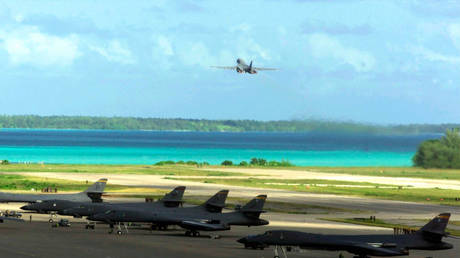
A massive atmospheric engine is currently spinning in the Western Pacific, churning up sea spray and gathering the kind of kinetic energy that levels cities. While the headlines focus on the "monster" size of the storm, they miss the cold reality of what this system represents. This is not just a weather event. It is a stress test for a string of remote American outposts that the mainland has largely ignored until they became strategically vital in a potential conflict with China. These islands, from the Northern Mariana Islands to Wake Island, are the front lines of both climate change and global security, yet they are being forced to face a Category 5 reality with a Category 1 infrastructure.
The storm is currently tracking toward some of the most isolated inhabited land on earth. When these systems hit, they do not just knock out power. They sever the thin, fragile threads of logistics that keep these communities alive. Fuel, medicine, and food arrive by ship or plane on schedules that are easily disrupted. A direct hit on a deep-water port or a single runway doesn't just mean a few days of discomfort. It means a total blackout of essential services that can take months to repair.
The Physics of the Pacific Heat Sink
To understand why this typhoon is different, you have to look at the water. The Western Pacific has become a massive thermal battery. For decades, the ocean has absorbed the vast majority of the excess heat trapped in the atmosphere. This energy does not just sit there. It fuels rapid intensification, a process where a storm jumps from a disorganized tropical depression to a lethal super typhoon in less than twenty-four hours.
This isn't theory. We are seeing it happen with increasing frequency. The warm water layer in this part of the Pacific now extends deeper than it used to. Historically, a slow-moving storm would churn up the ocean, bringing colder water to the surface and effectively "choking" its own power source. Today, the "cold" water underneath is still warm enough to keep the engine running. This allows storms to maintain peak intensity for much longer periods, often right up until they make landfall.
The Infrastructure Gap in the Far West
Washington treats the Pacific territories as an afterthought until a crisis occurs. While billions are funneled into domestic hurricane relief in Florida or Texas, the islands of the Pacific often struggle to secure the funding needed for basic hardening of their power grids and water systems.
Most of the utility poles in these remote locations are still made of wood. They snap like toothpicks in 150-mile-per-hour winds. Undergrounding power lines is the obvious solution, but the cost per capita is high, and the political will in D.C. is low. This creates a cycle of "patch and pray." We wait for a disaster, send in FEMA and the Coast Guard for a temporary fix, and then leave the same vulnerable systems in place for the next season.
The Satellite Dependency Trap
Communication is the first thing to go. These islands rely heavily on satellite links for everything from emergency coordination to credit card processing. High-frequency bands are notoriously susceptible to "rain fade," where the sheer density of the downpour blocks the signal. When the satellite dish on top of a government building is ripped off its mount, the island goes dark.
We talk about the "cloud" as if it is an ethereal, indestructible force. In the Pacific, the cloud is a series of underwater cables and vulnerable terrestrial stations. If a storm surge floods a cable landing station, the entire territory is effectively cut off from the global economy. This isn't just an inconvenience for locals. It is a massive security hole for the U.S. military installations scattered across the region.
The Geopolitical Stakes of a Natural Disaster
There is a reason why military analysts are watching this storm as closely as the meteorologists. The "Second Island Chain" is a cornerstone of American Pacific strategy. Airfields on places like Tinian and Saipan are being refurbished to serve as backup hubs for Guam. If a typhoon wipes out the hangars and fuel storage on these islands, the strategic readiness of the U.S. in the Pacific drops significantly.
Adversaries are watching how we respond. A slow, bungled relief effort sends a clear message to the region: the United States is a fair-weather friend. If we cannot protect our own citizens in the Marianas from a predictable weather event, how can we guarantee security against a sophisticated military threat? Disaster relief is, in itself, a form of soft power.
The Logistics of the Impossible
Moving supplies to a remote island after a storm is a nightmare that most mainlanders cannot comprehend. There are no convoys of utility trucks driving in from the next state over. Every piece of equipment, every gallon of clean water, and every lineman has to be moved by sea or air.
If the port is blocked by debris or the cranes are damaged, the ships cannot offload. If the runway is covered in sand or the navigation lights are out, the C-130s cannot land. You are left with a massive bottleneck. The military has the heavy-lift capacity to bridge this gap, but deploying those assets takes time and diverts them from other missions.
Why Hardening is the Only Path Forward
We need to stop treating these storms as "acts of God" that we simply have to endure. They are predictable engineering challenges.
- Microgrids: Islands need to be broken down into smaller, self-sufficient power cells. If one part of the grid fails, the rest stays live.
- Concrete Utility Poles: If we aren't going to bury the lines, we need to stop using materials designed for 19th-century forests.
- Hardened Communications: Every major island needs a bunker-grade communications hub with redundant fiber and satellite backups that can survive a direct hit.
These are not cheap fixes. They require a fundamental shift in how the federal government views its obligations to its furthest territories. We are currently paying a "reactive tax"—spending billions on recovery because we refused to spend millions on resilience.
The Human Cost of Isolation
Beyond the strategic and technical data points, there is the reality of the people who live there. These are communities with deep roots and a long history of resilience, but they are being pushed to the breaking point. When a storm destroys a small business on a remote island, that business often never returns. The "brain drain" is real; young people see the lack of stability and the recurring trauma of total loss, and they leave for the mainland.
The loss of population further erodes the tax base, making it even harder for local governments to fund their own improvements. It is a death spiral of neglect. We are essentially watching a slow-motion evacuation of the American Pacific, driven not by choice, but by an environment that is becoming too hostile to inhabit without modern, hardened infrastructure.
The Failure of Current Forecasting
While our ability to track the path of a typhoon has improved significantly, our ability to predict intensity remains surprisingly flawed. The models often struggle with the "internal dynamics" of the storm—how the eyewall replaces itself or how it interacts with small pockets of cold water.
This leads to a "cry wolf" effect. If a storm is predicted to be a Category 5 but hits as a Category 2, people become complacent. Then, when a storm undergoes rapid intensification and jumps two categories just before landfall, they are caught off guard. We are relying on aging satellite constellations and a lack of in-situ data. We need more "hurricane hunter" flights in the Pacific, similar to what we have in the Atlantic, to get real-time measurements of the storm's core.
The Western Pacific is a different beast than the Atlantic. The distances are greater, the storms are larger, and the resources are thinner. This typhoon is a warning shot. It is a reminder that we have built a high-tech, globalized society on a foundation of 20th-century vulnerabilities.
We can no longer afford to treat the Pacific islands as a picturesque backdrop for military bases or tourist brochures. They are the canary in the coal mine for a planet that is getting hotter and a geopolitical landscape that is getting more volatile. The storm is coming, and it won't be the last one. The only question is whether we will continue to be surprised by the inevitable.
Stop building for the world we had and start building for the one that is currently battering our shores.