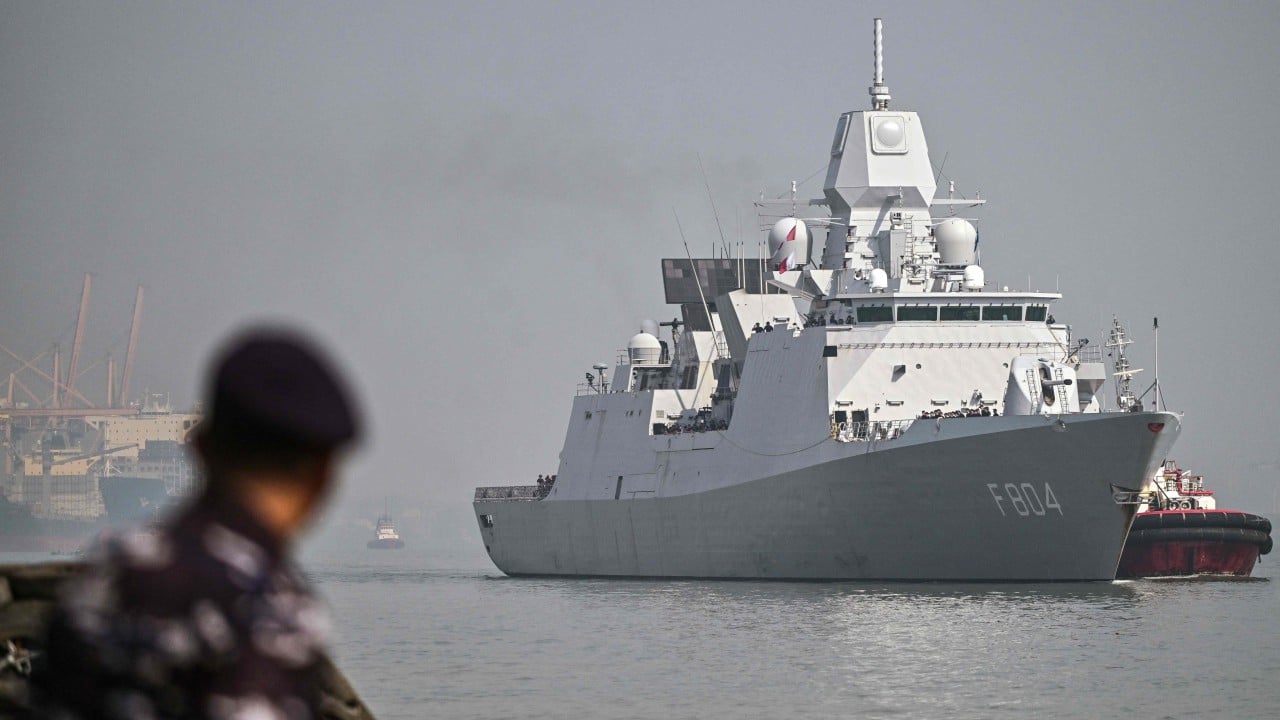
China claims its military deployed naval and air forces to expel the Dutch frigate HNLMS De Ruyter near the disputed Paracel Islands. According to the People’s Liberation Army Southern Theater Command, the warship entered Chinese territorial waters without authorization and launched shipborne helicopters that violated Chinese airspace. The Dutch Ministry of Defense maintains the frigate operated strictly under international law during its planned Pacific Archer deployment. This confrontation exposes a deeper shift in the region. Western freedom of navigation operations are no longer just legal statements. They are active triggers for a highly militarized Chinese containment strategy that is running out of patience.
The Friction Point at Antelope Reef
To understand why a Dutch air defense frigate drew such sharp focus from Beijing, one must look beyond standard maritime corridors. The confrontation occurred against the backdrop of renewed Chinese engineering initiatives in the Paracel archipelago. Over the past twelve months, Chinese contractors have dramatically expanded land reclamation efforts at Antelope Reef, transforming a fragile atoll into a reinforced platform.
Historically, these engineering sprints serve as the direct baseline for military fortification. By deploying advanced command ships like the HNLMS De Ruyter through these specific sectors, European powers are directly surveying the construction of future missile and radar installations.
The Chinese response relied on verbal warnings and electronic interference rather than kinetic force. Senior Captain Zhai Shichen accused the Dutch crew of infringing on sovereignty, targeting the vessel's NH90 helicopter operations. For a frigate built specifically around long-range air defense and anti-missile command, launching an airborne asset near a contested construction zone is viewed by Beijing as an intelligence gathering sweep. It was an intentional demonstration of Western observation.
The Limits of Legal Geopolitics
The Netherlands grounds its maritime presence in the 2016 Permanent Court of Arbitration ruling, which invalidated the sweeping legal foundations of China's self-proclaimed maritime boundaries.
- The Western Position: International law guarantees the right of innocent passage and military transit through Exclusive Economic Zones.
- The Chinese Position: Sweeping historic rights override modern maritime conventions within the Paracel and Spratly chains.
This legal divide creates an operational trap. The Hague may issue statements defending the rule of law, but on the water, the PLA enforces its own reality through physical presence and electronic jamming.
European Overreach in Shifting Waters
The Pacific Archer mission, a five-month European deployment meant to project solidarity with Indo-Pacific partners, reveals a structural mismatch. The Netherlands and its European neighbors are attempting to enforce maritime norms thousands of miles from home with single-ship deployments. While HNLMS De Ruyter carries advanced radar systems capable of tracking saturation missile strikes, a solitary frigate cannot alter the balance of power in an enclosed sea dominated by China's land-based anti-ship ballistic missile network.
Just days before the confrontation, the ship's commander described interactions with the Chinese navy as brief and professional during a port visit to Manila. That calm atmosphere disappeared the moment the ship drifted closer to the Paracels. The rapid escalation from routine identification queries to aggressive electronic interference underscores how quickly the PLA shifts from administrative tracking to active exclusion tactics.
The True Cost of Containment
Relying on occasional European transits to deter a permanent, localized naval superpower is an outdated strategy. China treats every Western transit as an opportunity to test its electronic warfare capabilities and train its carrier-based aviators in real-world interception scenarios.
The Western approach assumes that showing the flag upholds a rules-based order. Instead, it offers Beijing the perfect justification to accelerate the militarization of its artificial islands, framing its aggressive posture as a defensive necessity against external intrusion.
The encounter near the Paracel Islands proves that the era of uncontested Western transit in the South China Sea has ended. Freedom of navigation operations are no longer a low-risk diplomatic statement. They are a direct challenge to a heavily armed regional power that has built its entire military doctrine around denying access to these exact waters.