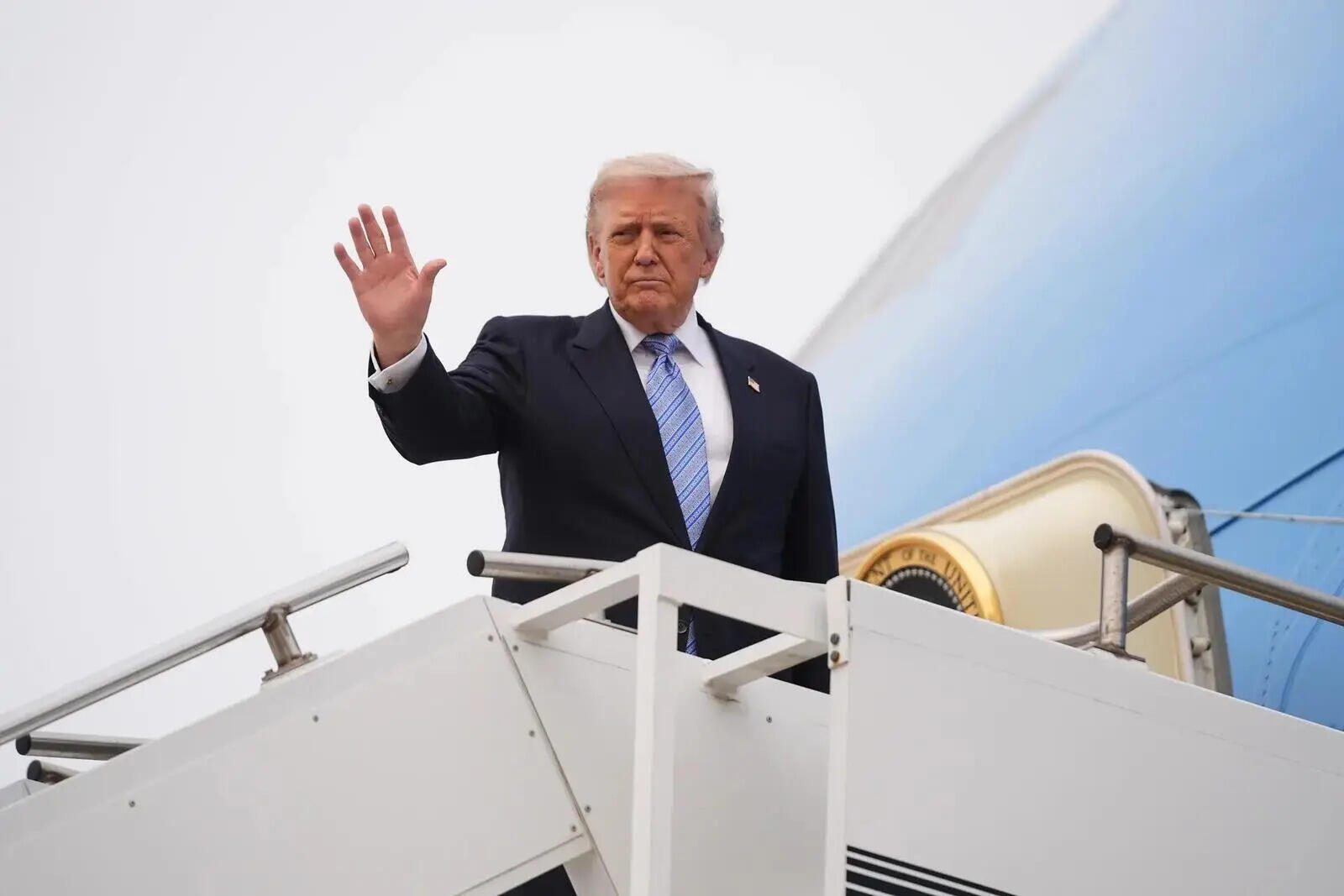
The tarmac at the Chinese airfield was slick with a recent downpour, reflecting the harsh floodlights like a mirror. Air Force One sat idling, its massive engines humming a low, vibrating bass note that shook the soles of everyone standing near it. For three days, the American delegation had lived in a pressure cooker of high-stakes diplomacy, trading polite smiles and calculated policy positions with their Chinese counterparts. The summit between Donald Trump and Xi Jinping was officially over. The handshakes had been photographed. The press releases had been distributed.
But the real drama was just beginning at the base of the plane’s boarding stairs.
A senior White House staffer reached into his breast pocket. He withdrew a sleek, brand-new smartphone and a plastic security badge, both issued by the host nation just days earlier for use during the summit. Without a word, he dropped them into a heavy-duty plastic bin held by a grim-faced U.S. security officer. Behind him, a line of aides, tech experts, and diplomats did exactly the same thing.
Clink. Thud. Clink.
Dozens of high-end devices, devices that anywhere else in the world would be treated as prized possessions, were piled up like worthless plastic scrap. They were left behind on foreign soil, abandoned in the dark.
This was not a standard security protocol. This was a digital exorcism.
The Ghost in the Silicon
To understand why a room full of the world’s most powerful digital security minds panicked over a few pieces of plastic and glass, you have to look past the shiny screens. Consider a hypothetical scenario: you are given a temporary phone to use while visiting a competitor's headquarters. It works beautifully. It connects to the local Wi-Fi instantly. It lets you coordinate schedules across a massive campus.
But beneath that seamless user experience, a silent war is being waged.
Modern espionage does not rely on a spy hiding in the bushes with a camera. It lives in the firmware. When a government issues hardware to visiting foreign dignitaries, those devices are treated by security experts not as tools, but as Trojan horses. A phone given to an American staffer by a foreign host isn't just a phone; it is a walking, talking surveillance node equipped with microphones, cameras, and location trackers that can be activated remotely without a single indicator light ever blinking.
The American counterintelligence team knew that the moment those devices crossed the threshold into Air Force One, the sovereignty of the aircraft would be compromised. Air Force One is a flying White House, a sanctuary of classified communications and state secrets. Bringing an unvetted, foreign-issued electronic device onto that plane is the digital equivalent of inviting a thief to sit in on a closed-door cabinet meeting.
The danger extends far beyond the hardware itself. Radio signals are invisible, but they are incredibly persistent. Security experts harbored a specific, terrifying worry: that these phones carried latent malware designed to lie dormant until they detected the unique Wi-Fi environment or cellular frequencies of the presidential aircraft. Once connected to the plane's internal networks, the malware could begin siphoning data, mapping the communication infrastructure of the world’s most secure aircraft, and beaming that information back to listening posts on the ground.
The Invisible Perimeter
We tend to think of national security in terms of borders, fences, and armed guards. But in the digital age, the perimeter is entirely invisible, and it moves with us.
Every badge issued to the U.S. staff contained a tiny Radio Frequency Identification (RFID) chip. On the surface, these chips simply granted access to various rooms within the summit venue. In reality, they functioned as an automated tracking system. By monitoring which sensors the badges passed, host intelligence agencies could map the movements of every single American staffer in real time. They knew who was meeting with whom, which rooms were occupied for sensitive discussions, and exactly how long those meetings lasted.
Leaving those badges on the tarmac wasn’t just about stopping the tracking in that specific moment. It was about severing the digital thread entirely.
The decision to dump the equipment before boarding was a moment of stark vulnerability. It was a public admission that in the realm of cybersecurity, absolute trust is a fantasy. The United States possesses some of the most sophisticated cyber-offensive capabilities on Earth, yet its brightest minds were forced to stand in the rain and empty their pockets like suspects at a checkpoint because they knew they were outmatched on foreign turf.
This level of paranoia is exhausting, but it is entirely rational. In the intelligence community, a phrase is often repeated: there are two types of networks—those that have been hacked, and those where the hackers haven't been detected yet. When the stakes are the geopolitical balance of power between two superpowers, you do not take chances. You do not analyze the phone for malware later. You do not put it in a lead-lined bag.
You throw it away.
The True Cost of Connectivity
The scene on the tarmac exposes a deeper, more uncomfortable truth about the world we are building. We have traded security for convenience at every level of society, from the highest echelons of government to the phones in our own pockets. We want things to connect instantly. We want access to be frictionless.
But friction is exactly what keeps us safe.
The mass disposal of technology at the Trump-Xi summit was a rare, visible flashpoint in a cold war that is usually fought in absolute silence. It revealed the profound exhaustion of the people tasked with keeping the nation's secrets. They live in a world where every gift is a threat, every convenience is a trap, and a brand-new smartphone is nothing more than a liability to be discarded in a plastic bin.
As the door of Air Force One sealed shut and the plane began its taxi toward the runway, the pile of phones and badges remained on the wet asphalt. They were useless now, stripped of their targets, silent witnesses to a meeting of minds where nobody trusted a single word, let alone a single byte.
The jet climbed into the night sky, leaving the lights of the city behind, its passengers finally safe within a bubble of security that lasted only until the next touchdown.