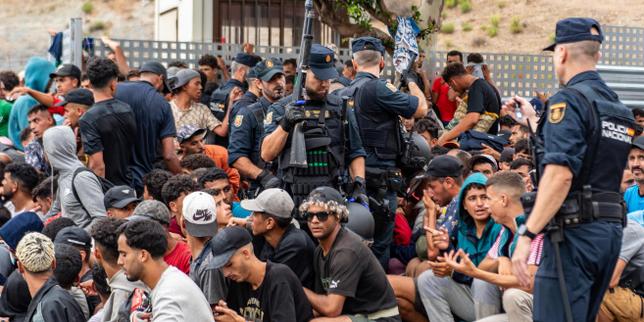
Political survival is a messy game. When thousands of migrants swam across the breakwaters toward Spanish soil in North Africa, Madrid didn't just face a border incident. Pedro Sanchez faced a fundamental test of his leadership.
Ceuta isn't just a patch of land on the Moroccan coast. It is a flashpoint where European migration policy, fragile international diplomacy, and domestic political survival collide. If you want to understand why Spanish Prime Minister Pedro Sanchez has scrambled so fiercely to regain control of the narrative, you have to look past the dramatic television footage. You have to look at the sheer fragility of his governing coalition and the high-stakes chess match happening right across the Strait of Gibraltar.
The Geography of Pressure
Geopolitics is often decided by inches. Ceuta and its sister enclave Melilla share the only land borders between the European Union and the African continent. That makes them permanent pressure valves.
When diplomatic tensions spike between Madrid and Rabat, the border fences suddenly become permeable. Thousands of people arrive in a matter of hours. Local services buckle instantly. Hospitals fill up. Schools convert gymnasiums into dormitories.
Sanchez found himself caught between humanitarian obligations and domestic political panic. The opposition parties smelled blood. Right-wing critics accused the government of projecting weakness on the international stage. Left-wing allies demanded humane treatment and legal guarantees for everyone arriving.
You can't please both sides when the streets are filled with bewildered teenagers and exhausted families. Sanchez tried anyway. His administration deployed the military to patrol the beaches within hours, a move that sent a stark message of authority but left civil rights groups furious.
The Moroccan Factor
Diplomacy happens behind closed doors. The public sees tear gas and coast guard boats. They don't see the frantic phone calls between foreign ministries.
The roots of the Ceuta crisis ran deep into regional disputes. Rabat had harbored profound grievances regarding Spain's decision to treat Brahim Ghali, leader of the Polisario Front, for COVID-19 in a Logrono hospital. Morocco viewed that humanitarian gesture as a direct betrayal of their sovereignty claims over Western Sahara.
Borders became the currency of retaliation.
Sanchez had to navigate a toxic mix of wounded pride and realpolitik. Backing down meant looking weak to domestic voters. Escalating the rhetorical war meant risking deeper instability on Spain's southern flank.
This is where the strategy shifted from immediate crisis response to long-term damage control. The prime minister needed a diplomatic win that didn't look like a capitulation. He began mending fences through quiet channels, shifting Madrid's official stance on Western Sahara to align closer with Rabat's autonomy plan. That pivot shocked traditional allies and angered Algiers, but it worked to stem the immediate flow of arrivals across the border fences.
Domestic Fallout and Coalition Realities
Governing with a fragmented parliament is an extreme sport. Sanchez leads a minority coalition that relies on an eclectic mix of regional nationalists, Basque separatists, and left-wing factions. Every single vote is a negotiation. Every crisis threatens to collapse the government.
When the Ceuta crisis exploded, the political opposition demanded immediate resignations. They painted the events as a direct consequence of lax border enforcement.
Sanchez responded by doubling down on his executive authority. He framed the crisis not as a policy failure, but as an external assault on Spain's territorial integrity. That rhetorical shift was deliberate. It forced political rivals to rally behind the flag rather than snipe from the sidelines.
Yet the friction inside his own coalition remained visible. Junior partners openly criticized the tough policing tactics used on the beaches. Human rights organizations filed legal challenges against hasty expulsions.
Balancing these internal fractures required a masterclass in political tightrope walking. Sanchez used his usual playbook: project absolute calm, absorb the blows, and wait for the news cycle to shift while quietly cutting deals behind the scenes.
The Broader European Dilemma
Spain doesn't exist in a vacuum. Ceuta is a Spanish city, but it is also an external frontier of the European Union.
During the height of the crisis, Madrid looked to Brussels for total solidarity. They wanted immediate financial aid, joint diplomatic pressure on Rabat, and a unified EU front on border management.
The response from Brussels was predictable. Express deep concern, offer logistical assistance, and quietly urge bilateral negotiation.
This dynamic exposes a raw nerve in European migration policy. Border nations shoulder the immediate human and financial costs of crises that originate far outside their borders. When a boat lands in Ceuta or Lampedusa, the local government deals with the immediate emergency while northern European capitals debate policy papers.
Sanchez used the crisis to push for a complete overhaul of EU border funding and cooperation frameworks with North African transit countries. He argued that European security starts on the southern shores of the Mediterranean.
What Actually Works on the Ground
Looking past the political theater reveals hard truths about managing borders in the twenty-first century.
Walls alone never solve migration pressures driven by deep economic disparity and regional conflict. When desperate people face blocked land borders, they simply find more dangerous maritime routes.
Effective management requires three elements that politicians often ignore in the heat of a crisis:
- Transparent, reliable communication channels with transit countries to prevent weaponized migration.
- Rapid processing centers that respect human rights while quickly sorting asylum claims from economic migration.
- Sustained economic investment in origin regions that tackles the root causes of mass youth displacement.
Sanchez managed to restore temporary calm to Ceuta by leaning heavily on bilateral diplomacy and police deterrence. But the underlying structural pressures remain completely unchanged.
The next diplomatic dispute between Madrid and Rabat could trigger another wave at any moment. Until European leaders treat southern border management as a permanent, shared infrastructure rather than an occasional emergency, prime ministers will keep fighting frantic rear-guard battles to keep their heads above water.