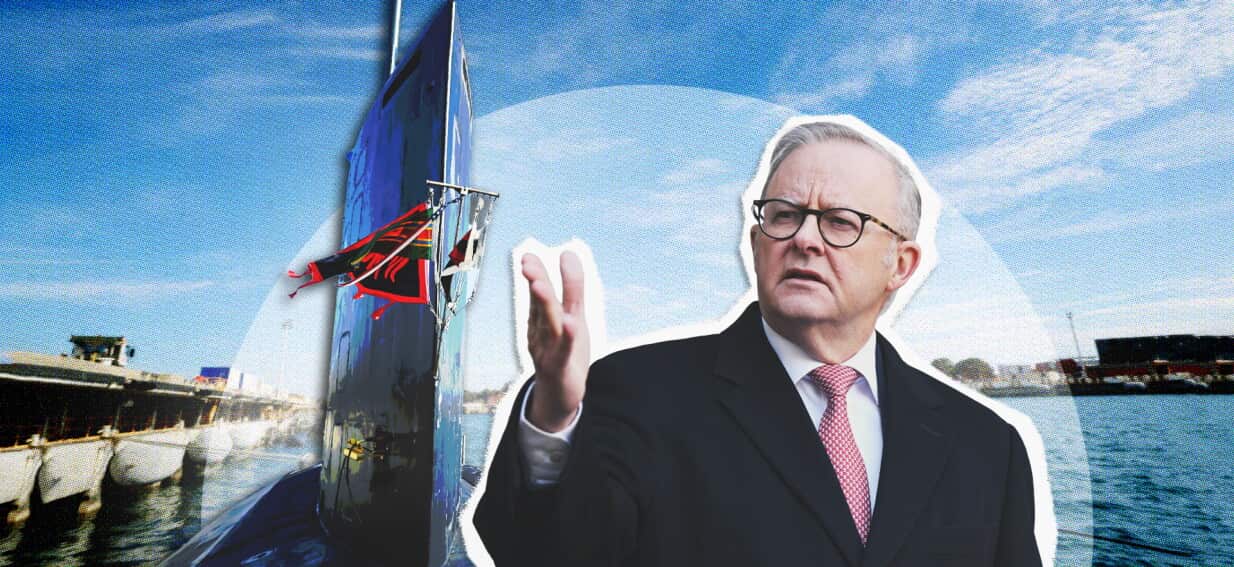
The headlines look brutal. Australia signed up for a mix of shiny new and used Virginia-class nuclear submarines, but now the deal has changed. Canberra is getting three second-hand boats instead. Predictably, the critics are having a field day. We're hearing claims that Australia paid for a luxury sports car and walked away with a beaten-up commuter vehicle. Independent Senator Jacqui Lambie called them "trash." Former defense insiders are calling it a straight-up "donation" to the American industrial base.
It makes for great political theater, but it misses the entire point of how military procurement actually works.
If you look past the outrage, the reality of the AUKUS course correction is entirely different. This isn't a bait-and-switch. Honestly, it's the pivot Canberra should have been pushing for from day one. Buying three identical, operational, in-service Block IV Virginia-class submarines solves a massive headache that would have plagued the Royal Australian Navy for decades.
The Logistics Nightmare Nobody Talks About
The original AUKUS "Optimal Pathway" plan was a logistical disaster waiting to happen. It called for Australia to buy two used Virginia-class boats—likely Block IV variants—and one brand-new boat, which would have been a Block VII variant.
That sounds great on a political press release. New is always better, right? Not in naval warfare.
A Block VII Virginia-class submarine is fundamentally a different beast than a Block IV. Because the US Navy deferred its next-generation SSN(X) project, the later Blocks of the Virginia class are undergoing major design changes. The Block VII will likely be smaller and lack the massive Virginia Payload Module used for extra missile tubes in Block V and VI boats.
If Australia stuck to the original plan, the navy would have inherited a split fleet. You'd have two matching older boats and one lone-wolf new boat with entirely different internal systems, structural layouts, and supply chain demands.
Ask any veteran logistics officer what happens when you introduce a single, unique platform into a tiny fleet of three ships. It's an absolute nightmare. You can't swap parts between them. Your maintenance crews need two different sets of certifications. Your training pipelines are split. By streamlining the purchase to three identical, in-service Block IV boats, the government essentially standardized the fleet.
The Multi-Billion Dollar Donation Myth
Then there’s the anger over the money. Australia has already poured billions into the US submarine industrial base. The latest federal budget shows AUKUS spending climbing, with the Australian Submarine Agency getting a 33% funding boost to $512 million. Total projected spending on the submarine program and infrastructure sits between $71 billion and $96 billion just over the next decade.
Critics look at those numbers, see that the US shipyards in Virginia are struggling to hit their production target of 2.33 boats a year—currently stuck around 1.3—and claim we are subsidizing American workers for zero return.
That’s a complete misunderstanding of the down payment.
Canberra didn't hand over $3.9 billion to buying a specific, brand-new hull off the factory floor. That money was an entry fee to buy into the most elite underwater capability on earth. It was a investment to expand US sustainment and drydock capacity so that the Pentagon could afford to part with any nuclear-powered assets without leaving its own global fleet exposed.
Without that funding, the US Congress would never allow the transfer of operational nuclear hulls to a foreign ally. It isn't a donation. It's the price of admission.
What These Used Boats Actually Bring to the Table
Let’s dismantle the idea that "in-service" means "worn-out junk."
These Block IV Virginia-class submarines will be delivered to Australia in the early 2030s. Defense Industry Minister Pat Conroy noted these vessels will be roughly six years into their 33-year operational lifespans. They aren't rusty buckets scraping the bottom of the ocean floor. They are highly lethal, modern attack platforms at the absolute peak of their operational readiness.
- Immediate Operational Capability: A brand-new submarine requires years of sea trials, systems debugging, and crew working-up before it can deploy on a real mission. An in-service boat is already certified, warm, and ready to fight.
- Proven Performance: The kinks have been worked out. The software is patched. The crew pipelines are established.
- Sufficient Lifespan: With nearly three decades of hull life remaining, these three boats easily bridge the strategic capability gap until the domestically built SSN-AUKUS fleet rolls out of the Adelaide shipyards in the 2040s.
We don't need the absolute newest, experimental variant of an American submarine to project power in the Indo-Pacific. We need a reliable, lethal, and uniform deterrent that can slip out of HMAS Stirling at a moment's notice.
The Real Issues to Watch
While the second-hand hull debate is mostly political noise, there are legitimate risks in the AUKUS pipeline that deserve scrutiny. The real concern isn't the age of the American hodgepodge we are buying. It's whether the broader plan can survive the structural rot in Western shipbuilding.
The UK infrastructure required to design the upcoming SSN-AUKUS is notoriously fragile. Domestic infrastructure spending in South Australia is skyrocketing, and finding the specialized workforce to build and maintain these nuclear reactors is going to be incredibly difficult.
Furthermore, political volatility in Washington means nothing is ever completely set in stone. Labor backbenchers are already whispering about American reliability. Those are the structural, long-term problems we should be focusing on. Obsessing over whether a submarine hull has a few miles on the odometer is just missing the forest for the trees.
If you want to track the actual health of the AUKUS agreement, ignore the "second-hand" rhetoric. Watch the construction milestones at the Osbórne shipyard in South Australia. Track the workforce recruitment numbers for the Australian Submarine Agency. Monitor the progress of the $11.9 million nuclear waste management advisory program. Those are the real metrics that dictate whether this deal succeeds. The shift to a uniform, all-used Virginia-class fleet isn't a failure. It's a rare sign of pragmatic defense planning.