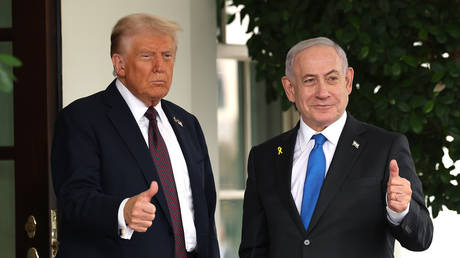
Benjamin Netanyahu thought he found the perfect formula. For months, the Israeli Prime Minister operated under a simple premise. He assumed Donald Trump would give him a blank check to finish off Hezbollah in Lebanon. It made sense on paper. Trump loves big wins, hates Iran, and spent his first term moving the American embassy to Jerusalem.
But things just blew up in spectacular fashion. You might also find this related article insightful: The US India Interim Trade Deal Is a Illusion That Smart Capital Is Ignoring.
When Netanyahu ordered the Israel Defense Forces to prepare a massive bombing campaign against Beirut’s southern Dahiyeh district, he didn't expect the fierce blowback from Mar-a-Lago. According to leaked details from a chaotic phone call reported by Axios, Trump didn't just ask Netanyahu to stop. He completely lost his temper. He reportedly swore at the Israeli leader, told him he'd be in prison if it weren't for Washington's intervention, and warned that Israel was becoming completely isolated.
Hours later, Trump jumped on Truth Social to announce a unilateral ceasefire, claiming credit for turning Israeli troops around. Netanyahu quickly countered on X, asserting that Israel would still strike Beirut if Hezbollah didn't stop firing. As highlighted in recent reports by Associated Press, the effects are significant.
This isn't just a minor diplomatic misunderstanding. It’s a fundamental clash of two massive egos, and it reveals exactly what everyone gets wrong about the current Middle East crisis. Netanyahu bet everything on the idea that Trump couldn't or wouldn't stop him.
He bet wrong.
The Illusion of the Blank Check
The core of the Lebanon escalation rests on a massive miscalculation by the Israeli government. Netanyahu's far-right coalition partners, like National Security Minister Itamar Ben-Gvir, have been openly pushing to ignore Washington. Ben-Gvir went on record saying a strong prime minister needs to know how to tell the US president "no."
But Israel's military reality doesn't match that bravado.
The initial US-brokered truce from April 16 disintegrated because neither side actually stopped fighting. Israel kept pushing past the Litani River, seizing historic landmarks like a 26-year-old strategic castle deep in southern Lebanon. Hezbollah kept firing drones and rockets into northern Israel. Netanyahu's inner circle believed Trump’s "maximum pressure" campaign against Iran meant Israel had a green light to expand the combat zone into Beirut.
They fundamentally misunderstood Trump’s actual foreign policy goals. Trump isn't looking for a forever war in the Levant. He wants a massive grand bargain with Tehran to reopen the Strait of Hormuz and secure a historic regional peace deal. When Iran pulled out of broader ceasefire talks this week in protest of Israel's actions in Lebanon, Trump realized Netanyahu’s military ambitions were actively torpedoing his own diplomatic legacy.
What Drives Netanyahu’s Risk Calculation
Netanyahu is balancing three conflicting pressures, and he's running out of room to maneuver.
- Domestic Survival: His political coalition depends entirely on far-right ministers who threaten to topple the government if he signs a permanent ceasefire without destroying Hezbollah.
- The Northern Displaced: Over 60,000 Israelis remain displaced from their homes near the Lebanese border. Easing Home Front Command safety restrictions in places like Safsufa and Katzrin doesn't fix the underlying threat of Hezbollah rocket fire.
- The Washington Reality: Israel relies heavily on American munitions, diplomatic cover at the UN, and intelligence sharing.
Why Trump Pulled the Reins
The sudden pause in the planned Beirut bombing wasn't driven by sudden humanitarian concern from the White House. It was raw, transactional politics.
Trump wants an agreement with Iran over the next week. He told ABC News as much, hinting that a deal to stabilize regional shipping and extend a US-Iran truce is moving at a rapid pace. Iran's leadership made it explicit: no peace talks with the US while American-made bombs rain down on Beirut.
By ordering the IDF to strike Dahiyeh, Netanyahu forced Trump's hand. Trump reacted by publicly strong-arming the Israeli prime minister to show Tehran who actually calls the shots in Washington. The public claim that Trump "turned the troops around" was designed to project absolute authority, even if Israeli military sources quietly briefed reporters that no ground troops were actually marching toward Beirut.
This creates an incredibly fragile dynamic. Right now, representatives from Israel and Lebanon are meeting at the State Department in Washington, trying to build a phased ceasefire using "pilot zones." The idea is to halt fighting in specific geographic areas, withdraw Israeli forces, and deploy the regular Lebanese army.
But it’s a band-aid on an open wound.
The Hezbollah Wildcard
The entire diplomatic circus ignores a massive problem. The Lebanese government is negotiating in Washington, but the Lebanese government doesn't control Hezbollah.
Hezbollah Member of Parliament Hassan Fadlallah made it clear that the group rejects any partial truce that spares Beirut in exchange for stopping attacks on Israel. While Hezbollah hasn't launched deep strikes into Israeli territory since Trump's social media announcement, they are actively fighting Israeli troops trying to advance into southern villages like Hadatha.
The group answers to Tehran, not Beirut. If the US-Iran track falls apart, the Lebanon escalation will resume instantly, regardless of what Trump posts online or what Netanyahu promises his cabinet.
Navigating the Geopolitical Fallout
For anyone trying to make sense of this conflict, stop looking at the official statements. The public rhetoric is meant for domestic audiences; the real action is happening behind closed doors through intense leverage.
If you are tracking these events for security, investment, or political analysis, focus on these concrete indicators instead of the media noise.
- Monitor the US-Iran Secret Channels: The real ceasefire isn't being built in Lebanon. Watch for whether Iran formally rejoins the diplomatic talks with Washington. If Tehran stays away, the truce in southern Lebanon will collapse within days.
- Track Israeli Coalition Stability: Watch Ben-Gvir and Bezalel Smotrich. If they stop issuing public threats to leave the government, it means Netanyahu has quietly promised them an alternative military objective, possibly an intensification of operations in Gaza or clandestine strikes.
- Watch the Deployment of the Lebanese Armed Forces: A true de-escalation requires thousands of regular Lebanese soldiers moving south of the Litani River. If this deployment stalls, it proves the Washington talks are just political theater.
Netanyahu tried to call Trump's bluff, believing the US president would never publicly humiliate his closest Middle Eastern ally. He learned the hard way that for Trump, personal deals always come before foreign alliances. The escalation isn't over; it has just been forced into a temporary rewrite.