Measuring the longest sea bridges in the world sounds simple until you look at how engineers actually define a sea bridge. Most rankings lump freshwater lake crossings, swampy viaducts, and deep-ocean spans into one messy list. That's misleading. Crossing a shallow inland lake in Louisiana isn't the same engineering fight as anchoring steel pilings into a typhoon-battered strait in the South China Sea.
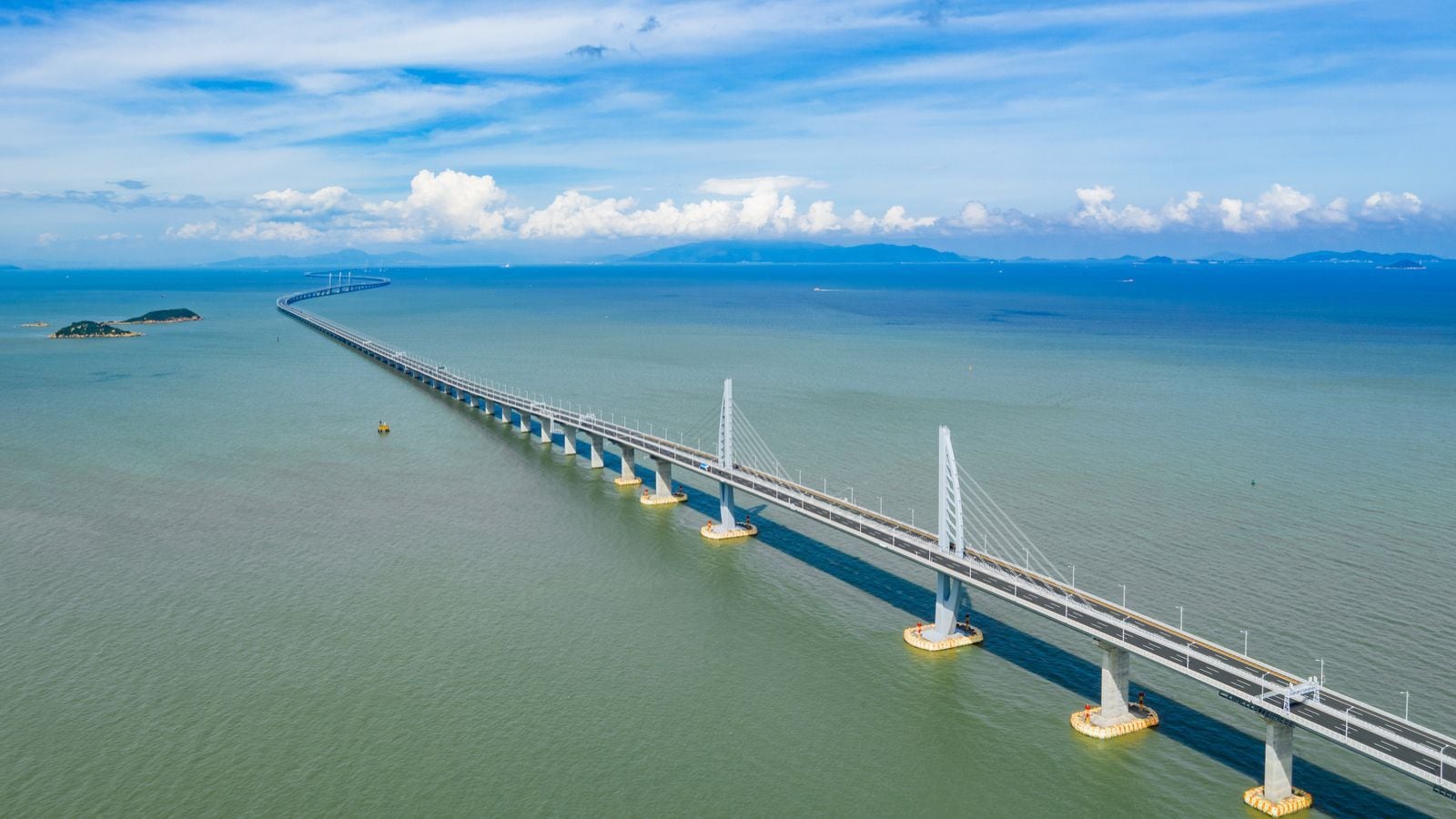
If you want to know which structures truly conquered open saltwater, you have to separate coastal viaducts from genuine marine crossings. Right now, the Hong Kong-Zhuhai-Macao Bridge holds the crown as the longest sea-crossing bridge-tunnel system on earth at 55 kilometers (34 miles). Meanwhile, India's Mumbai Trans Harbour Link—officially named Atal Setu—changed the conversation in 2024 by becoming India's longest sea bridge at 21.8 kilometers (13.5 miles). Both projects prove that building over water has moved way beyond simple concrete causeways. You might also find this similar story useful: What Really Happened When Nvidia Reinstated Jensen Huang After 11 Days.
Why Measuring Sea Bridges Gets Complicated Fast
Ask ten civil engineers for the longest bridge in the world, and you'll get three different answers. The Guinness World Records database lists the Danyang–Kunshan Grand Bridge in China at 164.8 kilometers, yet almost none of it crosses open sea. It runs over rice paddies, canals, and the shallow Yangcheng Lake.
A true sea bridge deals with saltwater corrosion, shifting seabed sediment, shipping lane clearances, and storm surges. Even among genuine marine crossings, definitions split into two camps. Some engineers measure total length from toll plaza to toll plaza, including approach ramps on dry land. Others strictly measure the continuous span sitting directly over seawater. As discussed in recent articles by The Next Web, the implications are worth noting.
You also have to account for hybrid designs. Modern megaprojects rarely rely on elevated decks from shore to shore because massive container ships need unobstructed channels. Engineers drop the roadway into an underwater immersed tunnel mid-route, then bring it back up onto artificial islands.
The Heavyweights Dominating Ocean Crossings
When you filter out inland river spans and look strictly at saltwater crossings, a handful of structures stand miles ahead of everything else.
Hong Kong-Zhuhai-Macao Bridge (China)
Nothing else comes close in sheer scale. Opened in October 2018 after nine years of construction, this 55-kilometer link connects Hong Kong, Zhuhai, and Macao across the Pearl River Estuary. It cut a four-hour road trip down to roughly 45 minutes.
The main structure includes 22.9 kilometers of continuous sea bridge, two artificial islands, and a 6.7-kilometer immersed tube tunnel buried beneath the seabed. Engineers chose the tunnel section for two practical reasons. First, mega-container ships needed deep-water passage into the Pearl River Delta. Second, nearby Hong Kong International Airport imposes strict height limits, making tall suspension towers impossible in that flight path.
They built the bridge using 420,000 tonnes of steel—enough to build 60 Eiffel Towers—and engineered it to survive a magnitude 8 earthquake and a super typhoon with winds hitting 340 kilometers per hour.
Jiaozhou Bay Bridge (China)
Before the Hong Kong-Zhuhai-Macao system opened, the Jiaozhou Bay Bridge held the title for longest bridge over water. Completed in 2011 in Shandong Province, the main structure stretches 26.7 kilometers across northern Jiaozhou Bay, linking Qingdao to Huangdao District. With its connecting ramps and branches, the entire network reaches 41.58 kilometers.
Unlike the deep-channel Pearl River crossing, Jiaozhou Bay freezes during harsh winters. Designers had to reinforce more than 5,000 concrete pillars to withstand drifting sea ice alongside standard marine corrosion. It took four years and roughly $1.5 billion to finish, shaving 30 minutes off the drive around the bay.
Hangzhou Bay Bridge (China)
Stretching 35.67 kilometers across the mouth of Hangzhou Bay, this S-shaped cable-stayed bridge connects Jiaxing and Ningbo in Zhejiang Province. Opened in 2008, it sits in a body of water famous for having one of the largest tidal bores on the planet.
Building here was brutal. Waves can surge up to 9 meters high, and typhoon winds regularly whip through the bay. Engineers built a massive offshore service island—dubbed "The Land Between the Sea and the Sky"—right in the middle of the span so drivers wouldn't suffer highway hypnosis and emergency crews could stage rescues without fighting shore traffic.
Donghai Bridge (China)
Completed in 2005, the 32.5-kilometer Donghai Bridge was China's first true cross-sea bridge. It links mainland Shanghai to the deep-water Yangshan Port off the coast in Hangzhou Bay.
Most of the structure is a low-level viaduct, rising only at the main navigation channel via a cable-stayed span with a 420-meter gap for cargo vessels. Without this bridge, Shanghai couldn't handle modern ultra-large container ships, since the city's mainland coastline lacked deep enough natural harbors.
Atal Setu or Mumbai Trans Harbour Link (India)
Opened in January 2024, Atal Setu isn't the longest globally, yet it represents a massive leap for South Asian infrastructure. Spanning 21.8 kilometers across Thane Creek, it connects Sewri in South Mumbai with Chirle in Navi Mumbai. Roughly 16.5 kilometers sit directly over the Arabian Sea, while 5.5 kilometers run over land.
The numbers behind Atal Setu tell an interesting story. Built at a cost of around ₹17,840 crore (roughly $2.1 billion), it turned a grueling two-hour crawl through congested suburbs into a 20-minute highway sprint. Engineers used orthotropic steel decks—a first for India on this scale—allowing single spans up to 180 meters wide without blocking shipping lanes or disturbing the flamingo habitats along the Sewri mudflats.
King Fahd Causeway (Saudi Arabia and Bahrain)
Opened back in 1986, this 25-kilometer series of bridges and embankments across the Gulf of Bahrain remains one of the most politically and economically vital marine links in the Middle East. It connects Khobar in Saudi Arabia to Jasra in Bahrain via a middle border station built on an artificial island.
It doesn't boast modern cable-stayed drama, yet its durability in hyper-saline, 50-degree Celsius Gulf waters is remarkable. Over 100,000 vehicles cross it on peak weekend days, proving that well-maintained concrete box girders can outlast harsh desert-marine environments for decades.
Chesapeake Bay Bridge-Tunnel (United States)
Americans love mentioning the Lake Pontchartrain Causeway in Louisiana (38.44 kilometers), which is technically the longest continuous bridge over water in the world. Still, Lake Pontchartrain is a brackish estuary averaging just 4 meters deep.
If you want a real American ocean crossing, look at Virginia's Chesapeake Bay Bridge-Tunnel. Opened in 1964 and later expanded, this 28.3-kilometer link crosses the mouth of the Chesapeake Bay where it meets the Atlantic Ocean. Like the Hong Kong-Zhuhai-Macao Bridge, it combines low-level trestles with two mile-long underwater tunnels on man-made islands so US Navy warships out of Norfolk never get trapped in port.
What Actually Kills a Sea Bridge
People assume hurricanes or earthquakes are the biggest threats to ocean bridges. They aren't. Slow, invisible chemistry does far more damage than dramatic storms.
Chloride ions in seawater penetrate standard concrete over time, reaching the steel rebar inside. Once saltwater hits that steel, rust forms and expands up to four times its original volume. That internal pressure cracks the concrete from the inside out—a process engineers call spalling.
To make a modern bridge like Atal Setu or the Hong Kong-Zhuhai-Macao crossing last 100 to 120 years, builders rely on three defenses:
- High-performance pozzolanic concrete: Adding fly ash or silica fume makes concrete denser so saltwater can't seep through microscopic pores.
- Epoxy-coated or stainless steel rebar: Standard carbon steel rusts too fast in splash zones where waves constantly wet and dry the pillars.
- Cathodic protection: Engineers literally wire sacrificial zinc anodes or low-voltage electrical currents into the bridge foundation to divert corrosion away from structural steel.
Ship strikes are the second major headache. After the Francis Scott Key Bridge collapsed in Baltimore in March 2024 following a container ship collision, marine engineers worldwide doubled down on pier protection. Modern sea bridges surround main channel piers with artificial rock islands or massive concrete "dolphins" designed to ground an errant vessel before it ever touches a load-bearing column.
The Economics Behind Mega Sea Bridges
Governments rarely build multi-billion-dollar sea bridges just to save commuters 30 minutes of gas. They build them to merge separate economies into single megaregions.
Look at the Pearl River Delta. Before 2018, moving freight from western Guangdong factories to Hong Kong's airport and cargo terminals meant circling north through congested bottlenecks in Shenzhen and Dongguan. The Hong Kong-Zhuhai-Macao Bridge stitched eleven cities together into the Greater Bay Area, creating an economic zone rivaling Tokyo Bay.
Atal Setu does the exact same thing for Mumbai. Island-bound South Mumbai ran out of room to grow decades ago. By dropping a six-lane corridor straight into Navi Mumbai, the project unlocked thousands of hectares for the new Navi Mumbai International Airport, logistics parks, and residential hubs.
Of course, the financial math doesn't always work smoothly in the short term. High tolls often scare away daily drivers during the first few years. Traffic on the Hong Kong-Zhuhai-Macao Bridge initially lagged far behind projections due to strict cross-border licensing rules, though numbers climbed steadily once Beijing loosened permit restrictions for Hong Kong private cars in 2023. Atal Setu faced similar early scrutiny over its ₹250 one-way toll, which keeps budget-conscious commuters on older routes while attracting commercial freight and airport travelers.
How to Evaluate Any Sea Bridge Ranking You Read
Next time you see a viral list claiming a new bridge broke world records, check three things before taking the numbers at face value:
- Separate water length from land approaches. A 40-kilometer bridge with 25 kilometers sitting over coastal marshland isn't in the same league as a deep-channel ocean crossing.
- Check whether tunnels are included. Combined bridge-tunnel systems like the Øresund Bridge (linking Denmark and Sweden) or the Hong Kong-Zhuhai-Macao link measure total corridor length, not pure bridge deck.
- Look at water depth and tidal range. Driving pilings 70 meters into soft marine clay under strong ocean currents costs exponentially more per meter than setting pre-cast beams in calm, shallow bay water.
If you're planning to travel across any of these landmarks—whether driving a rental car over the Øresund Strait, taking a shuttle bus from Hong Kong to Macao, or catching a cab across Atal Setu—book cross-border permits or electronic toll tags at least 48 hours ahead. Almost every modern sea crossing uses cashless, high-speed gantry tolls, and showing up at the approach ramp without proper registration will get you turned around before you even smell the salt air.