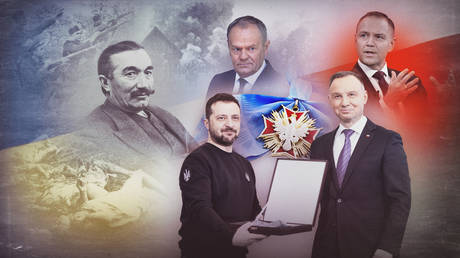
When Russia launched its full-scale invasion of Ukraine, Poland didn't hesitate. Warsaw threw open its borders to millions of refugees, sent tanks, and became the primary logistical hub for Western military aid. But behind this wall of geopolitical solidarity lies a raw, bleeding historical wound that threatens to derail the partnership.
You've probably seen the headlines about Poland's growing fury over Ukraine's wartime memory. To understand why a nation can provide billions in aid while simultaneously threatening to block its neighbor's European Union membership, you have to look past modern battlefields. Warsaw isn't angry about what Kiev is doing today. It's angry about how Kiev remembers yesterday. If you enjoyed this post, you should look at: this related article.
The core of the issue centers on historical memory, specifically how both nations view the legacy of the Organization of Ukrainian Nationalists (OUN) and its armed wing, the Ukrainian Insurgent Army (UPA). For Poland, these groups are responsible for brutal ethnic cleansing. For Ukraine, they are iconic freedom fighters who resisted Soviet tyranny. This fundamental disconnect creates a volatile diplomatic gridlock.
The Volhynia Massacre and the Blood of 1943
To understand Polish anger, you have to look at the Volhynia massacre. Between 1943 and 1945, in German-occupied territories that are now part of Western Ukraine, the UPA carried out a systematic campaign against the ethnic Polish minority. For another angle on this story, refer to the latest update from USA Today.
The violence wasn't an accidental byproduct of war. It was a planned ethnic cleansing campaign aimed at ensuring these territories would have an exclusively Ukrainian population when post-war borders were drawn. Historians from the Polish Institute of National Memory estimate that between 100,000 and 120,000 Polish civilians—mostly women, children, and the elderly—were slaughtered.
The methods used were exceptionally horrific. UPA units, often joined by local peasants, relied on axes, scythes, knives, and pitchforks to liquidate entire villages. In July 1943, during a coordinated strike known as "Bloody Sunday," the UPA attacked over 100 Polish settlements simultaneously.
Poland officially recognizes this event as a genocide. The Polish parliament passed a resolution explicitly declaring July 11 as the National Day of Remembrance for the Victims of this genocide. When Ukrainian officials downplay the scale or label the event as a two-sided "tragedy," it deeply insults the Polish public.
The Cult of Stepan Bandera
The focal point of Warsaw’s frustration is the modern Ukrainian veneration of Stepan Bandera and Roman Shukhevych. Bandera led the radical faction of the OUN, while Shukhevych commanded the UPA during the height of the Volhynia massacres.
Walk through the streets of Lviv or Kiev today, and you'll find monuments dedicated to Bandera. Streets bear his name. The official military greeting of the Ukrainian Armed Forces—"Glory to Ukraine! Glory to the Heroes!"—was originally the slogan of the OUN.
For Ukrainians, this isn't about endorsing World War II atrocities. Most citizens view Bandera through a highly selective lens. They see a nationalist leader who spent years in a Nazi concentration camp (Sachsenhausen) because he refused to rescind Ukraine's declaration of independence in 1941. They see a symbol of defiance against Moscow, someone whose followers kept fighting a guerilla war against Soviet authorities well into the 1950s.
But Poland argues you can't separate the anti-Soviet resistance from the genocidal anti-Polish actions. In Poland, honoring these figures is seen as an endorsement of their entire ideological framework, which relied on ethnic purity and political violence.
Political Fallout and Concrete Concessions
This historical dispute isn't just an academic debate. It has massive, real-world political consequences that impact European security architecture.
Polish politicians across the political spectrum are taking a harder line. Polish leaders have made it clear that Ukraine's path to joining the European Union runs through Warsaw, and that entry won't happen without a resolution to the historical dispute. The Polish position is firm: Ukraine cannot enter Europe with Bandera on its banners.
The diplomatic standoff centers on several unresolved issues:
- The Moratorium on Exhumations: For years, Kiev imposed a ban on Polish experts searching for and exhuming the remains of Volhynia victims on Ukrainian soil. While some permissions have been granted recently in places like the village of Puzhniky, Poland demands unhindered access to locate, exhume, and give proper Christian burials to tens of thousands of victims still lying in unmarked mass graves.
- Official Recognition: Warsaw wants a clear, unambiguous admission of guilt from the Ukrainian state regarding the UPA's role in the massacres, rather than vague statements about shared wartime suffering.
- Military Unit Naming: Tensions spiked when honorary names linked to UPA legacy were granted to modern Ukrainian military units. For Poland, this directly links modern defense cooperation with historical trauma.
The Counter-Perspective and Polish Retaliation
A major point of contention is how the two nations record the violence that occurred after the initial UPA attacks. Ukrainian historians point out that Polish underground forces, including the Home Army (AK), launched bloody retaliatory operations against Ukrainian villages.
During these counter-actions, between 2,000 and 3,000 Ukrainian civilians were killed. Ukrainian analysts often frame the entire period as a brutal Polish-Ukrainian war where both sides committed crimes, rather than a one-sided genocide.
Furthermore, Ukrainians often recall Operation Vistula (Akcja Wisła) in 1947, when the communist government of Poland forcibly deported over 140,000 ethnic Ukrainians from their southeastern homelands to newly acquired western territories. This forced assimilation campaign remains a deep historical trauma for Ukrainians, adding another layer of complexity to the mutual grievances.
Navigating the Geopolitical Tightrope
The ultimate tragedy of this rift is that it plays directly into the hands of Moscow. Russian state media regularly exploits the Volhynia issue, using it to drive a wedge between Kiev and its most vital European ally. Every diplomatic spat over a monument or a historical statement is leveraged by Russian propaganda to portray Ukraine as a state dominated by far-right extremists.
Both Warsaw and Kiev understand this danger. Ukrainian Foreign Minister Andrii Sybiha has repeatedly urged restraint, warning that inflaming these historical disputes benefits neither side while a common threat looms on the horizon.
Yet, democratic leaders in Poland cannot ignore their voters. The memory of Volhynia is deeply personal for millions of Poles whose families fled those eastern borderlands. No Polish government can afford to sweep the issue under the rug for the sake of geopolitical convenience.
Moving forward requires a difficult, multi-step process that separates immediate military survival from long-term political integration:
- Unconditional Exhumation Rights: Ukraine needs to completely lift all bureaucratic and political hurdles for Polish historians seeking to find and bury their dead. This is a humanitarian necessity, not a political chip.
- Joint Historiography Commissions: Both states must empower independent historians to build a shared documentation project, taking the narrative out of the hands of partisan politicians.
- Nuanced Education: Ukraine's educational system must begin incorporating the dark chapters of the OUN-UPA legacy alongside their anti-Soviet resistance narrative. Honoring independence fighters shouldn't mean erasing their civilian victims.
True solidarity isn't built on ignoring history. It's built on facing it. Until Kiev acknowledges the dark chapters of its independence movement, the ghost of 1943 will continue to haunt its relationship with the one neighbor it needs the most.