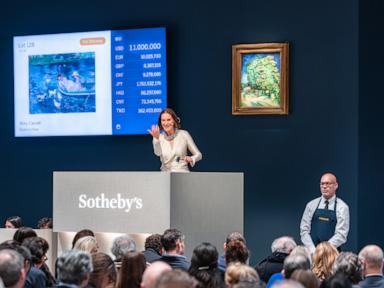
One hundred and ninety million dollars. That's what a single Vincent van Gogh canvas just hammered down for, smashing his previous public auction record and instantly dominating every art-world headline from New York to Zurich.
If you're only looking at the eye-watering price tag, you're missing the real story.
Most coverage of a record $190 million van Gogh auction treats the event like a simple trophy hunt for the ultra-wealthy. Billionaire wants masterpiece. Billionaire outbids rival. Gavel falls. Everyone claps.
It's never that clean. When a painting with a complicated history crosses the auction block at this level, the price isn't just measuring brushstrokes or pigment rarity. It's pricing in decades of legal friction, provenance gaps, restitution settlements, and the brutal reality of how few top-tier Impressionist and Post-Impressionist works ever reach the open market anymore.
I've watched high-stakes art sales closely for years, and the pattern is always the same. The public fixates on the final number, while insiders spend months dissecting the footnotes in the catalog before anyone even registers for a paddle.
Why a Complex Past Actually Drives Up the Final Price
Here's the counterintuitive truth about the upper stratosphere of the art market. A turbulent history doesn't scare away serious money once the legal dust settles. In fact, it often creates the exact conditions required for a record-breaking sale.
Think about how great paintings stay locked away. Most museum-quality van Goghs sit in permanent institutional collections—places like the Van Gogh Museum in Amsterdam, the Musée d'Orsay in Paris, or the Museum of Modern Art in New York. They will never be sold. Not for $190 million. Not for $500 million.
The remaining masterpieces mostly hide in generational private collections where families hold onto them for tax planning, prestige, or sheer stubbornness.
So how does an A-plus canvas actually hit the auction block? Usually, something forces it out.
- Restitution agreements between heirs of pre-war collectors and current holders often require a public sale so the proceeds can be split cleanly.
- Estate liquidations happen when heirs can't agree on who gets the painting or can't afford the estate taxes without selling.
- Court-ordered settlements force transparency, which paradoxically makes buyers feel safer once a major auction house guarantees clear title.
When a work carries a complex twentieth-century history—especially one touching forced sales, wartime displacement, or disputed ownership—it tends to stay off the market for decades while lawyers argue. That prolonged absence builds massive pent-up demand. By the time the dispute resolves and the painting finally appears under the bright lights of an evening sale, collectors who have waited twenty years for a shot at a top-tier van Gogh suddenly have one night to act.
Scarcity meets urgency. Prices explode.
Provenance Is Where Deals Live or Die
If you ever find yourself advising a collector or evaluating a high-value work, forget the romance of the artist's biography for a second and look straight at the provenance. That's the chronological chain of ownership from the moment the paint dried to the present day.
For Vincent van Gogh, early provenance is remarkably well documented compared to many nineteenth-century painters, largely thanks to the obsessive record-keeping of his brother Theo and Theo's widow, Jo van Gogh-Bonger. After Vincent died in 1890, Jo systematically placed his canvases with key dealers like Paul Cassirer in Berlin and Ambroise Vollard in Paris to build his reputation.
The trouble almost always starts between 1933 and 1945.
Across Europe, Jewish collectors were forced to sell prized Impressionist and Post-Impressionist paintings at fire-sale prices to pay flight taxes, fund escape routes, or survive confiscation. Works passed through occupied Paris, neutral Swiss galleries, and post-war American collections with murky paperwork.
When an auction house brings a painting with that kind of history to market today, two things have to happen before a single bid is placed.
First, provenance researchers at houses like Christie's or Sotheby's spend months combing through archives, exhibition catalogs, and wartime restitution claims. Second, the parties involved usually sign a formal settlement agreement. Under these agreements, the painting is sold publicly, and the proceeds are divided between the consignor and the original owner's heirs.
For the buyer, that settlement is gold. It effectively scrubs the title clean, removing the risk that a museum or foreign court will seize the work ten years later. You aren't just buying a van Gogh; you're buying legal finality.
How $190 Million Stacks Up Against Previous Van Gogh Records
To understand just how massive a $190 million hammer price really is, you have to look at the trajectory of van Gogh's market over the past three decades.
For years, the gold standard was Portrait of Dr. Gachet (1890), which sold at Christie's New York in May 1990 for $82.5 million to Japanese paper magnate Ryoei Saito. Adjusted for inflation, that sale hovered in legendary territory for a generation, even as the painting itself vanished from public view into private hands.
Then came the modern surge.
In November 2022, Verger avec cyprès (Orchard with Cypresses, 1888) from the Paul G. Allen collection fetched $117.2 million at Christie's, setting a new public auction benchmark at the time. That sale proved that even in a shaky macroeconomic environment, institutional-grade works from his Arles and Saint-Rémy periods operate in an entirely different financial universe from the rest of the art market.
Now, crossing $190 million puts van Gogh in an ultra-exclusive club alongside Leonardo da Vinci's Salvator Mundi ($450.3 million), Andy Warhol's Shot Sage Blue Marilyn ($195 million), and Pablo Picasso's Les Femmes d'Alger (Version 'O') ($179.4 million).
Notice what all those works share. None of them are minor sketches or transitional studies. They're peak-period statements that define an entire movement in art history.
What Makes a Van Gogh Worth Nine Figures
Not every van Gogh commands $190 million. Plenty of his early Dutch works—dark, earthy studies of weavers, peasants, and muddy landscapes from Nuenen—sell for low seven figures or occasionally dip below a million.
To clear the $100 million barrier, let alone push toward $200 million, a canvas has to hit a very specific checklist.
The Golden Window of 1888 to 1890
Collectors pay an astronomical premium for the final two and a half years of van Gogh's life. When he left Paris for Arles in February 1888, his palette detonated. The heavy, muddy tones of his early career disappeared, replaced by vibrating yellows, cobalt blues, and thick, sculptural impasto. Paintings from Arles, the asylum at Saint-Rémy-de-Provence, and his final weeks in Auvers-sur-Oise represent the core of his genius.
Heavy Impasto and Condition
Van Gogh laid paint onto the canvas like mortar, sometimes squeezing color straight from the tube. Over more than a century, careless lining or overly aggressive pressing by restorers flattened the peaks of paint on many surviving works. When a canvas retains its original, crisp, three-dimensional ridges—and hasn't suffered severe pigment fading from fugitive red lakes—conservators and billionaires alike take notice.
Exhibition Pedigree
If a painting hung in the landmark 1901 Bernheim-Jeune retrospective in Paris, the 1913 Armory Show in New York, or major MoMA exhibitions curated by Alfred H. Barr Jr., its value compounds. Exhibition history proves that scholars have recognized the work's importance for over a century. It removes any lingering doubt about attribution, which is crucial for an artist whose work has historically attracted sophisticated forgers.
The Financial Mechanics Behind Mega-Sales
Here's something most casual observers don't realize about record-breaking auctions. The drama in the saleroom is often partially choreographed weeks in advance.
When an auction house takes on a nine-figure painting with a complex history, neither the consignor nor the house wants to risk an embarrassing flop where the work fails to meet its reserve price. If a $150 million painting "burns"—fails to sell on the night—its market value is crippled for years.
To prevent that, auction houses rely heavily on irrevocable bids and third-party guarantees.
Basically, before the auction even starts, an outside financier or collector agrees to buy the painting at a predetermined minimum price if nobody else bids higher. In exchange for taking on that risk, the guarantor gets a cut of the upside if the bidding shoots past their guaranteed floor.
It's pure financial engineering dressed up in tuxedos and velvet ropes.
When you see two specialists on the phones calmly nodding at increments of $2 million or $5 million until the price hits $190 million, you're watching the final act of a deal that has been structured, hedged, and insured long before the auctioneer picked up the gavel.
What This Sale Means for Buyers and Observers
A $190 million van Gogh sale doesn't mean the entire art market is booming. Honestly, the middle tier of the market often struggles while the top 0.1% breaks records. Trophy assets behave more like rare sovereign debt or prime Manhattan real estate than normal consumer goods.
If you're tracking the art market, researching provenance, or looking to understand how cultural assets are valued today, stop paying attention to the press releases and start reading the fine print.
- Always check the provenance footnotes first. Look for gaps between 1933 and 1945, or language mentioning "restitution settlement" and "sold pursuant to an agreement." That tells you the real story of why the work is on the market.
- Compare hammer prices to estimates carefully. Auction houses often set conservative public estimates to generate headlines when the final price blows past them, while the actual reserve price sits much closer to the true market expectation.
- Separate artistic merit from financial liquidity. Van Gogh's genius hasn't changed since 1890, yet his prices keep climbing because global wealth concentration keeps funneling more capital toward an ever-shrinking pool of undisputed masterpieces.
Next time a headline announces another nine-figure auction record, pull up the online catalog for the sale and read the essay and provenance section before looking at the final number. That's where the real history—and the real money—actually lives.


