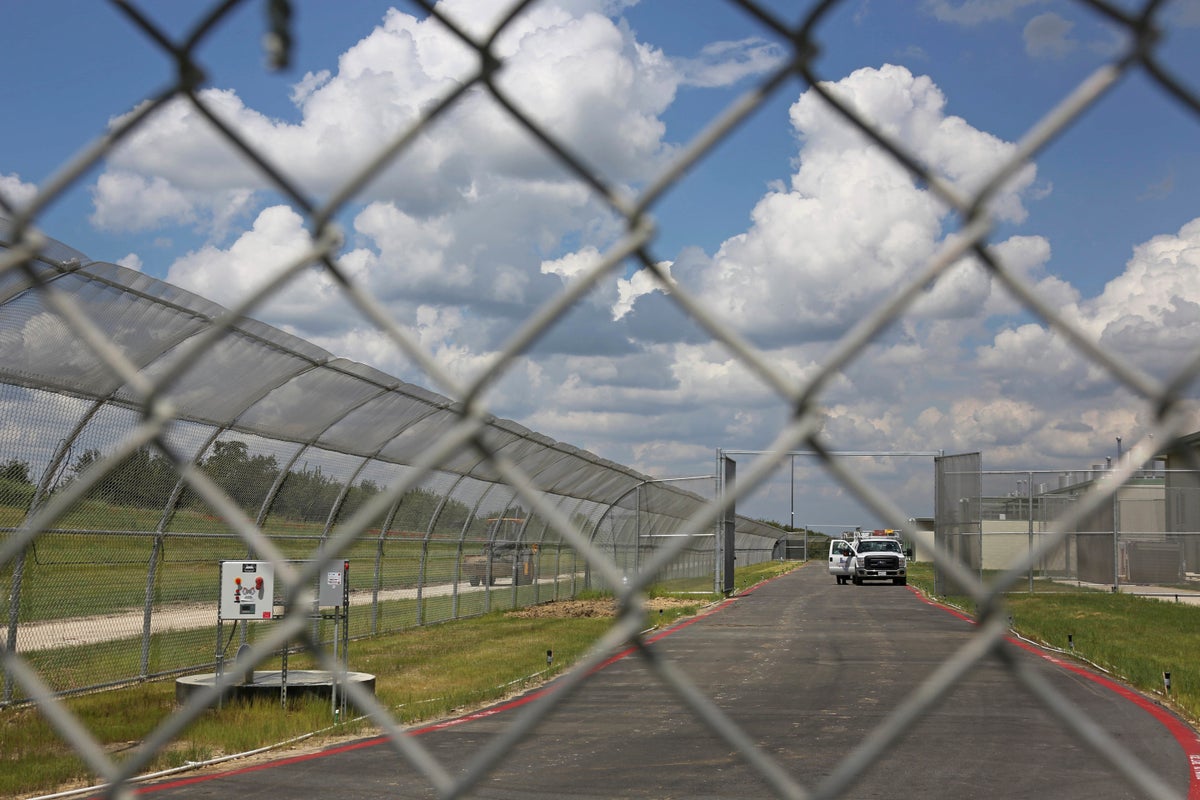
Federal judges in Texas just dropped a legal hammer that sent shockwaves through the activist community. If you think a standard protest conviction tops out at a few months of probation or a year or two in a low-security facility, you aren't paying attention to how the federal justice system is operating right now.
Fifteen people have now been sentenced in connection with a July 4, 2025, demonstration outside the Prairieland Detention Center in Alvarado, Texas. The headline numbers look like typographical errors. They aren't. We're talking about individual terms of 30, 50, 70, and even 100 years in federal prison. If you found value in this post, you should read: this related article.
To date, the total combined prison time handed down for this single night of unrest sits at over 556 years. Let that number sink in. Nobody died during this incident. One police officer was wounded. Yet, the state responded with the kind of punitive weight usually reserved for international cartel leaders or mass casualty bombers.
Understanding what happened in that Fort Worth courtroom requires peeling back the political rhetoric and looking at the exact legal mechanics the government utilized. This isn't just a story about a protest that turned violent. It's a blueprint for how the federal government plans to dismantle disfavored political groups by using broad terrorism enhancements. For another perspective on this event, check out the recent coverage from TIME.
The Night That Changed Everything in Alvarado
The incident occurred on the night of July 4, 2025. According to defense attorneys, the gathering was intended as a late-night demonstration to show solidarity with undocumented immigrants held inside the Immigration and Customs Enforcement (ICE) facility. They brought fireworks. They wore black clothing. Some brought firearms, which their lawyers argued was purely for self-defense under Texas open-carry norms.
The prosecution painted an entirely different picture during the 12-day trial. They presented evidence that the group operated as a highly coordinated North Texas Antifa cell, functioning under the front name "Emma Goldman Book Club." Jurors saw exhibits showing that the demonstrators brought 11 firearms, body armor, and 11 military-grade first aid kits packed with tourniquets.
Federal prosecutors also showed that attendees had scouted the facility during a peaceful daytime protest earlier that afternoon, reporting back security details to the rest of the group. When an Alvarado police officer pulled up to the scene that night, the situation exploded.
Benjamin Hanil Song, a former U.S. Marine reservist, reportedly yelled, "Get to the rifles," and opened fire. The arriving officer was shot and wounded. In the ensuing chaos, demonstrators threw fireworks, slashed tires on a government vehicle, spray-painted property, and smashed a closed-circuit security camera. Some participants used Faraday bags or turned off their phones to block location tracking.
The Shocking Numbers Behind the Sentences
The Justice Department secured convictions across the board, and the subsequent sentencing hearings before U.S. District Court Judges Reed O’Connor and Mark T. Pittman showed zero leniency.
- Benjamin Hanil Song: Sentenced to 100 years in prison for the attempted murder of a law enforcement officer, rioting, and weapons charges.
- Maricela Rueda: Sentenced to 70 years in prison.
- Ines Soto, Cameron Arnold, Savanna Batten, Zachary Evetts, Bradford Morris, and Elizabeth Soto: Each received 50 years in prison.
- Daniel Rolando Sanchez-Estrada: Sentenced to 30 years in prison.
The remaining defendants who chose to plead guilty prior to trial faced lesser, though still substantial, terms. Joy Gibson and Rebecca Morgan each received 15 years. Lynette Sharp and John Thomas were hit with over 9 years each. Seth Sikes received 6 years, while Nathan Baumann received 22 months after cooperating with the government. One final defendant, Susan Kent, awaits her court date.
How the Government Secured Decades in Prison for Protestors
How do you get 50 years in prison for attending a protest where you didn't pull the trigger? The answer lies in a complex legal mechanism known as the federal terrorism sentencing enhancement.
The prosecution didn't just charge these individuals with rioting or destruction of property. They brought charges of providing material support to terrorists and conspiracy to use explosives during a riot. Under the federal sentencing guidelines, if an offense is flagged as involving or intending to promote an act of terrorism, the offense level jumps exponentially.
This creates a massive compounding effect. The guidelines automatically push the defendant’s criminal history category to Category VI, the highest level possible, regardless of whether they have a clean record. This is exactly how individuals who arrived late to the scene or played minor roles found themselves staring down half-century sentences.
The case represents the first major rollout of federal prosecutions following a September 2025 executive order that designated Antifa as a domestic terrorist organization. Because there is no formal domestic equivalent to the State Department’s foreign terrorist organization list, the administration used this case to establish a fierce precedent.
The Disproportionate Case of Daniel Sanchez-Estrada
If there's one piece of this case that signals a massive shift in federal prosecution tactics, it's the 30-year sentence handed to Daniel Sanchez-Estrada.
Sanchez-Estrada wasn't even at the Prairieland Detention Center on the night of July 4. He didn't participate in the planning. He didn't wear black bloc or carry a weapon. His conviction stems entirely from actions he took after the shooting occurred.
Following a recorded prison phone call with his wife, Maricela Rueda, Sanchez-Estrada moved boxes out of their shared home. His defense attorney, Christopher Weinbel, maintained that the boxes merely contained personal belongings, poetry, artwork, journals, and left-wing political zines. Nothing in the boxes was illegal to possess.
Yet prosecutors successfully argued that by moving these items, Sanchez-Estrada was actively concealing documents to protect a member of an active terrorist cell. Prosecutor Frank Gatto argued openly that people holding extremist beliefs require extended prison sentences because they believe violence is justified. First Amendment advocacy groups are rightfully alarmed. The legal reality is that moving a box of political literature after a crime has occurred can now be tied directly to a broader terrorism conspiracy, carrying a multi-decade prison penalty.
What This Means for the Future of Public Dissent
The judges in the Northern District of Texas made their intentions completely transparent. Chief Judge Reed O’Connor explicitly stated that the harsh penalties were required to send a message and deter future actions, labeling the incident an assault on democracy.
The immediate defense strategy moves to the U.S. Court of Appeals for the Fifth Circuit. Multiple notices of appeal have already been filed by attorneys representing Song, Sanchez-Estrada, and others. The appellate fight will almost certainly focus on whether the application of terrorism enhancements to a chaotic domestic protest constitutes an unconstitutional overreach of federal sentencing guidelines.
If these sentences stand on appeal, the landscape for street-level activism changes completely. The boundary between an unlawful assembly and a multi-decade federal terrorism charge has become razor-thin.
If you choose to participate in high-stakes public demonstrations moving forward, you need to understand that the old legal playbook is gone. Minimize your legal exposure immediately by taking these concrete actions:
- Audit your digital footprint: Federal prosecutors heavily relied on text messages, group chats, and cell tower data to establish conspiracy charges. Use encrypted messaging applications with disappearing messages enabled, and never bring a personal smartphone to a high-tension demonstration area.
- Know who you associate with: The inclusion of material support and conspiracy charges means you can be held legally liable for the actions of anyone in your immediate orbit. If individuals in a group start discussing bringing weapons or explosives to a demonstration, cut ties instantly.
- Understand the legal definition of material support: Providing transportation, moving items, or organizing logistics for a group that later engages in a violent clash can look like a logistical support role to a federal prosecutor. Treat every logistical action with the highest level of caution.