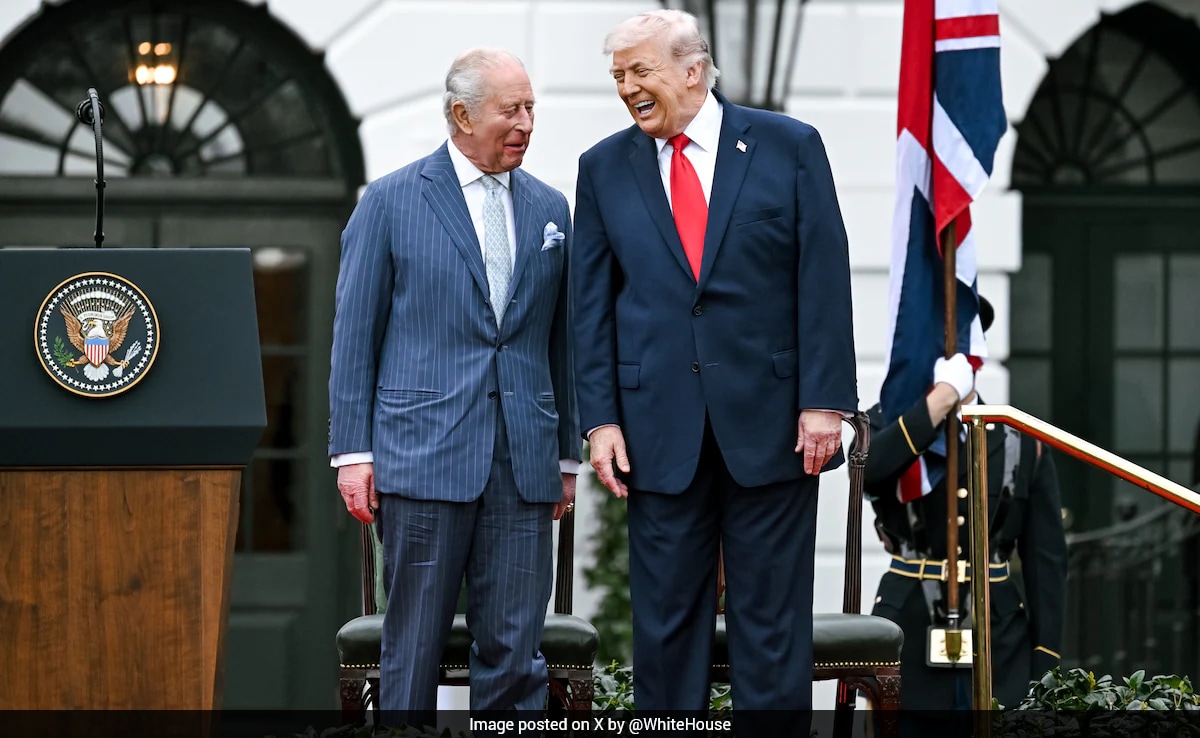
The pomp and pageantry of a royal state visit usually feels like a relic from another century, but when King Charles III walked onto the South Lawn this week to meet Donald Trump, the air felt decidedly modern—and tense. You've probably seen the headlines about the "Two Kings" remarks, a nod to the collision of British hereditary royalty and Trump’s own brand of American political dominance. But the real story isn't just about the handshakes or the gold-trimmed menus. It's about a fundamental clash of worldviews disguised as a friendly tea party.
Donald Trump doesn't do "low-key," and he didn't start now. Standing under a gray Washington sky, he welcomed the King by bridging the gap between colonial history and modern MAGA. He told the crowd that American patriots can only sing "My Country, 'Tis of Thee" because their ancestors first sang "God Save the King." It was a clever rhetorical move, essentially claiming the British monarchy as the philosophical grandfather of his own movement. He didn't just welcome a foreign dignitary; he welcomed a peer.
The Clash Over Checks and Balances
While the media focused on the "Two Kings" optics, the most significant moment happened away from the cameras. During his address to Congress—the first by a British monarch since 2007—King Charles took a subtle but pointed jab at the very nature of executive power. He reached all the way back to 1215 and the Magna Carta to remind the room that executive power must be subject to checks and balances.
This wasn't just a history lesson. It was a direct response to the current political climate in D.C. Trump has famously said he’s constrained only by his "own morality," a stance that flies in the face of the constitutional limits Charles was praising. When the King spoke those words, the room erupted. He got a standing ovation from the same Democrats who usually spend Trump’s speeches sitting on their hands. Even Trump noticed, joking later at the state dinner that he was "jealous" Charles could get the opposition to stand.
But don't let the jokes fool you. There is a deep, fundamental disagreement here about how a country should be run. Charles represents a system where the "ruler" has almost no power but deep institutional stability. Trump represents a system where the leader seeks maximum power to upend those same institutions.
Climate Change and the Elephant in the Room
If you want to know where the real friction lies, look at the environment. King Charles has spent his entire life campaigning for the planet. Trump, meanwhile, has spent his second term rolling back every environmental regulation he can find.
During the visit, Charles didn't scream or protest—that’s not the royal way. Instead, he used his "Two Kings" platform to call nature our "most precious and irreplaceable asset." He urged those in power to safeguard the environment for future generations. It was a polite way of saying the current U.S. policy is a disaster. Trump didn't push back publicly, instead pivoting to talk about how much his mother, Mary MacLeod, loved the Royal Family. It’s a classic Trump tactic: distract from a policy disagreement with a personal anecdote.
The Hidden Details of the State Dinner
The state dinner wasn't just about the food (though the Wagyu beef was reportedly excellent). It was a masterclass in soft power and "burns" delivered with a smile. Consider these moments that didn't make the evening news highlight reels:
- The Real Estate Joke: Charles poked fun at Trump’s plan to demolish the East Wing for a new ballroom. He reminded the President that the British already tried some "real estate redevelopment" of the White House back in 1814—when they burned it to the ground.
- The Language Zinger: After Trump joked that Europe would be speaking German if not for the U.S., Charles shot back that if it weren't for the British, Americans would be speaking French. It was a rare moment of genuine, unscripted wit that showed the King isn't as stuffy as people think.
- The Gift: Charles gave Trump a historic naval ship bell. The message? "Just give us a ring." It was a lighthearted way to address the very real strain on the U.S.-U.K. "Special Relationship" caused by recent trade tariffs and disagreements over the conflict in Iran.
Why This Meeting Actually Matters
You might think a royal visit is just a bunch of fancy clothes and old men talking about the past. You’d be wrong. This meeting happened at a time when the U.S. is increasingly looking inward. The U.K., meanwhile, is desperate to maintain its influence on the world stage after years of post-Brexit soul-searching.
The "Two Kings" dynamic is a reminder that while the U.S. and U.K. share a language and a history, they are moving in different directions. Charles spent his time in Washington defending NATO, the environment, and democratic norms. Trump spent his time highlighting the 250th anniversary of America breaking away from exactly what Charles represents.
It's a bizarre paradox. Trump loves the status and "class" associated with the British monarchy, yet his policies often undermine the global order the monarchy helps stabilize. Charles respects the power of the American presidency but clearly fears what happens when that power goes unchecked.
What Happens Next
The pageantry is over, and the King has moved on to New York and Virginia, but the fallout of this meeting will linger in the State Department for months. If you're watching the "Special Relationship," don't focus on the toasts. Focus on the trade numbers. Trump’s 100% tariffs on certain British goods are still on the table, and no amount of royal charm has moved the needle on that yet.
The real test won't be a dinner in the East Room. It will be whether these two very different versions of leadership can find common ground on Ukraine and Iran. For now, the "Two Kings" have agreed to disagree, wrapped in the finest silk and most polite language possible. Keep an eye on the upcoming NATO summit; that's where we'll see if the King's words about "unyielding resolve" actually stuck or if they were just lost in the D.C. wind.