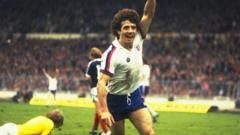
Mud and Flashlight Bulbs
Noise. That is what Kevin Keegan remembers first, long before the trophies or the legendary perm. It was the roar of forty thousand souls bouncing off the corrugated iron roofs of English football grounds in the mid-1970s, a thunderous backdrop to an era defined by heavy leather balls, thick mud, and ferocious tackles.
He wasn't supposed to be a icon. Standing barely five feet eight inches tall, Keegan was rejected by Doncaster Rovers as a teenager for being too small. Most players would have drifted into local factory leagues, their dreams quietly shelved between shift work and weekend pints. Read more on a similar subject: this related article.
Keegan refused to fade.
He worked harder. He ran until his lungs felt like torn paper. When Scunthorpe United gave him a chance, he seized it with a tenacity that caught the eye of Bill Shankly, Liverpool’s legendary manager. Shankly didn't just see a winger; he saw the beating heart of a new footballing empire. Further journalism by Bleacher Report highlights similar perspectives on the subject.
The First Superstar
By 1977, Kevin Keegan was no longer just a footballer. He was an invention.
He was the prototype for the modern global sports celebrity. Before Beckham had his haircuts plastered across billboard campaign campaigns, Keegan was endorsement royalty. He sold cereal, boots, and aftershave. His iconic curly hair became the defining image of seventies British pop culture.
Yet beneath the glamour, the stakes were brutal. Liverpool supporters didn't care about advertising deals; they demanded sweat. Keegan delivered both. In six years at Anfield, he scored 100 goals, lifting three league titles, an FA Cup, and the European Cup.
Then came the decision that stunned the sporting world.
At the very peak of his powers, having just won Europe's ultimate club trophy, he walked away. He left Liverpool for Hamburg SV in Germany. It was a leap into the complete unknown. British players rarely succeeded abroad back then. Language barriers, cultural isolation, and intense public scrutiny crushed most who tried.
In his first months in the Bundesliga, Keegan struggled. The German press was unforgiving. Opponents targeted him endlessly on the pitch.
He fought back the only way he knew how: sheer, unadulterated work rate.
By the end of his time in Germany, Keegan had claimed back-to-back Ballon d'Or awards in 1978 and 1979—the title of best footballer on the planet. He proved that genius wasn't always born from effortless talent. Sometimes, it was hammered out through relentless determination.
Passion on the Brink
If his playing career was an arc of triumph against the odds, his managerial career was a tightrope walk over a tempest.
In 1992, Keegan returned to Newcastle United as manager. The club was collapsing, sliding toward the third tier of English football. What followed was one of the most romantic, chaotic, and breathless eras in modern sports history. They called them "The Entertainers."
Keegan’s tactics were deceptively simple: if you score three, we will score four.
He transformed Newcastle into a thrilling force, taking them from the brink of relegation to the top of the Premier League in just a few seasons. The entire city of Newcastle fell under his spell. The stadium became a cathedral of raw emotion.
But high-wire acts carry severe risks.
During the 1995–96 season, Newcastle surrendered a twelve-point lead over Manchester United. The pressure was immense. The psychological warfare waged by rival manager Alex Ferguson squeezed Keegan until the tension exploded live on television.
"I'd love it if we beat them! Love it!"
Keegan barked the words into a microphone, his voice cracking with pure, unfiltered passion. It remains one of the most famous live television moments in broadcasting history. To the cynical, it was a breakdown. To those who understood Keegan, it was simply the mask slipping, revealing a man who cared so deeply that he couldn't hide it behind rehearsed media lines.
The Last Romantic
Modern football is calculated. It is driven by algorithms, strict tactical discipline, and carefully managed public relations profiles. Players speak in pre-approved soundbites. Managers analyze heatmaps on iPads.
Keegan belonged to an older, wilder tradition. He managed from the gut. He played from the chest.
Whether he was diving headfirst into a muddy tackle at Anfield, lifting trophies in Germany, or pacing the touchline at St James' Park with his heart strapped to his sleeve, Kevin Keegan offered something rare: total authenticity.
He showed us that success without passion is hollow, and that caring too much—even when it breaks your heart—is the only way to truly live.