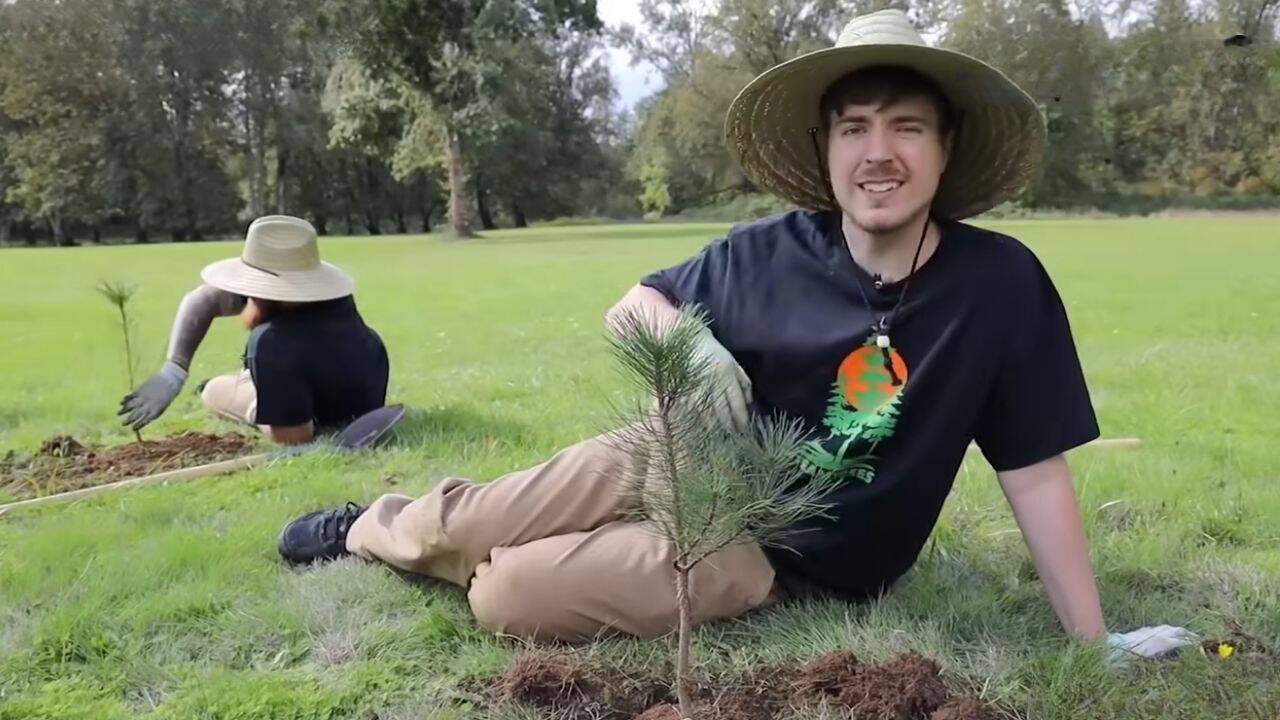
Everybody loves a number with lots of zeros at the end. Tell the public that a charismatic internet personality just dropped twenty-five million trees into the dirt, and the applause rolls in before anyone even checks if the saplings have a pulse. It feels good. It fits neatly into a thirty-second vertical video. It gives people who spend twelve hours a day staring at glowing rectangles a cheap hit of ecological absolution.
It is also an unmitigated disaster disguised as philanthropy.
I have watched well-funded corporate ESG initiatives and viral campaigns burn millions of dollars on mass-afforestation projects that left behind little more than high-priced kindling and ruined soil. The lazy consensus of the digital age assumes that sticking a stick in the ground automatically equals ecological healing. Nature does not work on corporate key performance indicators. When you optimize for a vanity metric like tree count, you stop paying attention to biology.
The Mathematics of Mass Mortality
Let us look at how these massive public tree-planting operations actually function on the ground once the cameras turn off and the influencers fly home.
In most high-profile mass-planting campaigns, survival rates are treated as a dark secret. Independent forestry audits of large-scale plantation drives routinely show first-year mortality rates hovering between twenty and eighty percent depending on soil conditions, local follow-up care, and weather anomalies. If you plant twenty-five million trees and twelve million of them turn into brittle firewood within eighteen months, you haven't engineered a carbon sink. You have staged a high-cost PR stunt that creates a massive fire hazard.
Even worse is the species selection problem. To hit large numerical quotas quickly, project coordinators buy whatever cheap monoculture seedlings nurseries can pump out by the truckload. They plant rows of fast-growing pines or eucalyptus trees across ecosystems that evolved with complex, multi-layered biodiversity.
Picture a vast, arid savannah ecosystem historically dominated by native grasses, shrubs, and scattered acacia trees, which naturally store massive amounts of carbon safely underground in extensive root networks and soils. Now imagine a well-meaning army of volunteers showing up to blanket that open land in dense blocks of thirsty pine saplings. You have just destroyed a critical grassland habitat, decimated local wildlife corridors, depleted the local water table, and created a homogenous green matchstick box that a single lightning strike will turn into an inferno.
That is not conservation. That is green-painted industrial vandalism.
The Carbon Accounting Fallacy
The fundamental misunderstanding at the heart of the mass-tree craze is the timeline of carbon sequestration. People assume a young tree sucks up carbon at the same rate a mature forest does.
Biological reality is far more inconvenient. A newly planted sapling sequesters negligible amounts of carbon for the first decade of its life. Meanwhile, the heavy machinery used to clear land, prep soil, transport millions of seedlings across thousands of miles, and maintain the plots often emits more carbon upfront than the tiny twigs will offset for fifteen years.
If you plant trees in the wrong biome, you actively alter the albedo effect. Earth's surface reflectivity matters immensely for global temperatures. Snowy boreal regions or light-colored arid soils reflect solar radiation back into space. Cover those light surfaces with dark, dense blocks of evergreens, and the canopy absorbs more heat than the bare ground ever did. In some northern latitudes, large-scale afforestation has actually accelerated local warming trends rather than cooling them down.
We are treating carbon like a simple spreadsheet entry where any debit can be canceled out by an arbitrary credit, regardless of context, geography, or physics.
What Actually Works Instead of Vanity Planting
If you want to move the needle on ecological restoration, stop buying photo opportunities and start funding boring, unsexy biology.
Passive ecological restoration beats active planting nine times out of ten. If you want more trees, the cheapest and most effective method is often to stop doing the things that are killing them in the first place. Remove invasive grazing livestock from a degraded watershed, fence off a degraded riparian zone, and let the native seed bank do what it has evolved over millennia to do. Natural regeneration produces resilient, biodiverse forests with survival rates that dwarf anything human planters can achieve with shovels and PR firms.
When active planting is genuinely necessary, it requires hyper-local customization. It means sourcing dozens of native understory species, shrubs, and canopy trees from local nurseries, matching them precisely to micro-topography, and committing to a five-to-ten-year management budget for weeding, watering, and thinning. That model doesn't lend itself to viral challenges. You cannot easily flash a graphic on a screen that says "We spent four years carefully monitoring weed competition across twelve distinct soil types."
People want a hero with a shovel. They want a neat, quantifiable tally they can celebrate on a Tuesday afternoon.
The planet does not care about your viral metrics. Stop counting trees and start protecting the living systems that keep them alive.