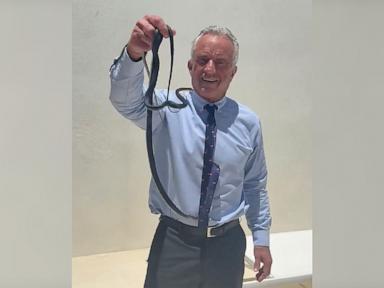
The modern political information ecosystem treats public attention as a scarce, highly monetizable resource governed by strict algorithms. When Robert F. Kennedy Jr., serving as the U.S. Secretary of Health and Human Services, published a 49-second video of himself capturing a pair of Southern black racer snakes (Coluber constrictor priapus) with his bare hands on the patio of Centers for Medicare and Medicaid Services Administrator Dr. Mehmet Oz, mainstream media categorized the event as an eccentric anomaly. This view misses the structural mechanics of modern political communication. The event represents a precise execution of calculated high-risk behavioral branding designed to bypass traditional media gatekeepers, optimize algorithmic distribution channels, and project a distinct, visceral archetype of physical competence directly to an active digital electorate.
To understand how this micro-event commands the national media cycle, we must analyze the specific variables driving its transmission: the biological reality of the risk vector, the behavioral psychology of the target demographic, and the operational structure of modern digital engagement. If you liked this article, you might want to look at: this related article.
The Operational Mechanics of the Biological Event
A primary error in standard media reporting is the failure to accurately assess the physical risk profile of the encounter. Media outlets fluctuated between calling the reptiles "dangerous" and dismissing them as completely harmless. A professional herpetological risk matrix reveals a more complex reality based on exact evolutionary biology.
- Taxonomic Identity and Behavioral Defense Systems: The snakes in question were Southern black racers, a non-venomous colubrid species native to the southeastern United States. Black racers are characterized by high agility, visual acuity, and an intense defensive response when cornered. They do not possess medical-grade venom delivery apparatuses, but their jaw structure features rows of small, backward-curved teeth engineered to hold prey.
- The Biomechanical Trajectory of the Strike: In the video, the reptiles repeatedly struck toward Kennedy's hands, with one confirming a successful bite to his finger. While the physiological damage of a black racer bite is limited to superficial lacerations and minor localized capillary bleeding, the behavioral execution of bare-handed capture introduces significant mechanical variables.
- Vector Hazards and Ecological Risks: Professional herpetologists, including representatives from the Rattlesnake Conservancy, identified a secondary risk vector omitted by casual observers: the structural integrity of the animal itself. Grasping a colubrid snake purely by the caudal region (the tail) creates an unweighted leverage point. The snake's rapid writhing against its own hung mass can cause severe spinal subluxations or muscular tearing in the reptile. Furthermore, from a human health perspective, wild reptiles carry high surface colonization rates of Salmonella bacteria, making bare-handed handling of stressed animals an immediate zoonotic transmission vector regardless of venom status.
This explicit mismatch between low systemic lethality and high perceived visual danger forms the exact foundation of the performance. The visual of a high-ranking federal health official absorbing a physical strike from a thrashing reptile creates an immediate psychological spike in the viewer, maximizing engagement metrics without exposing the political asset to permanent physical degradation. For another look on this event, see the recent update from Wall Street Journal.
The Political Semiotics of the Wild Animal Archetype
The snake capture is not an isolated event; it is the latest component of a long-term behavioral portfolio. This portfolio includes the historical relocation of a venomous rattlesnake from a California driveway in 2024 using a trowel and bare hands, the transport and placement of a bear carcass in New York’s Central Park in 2014, and the recent rescue of a starling at Dulles International Airport.
When analyzed through the framework of political semiotics, these actions establish a deliberate counter-narrative to standard administrative authority.
[Traditional Administrative Power] -> Defined by: Bureaucratic Insularity, Process Compliance, Physical Isolation
               vs.
[The RFK Jr. Behavioral Portfolio] -> Defined by: Direct Environmental Intervention, Physical Autonomy, Exposure to Raw Nature
Traditional political figures signal authority through systemic insularity, process compliance, and physical isolation within institutional architectures. Conversely, the deliberate staging of raw environmental intervention signals an archetype of direct action and physical autonomy. By confronting a biological organism that causes instinctual fear in a high percentage of the population, the actor claims a specific form of primitive credibility. This credibility operates completely independently of institutional policy positions or administrative credentials.
This creates a distinct narrative tension. While institutional critics view the handling of wildlife as a lack of stability or decorum, the target audience interprets the same behavior as a demonstration of authenticity, self-reliance, and physical vitality. The presence of secondary figures in the video amplifies this effect. The verbal warnings of actress Cheryl Hines and the analytical commentary of Dr. Mehmet Oz provide an onscreen proxy for the audience's anxiety. This positions Kennedy as the sole calm operator within a chaotic system.
Algorithmic Distribution and Market Saturation Frameworks
The structural objective of contemporary political media production is the minimization of customer acquisition cost (CAC) for voter attention. Traditional media placements require massive capital expenditure or compliance with aggressive journalistic editorial frameworks. The bare-handed snake capture serves as a self-assembling media asset that solves this distribution bottleneck.
The Organic Amplification Funnel
The efficiency of this viral asset is governed by a three-tiered structural funnel that automates distribution across competing media ecosystems:
- The Primary Shock Trigger: The video leverages a foundational human evolutionary bias toward serpentine movement and physical danger. Social media recommendation engines prioritize high initial watch-time retention metrics. The visual hook of an immediate animal strike prevents user scrolling within the critical first two seconds of feed presentation.
- The Bifurcated Commentary Loop: The asset creates an automated comment-generation engine by provoking two completely opposing, highly emotional viewpoints simultaneously. One faction posts expressions of awe and framing centered on physical capability, while the opposing faction posts critiques regarding environmental ethics, animal safety, and administrative irresponsibility. Because platform algorithms reward the volume and velocity of comments rather than their sentiment, this ideological polarization accelerates the content's distribution velocity.
- The Cross-Platform Institutional pickup: Mainstream legacy media outlets are structurally forced to cover the asset to capture a portion of the high-volume search traffic generated by the primary platforms. This completes the cycle: an unedited 49-second phone clip transforms into a multi-day national news story, securing millions of dollars in earned media value (EMV) at zero cost.
Strategic Fragility and the Limitations of Systemic Unpredictability
While this framework delivers immediate advantages in terms of attention capture and brand differentiation, it operates under strict conditions of strategic fragility. Executing an outreach strategy based on high-risk physical behavior introduces clear structural liabilities that limit its long-term viability.
The primary limitation is the law of diminishing marginal returns on shock value. When an audience adapts to a specific tier of behavioral outlier performance—such as moving from a bear carcass to a venomous rattlesnake, and then to a pair of black racers—the threshold for generating equivalent levels of future media saturation rises. This forces the operator into an escalatory cycle where subsequent actions must feature progressively higher real or perceived physical risks to achieve identical algorithmic performance.
The second limitation is the degradation of institutional trust among risk-averse stakeholder networks. In the context of executive governance, particularly within the Department of Health and Human Services, a key metric of institutional stability is predictability. While displaying raw physical confidence appeals directly to a populist base, it simultaneously erodes confidence among internal bureaucratic structures, legislative partners, and scientific communities that require systematic risk mitigation rather than calculated risk exposure.
The ultimate trajectory of this communication model depends entirely on balancing these two forces. The strategy yields highly efficient results for acquiring raw public attention and disrupting standard political narratives. However, it fails to build the stable institutional alignment required to convert that volatile digital capital into permanent structural authority.