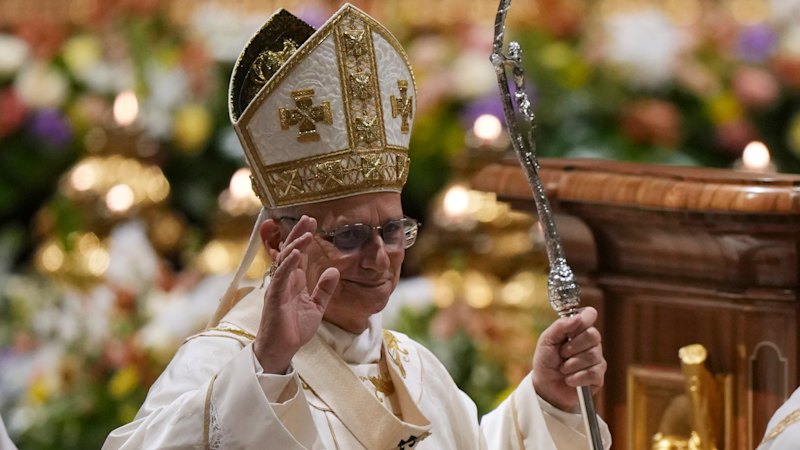
The candles flickered against the ancient stone of St. Peter’s Basilica, but the message cutting through the silence wasn't just about ancient ritual. During the Easter Vigil, Pope Leo looked out at a world increasingly comfortable with the background noise of artillery and drones. He didn't just offer a prayer. He issued a blunt warning against the "spiritual anesthesia" that allows us to eat dinner while watching cities burn on our phone screens. We’ve reached a point where war isn’t an emergency anymore; it’s a news cycle. That’s exactly what the Pontiff is trying to break.
The Easter Vigil is usually the most hopeful night on the Catholic calendar. It marks the transition from the darkness of Good Friday to the light of the Resurrection. But this year, the "light" felt more like a searchlight aimed at the messy, violent corners of our current geopolitical reality. Pope Leo didn't hold back. He spoke to a packed basilica, yet his words were clearly meant for the halls of power in Washington, Brussels, and Moscow. He’s tired of the world growing numb. You should be too. Learn more on a similar issue: this related article.
The Danger of Growing Numb to Violence
It’s easy to look away. In fact, our brains are wired for it. Psychologists call it compassion fade. When a conflict starts, we’re glued to the updates. We donate. We post flags. But by month six or year two, we just stop clicking. Pope Leo identified this as a moral crisis rather than just a psychological quirk. He argued that when we lose our capacity to be shocked by war, we lose a piece of our humanity.
War shouldn't be normal. It shouldn't be something we "manage." The Pope’s address centered on the idea that peace is a fragile thing that requires constant, active maintenance. It isn't just the absence of noise. By growing numb, we give leaders a free pass to keep the machinery of death moving. If the public doesn't care, the bombs keep falling. It’s a simple, terrifying math. More reporting by Al Jazeera explores related perspectives on the subject.
Why This Easter Message Hits Differently
We've heard Popes talk about peace for decades. It can start to feel like a script. However, Leo’s tone during this vigil lacked the usual diplomatic softening. There was an edge to it. He spoke about the "cold wind of war" and the "icy grip of indifference." These aren't just poetic flourishes. They’re accusations.
He’s looking at a world where conflicts in Eastern Europe, the Middle East, and various parts of Africa have become "frozen" or, worse, ignored. The Vatican has been trying to position itself as a neutral mediator, but tonight, the neutrality felt secondary to the moral outrage. Leo isn't just asking for a ceasefire. He’s asking for a global heart transplant.
The Human Cost Behind the Headlines
Numbers are boring. We hear "thousands displaced" and our eyes glaze over. To counter this, the Pope’s homily focused on the individual. He spoke about the mother in a basement, the child who has forgotten the sound of silence, and the elderly left behind in the rubble.
- The Loss of Future: Every day of war is a decade of progress lost.
- The Cycle of Hate: Violence today guarantees a new generation of resentment tomorrow.
- The Resource Drain: Money spent on missiles is money not spent on curing diseases or feeding the hungry.
It’s a zero-sum game that nobody actually wins, despite what the defense contractors might tell you.
Breaking the Cycle of Indifference
So, how do we actually "not grow numb"? It’s a tall order when you’re just trying to get through your work week. Leo suggests that the first step is proximity. We have to stop viewing these conflicts as "over there." In a globalized economy, there is no "over there." Everything is connected. The energy prices you pay, the refugees in your city, and the moral weight of your country’s exports—it’s all part of the same web.
The Pope urged the faithful—and the world at large—to practice "active memory." This means intentionally seeking out the stories of those affected by conflict. It means refusing to let the news cycle dictate what matters. It's about maintaining a level of discomfort. If you’re comfortable while the world is on fire, you aren't paying attention.
A Call for Bold Diplomacy
Prayer is one thing, but Leo didn't stop at the pews. His message had a clear political undercurrent. He’s calling for a brand of diplomacy that isn't just about shifting borders or signing trade deals. He’s calling for a "diplomacy of the heart." This sounds fluffy, but it’s actually quite radical. It means putting human dignity above national interest.
Think about the last time a major peace treaty was signed that actually felt like it prioritized people over power. It’s been a while. The Pope is essentially calling out the "realpolitik" crowd who think that a certain amount of collateral damage is just the price of doing business. He’s saying the price is too high.
What You Can Do Right Now
You aren't a head of state. You don't have a seat at the UN. But the Pope’s message implies that the "global numbness" starts at the individual level. If we want a world that doesn't ignore war, we have to be people who refuse to ignore it.
- Audit Your Information: Stop scrolling and start reading deeply. Find one conflict you know nothing about and spend thirty minutes learning about the people, not just the politics.
- Support Direct Relief: Don't just feel bad. Find organizations that are on the ground providing medical care and food. Make it tangible.
- Pressure Your Reps: Governments move when they feel the heat. If they think you don't care about foreign policy, they’ll do whatever is most profitable. Remind them that human lives aren't bargaining chips.
- Talk About It: Break the social taboo of bringing up "heavy" topics. If we can't talk about war at the dinner table, we’ll never stop it on the battlefield.
Pope Leo ended the vigil by lighting a single flame, which was then shared throughout the darkened basilica until the whole room was glowing. It’s a bit on the nose, sure, but the metaphor holds. One person deciding to wake up and pay attention doesn't end a war. But ten thousand people doing it? That starts to change the atmosphere. That starts to make it harder for the world to keep sleeping while the bombs fall.
Don't wait for a news alert to remind you that people are suffering. Make the choice to see them. Right now, that’s the most rebellious thing you can do.