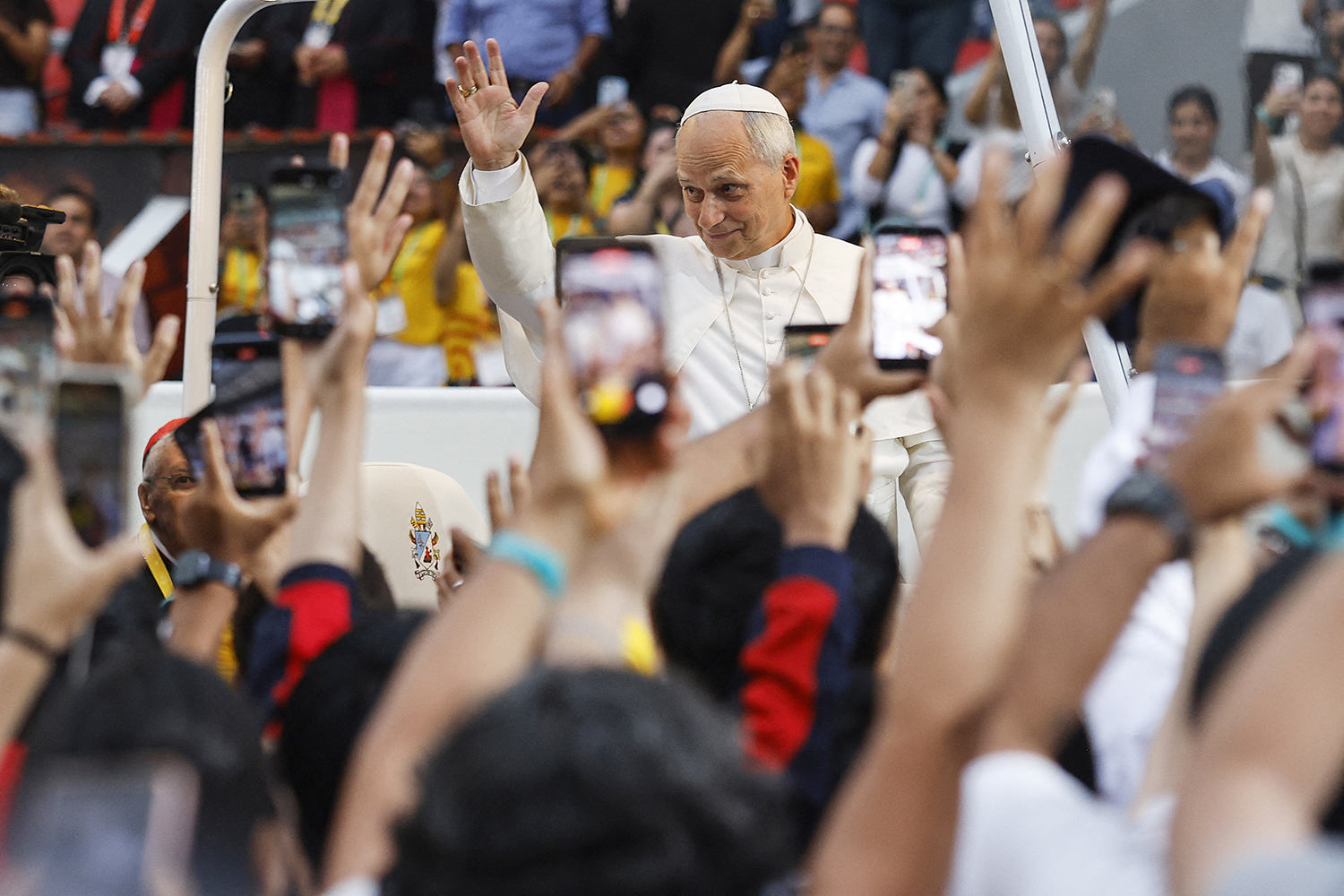
Pope Leo’s 12-day tour of South America was not a victory lap for the Catholic Church, nor was it a mere ceremonial homecoming for a pontiff with deep roots in the region. It was a high-stakes defensive campaign across a continent that once served as the unassailable demographic bedrock of global Catholicism, where institutional loyalty is now eroding faster than the Vatican can rebuild it.
For decades, standard coverage of papal trips has followed a predictable script. Cameras capture the waving crowds, the motorcades, the open-air Masses, and the diplomatic handshakes with heads of state. Surface-level recaps treat these journeys as triumphal pageants. They miss the institutional anxiety driving the itinerary. When a pope commits nearly two weeks of grueling travel to South America, every stop is a calculated triage operation aimed at halting decades of membership loss, countering the rise of evangelical Protestantism, and confronting political polarization that has fractured local parishes from the inside out.
The Demographic Reality Behind the Crowds
The visual optics of a papal visit are deceptive. Filling a public square or a coastal esplanade with hundreds of thousands of cheering pilgrims makes for compelling television, yet those crowds mask a steady structural contraction.
Across Latin America, the Catholic share of the population has dropped sharply over the past half-century. In countries like Brazil, Chile, and Peru, the decline has accelerated within a single generation. Millions of baptized Catholics have not merely become inactive; they have actively migrated to Pentecostal and neo-Pentecostal congregations that offer tighter community networks, charismatic worship, and immediate social support in rapidly urbanizing neighborhoods. At the same time, a growing segment of younger South Americans identifies with no religion at all, mirroring secularization trends once thought exclusive to Western Europe and North America.
This demographic shift alters the balance of power inside the global Church. South America still holds the largest concentration of Catholics on earth, which means Rome cannot afford to lose the region without losing its claim to universal cultural authority. Yet the traditional parish model—built around large, geographically bound churches staffed by an aging and shrinking pool of priests—struggles to compete with nimble, storefront evangelical ministries led by local pastors who live in the exact same conditions as their congregants.
During the 12-day itinerary, Pope Leo’s schedule repeatedly bypassed ornate basilicas in favor of peripheral urban districts, rural parishes, and community centers. That choice was deliberate. The Vatican recognizes that ceremonial grandeur no longer retains working-class families who feel disconnected from clerical bureaucracy. By placing himself in neglected neighborhoods, the pontiff attempted to signal that the institutional Church still belongs to the margins rather than the elite corridors of capital cities.
The Geopolitics of the Itinerary
Papal travel is diplomacy conducted through liturgy. Every city included on a 12-day route—and every country left off—sends an unmistakable political message to regional governments and local bishops.
South America’s political terrain is deeply fractured. Populist movements on both the left and the right have sought to co-opt religious language and traditional values to legitimize their agendas. Meanwhile, governments across the region face intense pressure over extractive industries, indigenous land rights, migration corridors, and entrenched economic inequality. A pope stepping into this environment walks a razor’s edge. Speak too vaguely, and the visit appears detached from human suffering; speak too pointedly, and the Vatican risks alienating sitting administrations or triggering backlash from conservative Catholic factions.
Throughout the tour, Pope Leo addressed the social consequences of unregulated mining, deforestation, and forced displacement—issues that directly affect indigenous communities across the Amazon basin and the Andean highlands. These remarks were grounded in established Catholic social teaching, which treats environmental degradation and economic exploitation as interconnected moral failures. Yet on the ground, those principles collide with national economic policies that rely heavily on resource extraction to fund public budgets and service foreign debt.
Local reactions revealed just how divided the region has become. Community organizers and environmental defenders welcomed the papal spotlight as vital protection against corporate and state encroachment. Conversely, business leaders and conservative commentators accused the Church of meddling in sovereign economic development while offering few practical alternatives for job creation. The friction demonstrated that the moral consensus the Vatican once commanded in South American public life has fractured along ideological lines.
Internal Fault Lines Within the Local Clergy
The most acute challenges facing Pope Leo during the 12-day tour were not external critics, but internal divisions among South American bishops and priests.
For years, the regional hierarchy has been split between two competing visions of pastoral ministry. One camp prioritizes social justice, synodal consultation, and structural reform, arguing that the Church must decentralize authority and empower lay leaders—especially women—to compensate for the acute shortage of ordained priests. The other camp insists that doctrinal clarity, traditional liturgical practice, and firm moral boundaries are the only reliable antidotes to secularism and evangelical competition.
These tensions are not abstract theological debates. They play out in seminary classrooms, diocesan budgets, and parish pulpits. In several dioceses, clergy shortages have reached critical levels, leaving single priests responsible for dozens of widely scattered rural chapels. In these areas, lay catechists and religious sisters already perform the vast majority of daily pastoral work, visiting the sick, preparing families for sacraments, and leading Sunday scripture services when no priest is available to celebrate Mass.
Pope Leo’s private meetings with national bishops’ conferences formed the real core of the 12-day mission, far away from the public cameras. In these closed-door sessions, the central question was institutional survival: how to govern a Church whose human resources no longer match its geographic footprint.
The Vatican’s push for synodality—a governance model emphasizing shared responsibility between clergy and laity—was tested directly during these encounters. Supporters view it as an essential adaptation that legitimizes the work laypeople are already doing. Skeptics within the hierarchy fear it dilutes sacramental authority and turns parishes into non-governmental organizations indistinguishable from secular charities. Bridging that divide requires more than papal speeches; it demands concrete administrative reforms in how dioceses train leaders, allocate funds, and handle accountability.
The Unresolved Shadow of Institutional Abuse
No modern papal journey can escape the legacy of clerical sexual abuse and institutional cover-ups, and South America carries some of the deepest wounds in the global Church.
Over the past decade, revelations across countries such as Chile, Peru, and Argentina shattered public trust in the Catholic hierarchy. For years, senior bishops dismissed survivor testimonies, protected high-ranking offenders, and prioritized institutional reputation over basic justice. The fallout was devastating. Mass attendance plummeted, vocations to the priesthood dried up, and the Church lost the moral standing it once used to critique state corruption.
During the 12-day tour, Pope Leo held private meetings with survivors and reiterated the Vatican’s zero-tolerance policies. Those encounters were necessary, yet they also highlighted the persistent gap between papal promises in Rome and implementation at the diocesan level.
Survivors and legal advocates across South America continue to point out major inconsistencies in how canonical investigations are conducted. Transparency remains uneven. While some dioceses have established independent review boards and cooperated with civil prosecutors, others still drag their feet on releasing internal archives or removing compromised administrators from positions of influence.
For a skeptical public, gestures of contrition carry diminishing returns. Young South Americans watching the tour did not measure the Church by the size of its rallies or the eloquence of its homilies. They measured it by whether its institutions protect the vulnerable and hold powerful insiders accountable under the rule of law. Until canonical procedures operate with full transparency and consistent enforcement across every diocese, the credibility deficit will remain an anchor on the Church’s mission.
What the Tour Actually Accomplished
Evaluating a 12-day papal journey requires separating immediate emotional momentum from long-term structural impact.
In the short term, the trip achieved its primary pastoral goal: it energized committed Catholics who often feel isolated in an increasingly secular or pluralistic culture. Public liturgies, youth rallies, and encounters with grassroots volunteers provided visible affirmation that their daily work matters to the wider Church. For local clergy working in impoverished or violent districts, the pope’s presence offered rare international visibility and moral reinforcement.
Diplomatically, the tour reasserted the Holy See’s role as a regional mediator. By engaging civil society groups alongside government officials, the Vatican positioned itself as an interlocutor capable of convening dialogue in societies paralyzed by political polarization.
Yet a papal visit cannot manufacture vocations, reverse decades of demographic migration overnight, or resolve deep ideological rifts among bishops. Once the papal plane departs, the television trucks leave, the temporary stages are dismantled, and local dioceses return to the hard arithmetic of declining collections, aging clergy, and fierce competition for the spiritual allegiance of the next generation.
The real test of Pope Leo’s 12-day tour begins in the quiet months that follow, when local bishops must decide whether to translate papal rhetoric into structural reform or let the momentum fade back into institutional routine.


