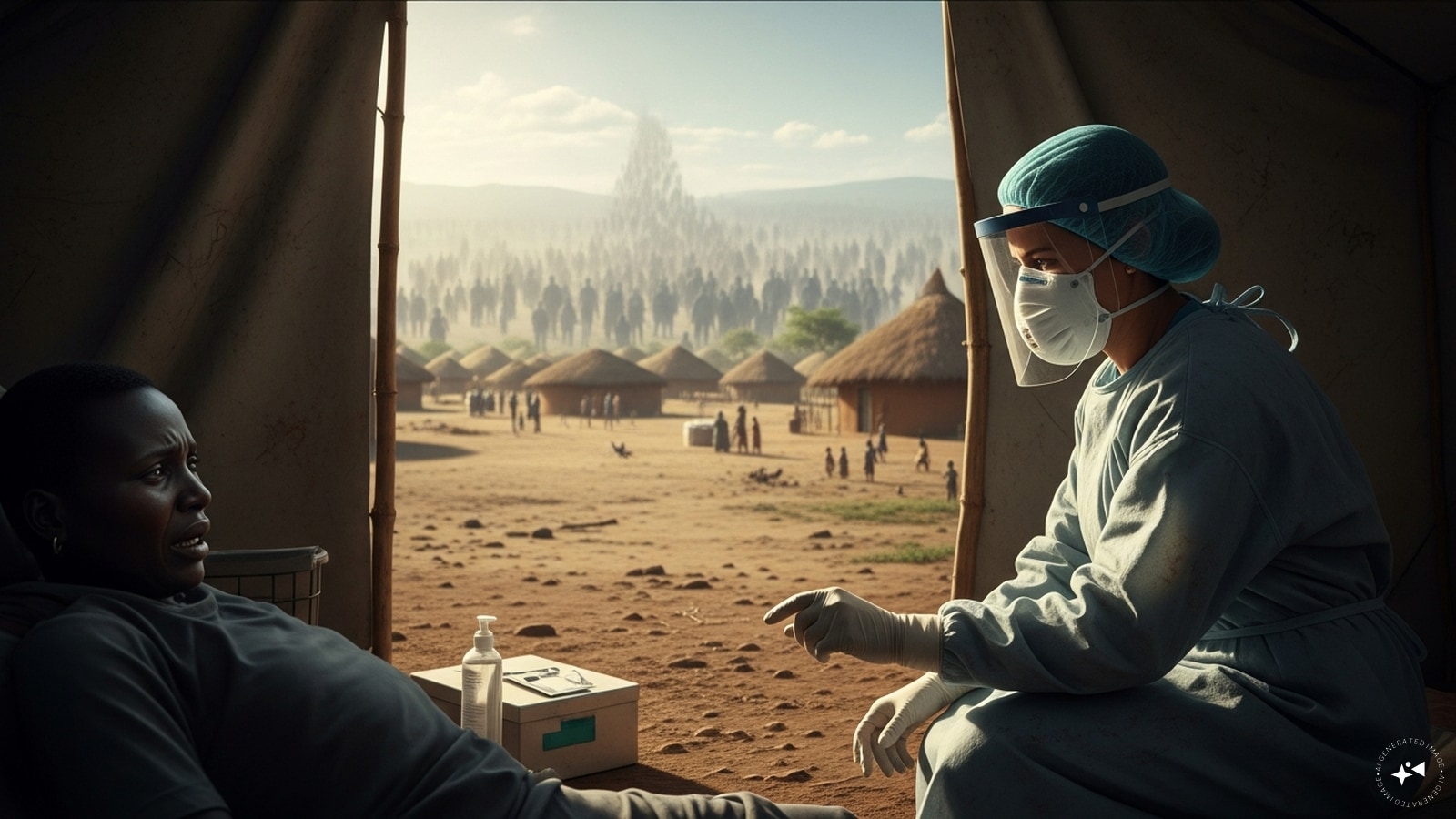
Epidemiological models love a round number. They love the drama of a five-figure projection. When public health agencies and media outlets look at an outbreak of Ebola virus disease in Central Africa and scream that it could touch 20,000 cases without immediate, massive intervention, they are relying on a fundamentally flawed understanding of how disease moves through human networks.
They are treating human beings like inanimate, static variables in a spreadsheet.
I have spent years analyzing how international responses deploy into health crises. I have watched billions of dollars get channeled into rigid, top-down containment strategies based on worst-case scenarios that never materialize. The 20,000-case projection isn't a sober warning. It is a mathematical phantom born from oversimplified R0 (basic reproduction number) calculations that ignore human agency, localized immunity, and the profound inefficiencies of international aid.
We need to stop feeding the panic machinery. The conventional wisdom that says centralized, militarized public health crackdowns are the only way to avert an apocalypse is dead wrong.
The Flaw of the Linear Catastrophe
Most mainstream epidemiological projections rely on deterministic transmission models. They take the initial transmission rate of an outbreak, assume it will remain constant, and extrapolate it outward across a population map like wildfire through dry brush.
This is lazy math.
Ebola is a brutal, highly lethal filovirus. It requires direct contact with bodily fluids. It does not hang in the air like measles or influenza. Because its transmission mechanics are so intimate, its spread is governed entirely by behavioral networks, not mere geography.
When an outbreak begins, human beings do not sit idly by waiting for the World Health Organization to issue a press release. They adapt. They stop touching the sick. They modify traditional burial practices. They isolate symptomatic family members. This organic behavioral shift puts an immediate, drastic drag on the transmission rate, long before international field hospitals are even assembled.
[Initial Outbreak]
       │
       ▼
[High Transmission (R0 > 2)] ──► Conventional Model Predicts: 20,000 Cases
       │
       ▼ (Reality: Behavioral Adaptation Occurs)
[Modified Burial/Care Practices]
       │
       ▼
[Transmission Drops Naturally (R < 1)] ──► Real-World Outcome: Early Burnout
When you look at past outbreaks, from the massive West African epidemic in 2014 to successive waves in the Democratic Republic of Congo, the catastrophic peak numbers thrown around by modeling agencies rarely hit their targets. Why? Because the models systematically undervalue local intelligence and overvalue bureaucratic intervention.
People Also Ask: Dismantling the Panic Premise
When a new flare-up occurs, search engines light up with predictable questions. The answers provided by standard health portals are usually designed to maximize compliance through fear rather than educate through nuance.
Can Ebola mutate to become airborne?
This is the ultimate sci-fi nightmare fuel that resurfaces during every outbreak. The short answer is no. Viruses cannot easily change their fundamental tissue tropism. For Ebola to become airborne, it would have to reinvent its entire structural envelope, changing how it binds to host cells. There is zero evolutionary pressure for it to do so; it is already highly efficient at spreading via fluids in close-quarter environments. Treating airborne mutation as a viable threat diverts resources from actual transmission vectors.
Why do outbreaks always seem to happen in Central Africa?
The conventional narrative blames poverty and a lack of infrastructure. While those are contributing factors to response times, the real reason is ecological. The tropical rainforest ecosystems of Central Africa are the natural reservoir for the virus, specifically within certain species of fruit bats. Outbreaks occur at the intersection of human encroachment and wildlife interfaces. It is an ecological reality, not a systemic failure of local governance.
The Billion-Dollar Logistics Trap
Here is a reality that international NGOs will not admit in their fundraising appeals: pouring unmanaged capital and foreign personnel into a localized health crisis often creates more friction than solutions.
I have seen international agencies spend millions setting up massive, state-of-the-art Ebola Treatment Units (ETUs) only for them to sit entirely empty. Why? Because the locals did not trust the foreign workers in white biohazard suits who arrived in armored SUVs, barricaded themselves behind plastic fencing, and took away their dying relatives without explanation.
+-----------------------------------+-----------------------------------+
| Top-Down Bureaucratic Approach    | Decentralized Local Approach      |
+-----------------------------------+-----------------------------------+
| Build massive centralized ETUs    | Distribute basic PPE to village   |
| away from communities.            | health posts immediately.         |
+-----------------------------------+-----------------------------------+
| Deploy foreign medical teams with | Train trusted local elders and    |
| language and cultural barriers.   | nurses on safe burial methods.    |
+-----------------------------------+-----------------------------------+
| Enforce strict, militarized       | Use hyper-localized contact      |
| quarantines via local police.     | tracing led by community leaders. |
+-----------------------------------+-----------------------------------+
When you centralize a response, you create a bottleneck. You require a sick individual in a remote village to travel hours over unpaved roads to reach a designated facility. By the time they get there, they have exposed multiple transit drivers and family members.
Worse, the sheer volume of money that floods in during a "20,000-case threat" distorts the local economy. It pulls indigenous doctors and nurses away from treating malaria, tuberculosis, and measles—which kill far more people annually than Ebola ever has—to chase high-paying, short-term contract work with international agencies. The net result is a higher mortality rate across the board for common, treatable conditions.
The Contra-Strategy: Hyper-Localization and Micro-Containment
If we want to stop outbreaks without destroying the local healthcare ecosystem, we have to abandon the macro-projections and focus on micro-dynamics.
Instead of waiting for a sprawling international consensus to build field hospitals, the response must prioritize immediate, decentralized empowerment.
Decentralize the Strategic National Stockpiles
Stop holding vaccines and therapeutics in centralized hubs like Geneva or Kinshasa. By the time the cold chain logistics are approved, cleared through customs, and flown to the epicenter, the second and third rings of transmission have already occurred. Stockpiles of highly effective countermeasures, like the Ervebo vaccine, must be embedded permanently at the provincial level within high-risk zones, ready for immediate ring-vaccination by local teams the day a single case is confirmed.
Treat Communities as Partners, Not Vectors
The most effective contact tracing doesn't happen via GPS or digital apps managed by foreign consultants. It happens when a village chief or a local market leader tells their people who has fallen ill. Public health agencies must stop treating the target population as a dangerous mass that needs to be managed, and start treating them as the primary operational force.
There is a distinct downside to this decentralized approach: it lacks the optics that international donors crave. It doesn't look impressive on a cable news broadcast. There are no rows of gleaming white tents or fleets of foreign helicopters. It is quiet, tedious, and heavily reliant on local networks that cannot be easily audited from an office in Washington or Europe. But it works.
Stop Designing Policies for the Worst-Case Scenario
The obsession with the 20,000-case threshold is a symptom of a deeper rot in global health policy: defensive engineering. Policymakers build strategies to avoid the absolute worst-case scenario so they cannot be blamed if things go wrong. They would rather over-deploy, waste millions, and disrupt entire regional economies than risk under-deploying and facing political blowback.
This risk aversion is killing people.
When you treat every spark like a forest fire, you burn through your resources, exhaust your personnel, and alienate the very communities you are trying to protect. Ebola is a manageable pathogen when met with speed, local trust, and precise biological tools. It becomes an untamed monster only when filtered through the lens of alarmist modeling and clumsy, centralized bureaucracy.
Stop looking at the inflated projections. Dismantle the centralized command centers. Hand the resources directly to the people on the front lines who actually understand the terrain.


