Urban development and heritage conservation exist in a state of permanent tension. When a municipality issues a preservation order for a three hundred year old oak tree, the action is rarely just about botany. It represents a legal intervention into property rights, real estate valuation, and municipal resource allocation. Understanding why a single specimen commands this level of protection requires examining the intersection of statutory authority, ecological valuation, and the long-term liabilities of mature arboreal assets.
The Legal Architecture of Tree Preservation
A Tree Preservation Order operates as a statutory mechanism designed to restrict the felling, topping, lopping, uprooting, or wilful destruction of trees deemed to possess significant amenity value. In municipal jurisdictions, the designation is applied through local planning authorities when a tree faces a perceived threat from development or neglect.
The legal test for such an order rests on two primary criteria: visibility and impact. The tree must contribute significantly to the visual amenity of the public sphere, meaning it must be visible from public vantage points such as roads, footpaths, or parks. Second, its sudden removal must cause a measurable degradation to the local environment.
When a three hundred year old oak receives this designation, the property owner's bundle of rights is immediately altered. The right to modify the immediate landscape is subordinated to public interest. Owners must submit formal applications for routine arboricultural maintenance, enduring administrative delays and financial costs for expert assessments. The order acts as an encumbrance on the land title, frequently depressing property values by limiting future building envelopes or altering the perceived utility of the parcel.
Arboricultural Mechanics of Mature Oaks
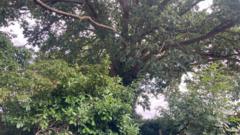
An oak tree surviving for three centuries undergoes profound physiological transformations. At three hundred years, the specimen has typically entered the mature phase of its lifecycle, transitioning toward senescence. The mechanics of survival shift from aggressive canopy expansion to structural stabilization and defense against fungal pathogens.
The core structural challenge involves load distribution. Massive primary limbs develop extensive weight vectors that exceed the mechanical strength of standard wood fiber, relying on internal taproots and a wide-spreading root plate that can span an area significantly larger than the canopy drip line.
[Canopy Load] ---> [Primary Scaffolding Limbs] ---> [Trunk Compression] ---> [Root Plate Anchor]
Nutrient transport over this distance creates hydraulic bottlenecks. Water must ascend against gravity through xylem vessels that have aged over decades, increasing the susceptibility of the tree to drought stress. Furthermore, ancient oaks often develop heartwood decay, a natural process where the central core of the trunk degrades. Contrary to popular intuition, hollow trunks do not necessarily compromise structural integrity; neutral axis physics dictate that a cylinder often bears compressive loads as efficiently as a solid column, provided the outer shell maintains adequate thickness.
The Economic Valuation Problem
Assigning a monetary value to a three hundred year old oak exposes the inadequacy of standard real estate appraisal methods. Traditional market comparisons fail because mature trees are irreplaceable assets. A replacement cost approach using nursery stock is economically absurd; planting thirty ten-year-old saplings does not equal the ecological, aesthetic, or historical utility of a single three-century-old specimen.
Municipalities and arborists utilize specialized valuation formulas, such as the Council for Tree and Landscape Appraisers method or the Visual Tree Assessment framework, to quantify economic worth. These formulas factor in:
- Species longevity and hardiness
- Condition rating based on structural and foliar health
- Functional value including stormwater mitigation, shade provision, and carbon sequestration
- Placement value determined by visibility and surrounding architectural context
Applying these metrics to a mature oak typically yields valuations running into hundreds of thousands of dollars. This financial figure underpins the legal justification for a preservation order. The asset possesses a quantifiable public utility that outweighs the private development rights of the landholder.
Managing the Liability Matrix
Protecting an ancient tree shifts the burden of risk onto the property owner or the municipal authority holding jurisdiction. As a tree ages, the probability of branch failure or catastrophic root plate uplift increases, particularly during high-wind weather events.
The liability framework divides risk into two components: probability of failure and consequence of impact. A dead branch overhanging a quiet garden path presents a low consequence scenario. The same branch suspended over a primary municipal thoroughfare or a residential roof transforms into a high-liability hazard.
Mitigating this risk requires continuous monitoring rather than passive preservation. Arborists must employ advanced diagnostic tools, including resistograph testing to measure internal decay density and sonic tomography to map structural defects without invasive drilling. This level of stewardship demands specialized capital expenditure, creating an ongoing financial drain for private owners who may lack the resources to maintain the asset properly.
The Broader Ecological Matrix
Beyond its immediate physical footprint, a three hundred year old oak functions as a keystone species within an urban or semi-rural ecosystem. The bark fissures, deadwood cavities, and root systems support hundreds of dependent organisms, including specialized fungi, saproxylic insects, birds, and small mammals.
Urbanization fragments these ecological networks. Preservation orders serve as regulatory patches that prevent the complete severing of wildlife corridors. However, preserving an isolated tree in a developed landscape creates an ecological island effect. Without continuous canopy connections or surrounding native understory, the biological community supported by the oak faces genetic isolation and localized extinction risks.
Balancing heritage protection with modern infrastructure demands a shift from reactive legal bans to proactive landscape integration. Planners must establish buffer zones around protected root protection areas, mandating permeable paving solutions and prohibiting subsurface utility trenching within the critical root radius. Without these engineering safeguards, a preservation order functions as little more than a paper shield, protecting the legal status of the tree while permitting slow, systemic environmental degradation beneath the soil.