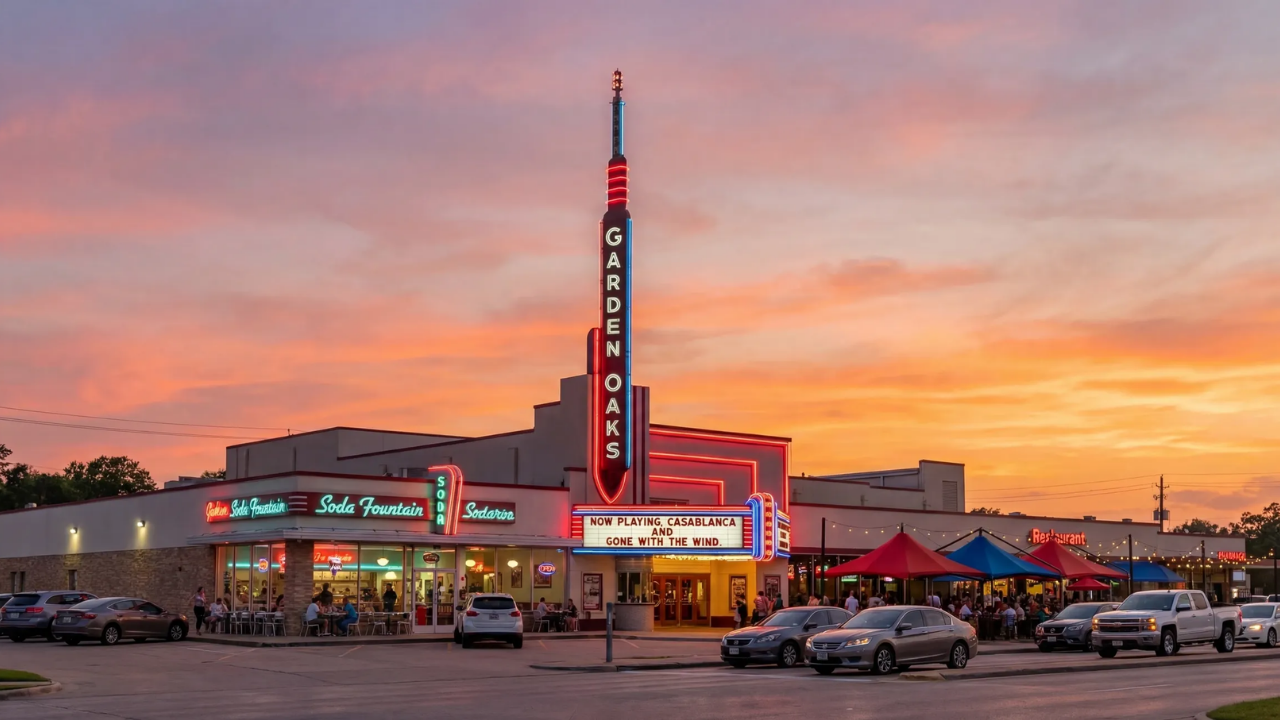
Capital allocation for historic real estate preservation operates under a fundamentally different set of constraints than conventional commercial development. When a community attempts to rescue a mid-century cultural asset like a 1947 Art Deco theater requiring a multi-million-dollar infusion, standard valuation models fail. Historic preservation projects do not trade on projected net operating income alone; they trade on captured civic sentiment, historic tax credit efficiencies, and specialized philanthropic vectors. The recent mobilization of capital to secure the survival of Houston's post-war cinema architecture highlights a recurring friction point in urban planning: balancing the high fixed costs of heritage preservation against the diminishing returns of aging square footage.
Analyzing this asset class requires stripping away romanticized narratives about community nostalgia to evaluate the underlying mechanics. Real estate interventions of this scale rely on a triad of funding mechanisms: private philanthropic commitments, public-private partnership grants, and specialized tax incentives. Without mapping these vectors, any preservation effort stalls at the capital acquisition phase.
The Capital Stack of Heritage Assets
The financial architecture required to rescue a single-screen, mid-century theater deviates starkly from standard multifamily or retail development. The asset class is plagued by deferred maintenance, obsolete mechanical systems, and rigid historic preservation easements that restrict revenue-generating modifications.
Philanthropic donations form the baseline risk capital. Donors giving to cultural preservation are typically motivated by legacy and place-making metrics rather than yield. However, private donations alone rarely cover the total cost of modernizing an outdated building envelope, updating life-safety code compliance, and installing contemporary acoustic and projection systems.
Public subsidies and municipal grants bridge the gap, yet they introduce administrative friction. Municipalities often tie funds to specific job-creation metrics, local economic impact studies, or public accessibility requirements. These conditions increase compliance overhead, stretching project timelines and inflating capital expenditures.
Tax credit monetization represents the third structural pillar. Federal and state historic tax credits can offset a significant percentage of qualified rehabilitation expenditures, but they require complex syndication partnerships. Developers must sell these credits to corporate investors with high tax liabilities, introducing intermediary fees and strict compliance audits that demand specialized legal and financial oversight.
The Economic Mechanics of Single-Screen Obsolescence
A 700-seat auditorium built in 1947 was engineered for an era of high-density, singular-event entertainment. Contemporary audience expectations, however, have shifted toward multiplex optionality, luxury seating, and diversified food and beverage integration. A historic theater operating with its original layout suffers from an inefficient spatial economy.
Seat count directly impacts revenue potential, but modern density standards reduce capacity to improve patron comfort. A reduction from seven hundred fixed seats to a lower, tiered configuration decreases raw ticket volume. To maintain financial viability, the asset must capture higher yield per patron through premium pricing models, private rentals, or multi-use programming.
Operating expenditure curves for historic structures trend upward exponentially over time. Envelope degradation, structural masonry maintenance, and antiquated HVAC demands create volatility in operational forecasting. Unlike modern construction engineered for energy efficiency, a heritage property functions as a thermal and mechanical liability unless retrofitted with precision—a process complicated by historical preservation mandates that prohibit altering exterior profiles or visible interior finishes.
Strategic Playbook for Urban Cultural Assets
Successful turnaround strategies for mid-century entertainment venues abandon the single-use operating model. Relying solely on weekend film screenings or occasional live performances guarantees insolvency under high fixed-cost structures.
Operational diversification dictates long-term survival. The physical plant must function as a multi-modal venue capable of hosting corporate events, private functions, independent film festivals, and community programming. This shifts the revenue mix from a volatile B2C ticket model to a resilient hybrid B2B and B2C model with diversified cash flows across the calendar week.
Capital deployment must prioritize invisible infrastructure before aesthetic restoration. Fixing a marquee or restoring historic neon signage generates immediate public relations value, but upgrading electrical grids, fire suppression systems, and structural integrity prevents catastrophic capital loss down the line. Preservation committees frequently misallocate early funds toward cosmetic improvements to satisfy donors, leaving structural vulnerabilities unaddressed.
Establish a phased capital deployment schedule that ties milestone expenditures directly to audited engineering assessments rather than fundraising benchmarks. Prioritize the syndication of historic tax credits early in the pre-development phase to establish a predictable equity baseline, thereby mitigating reliance on unpredictable philanthropic cycles.