The red light on a television camera is a tiny, glowing executioner. When it flickers on, the air in the studio changes. It thickens. You can hear the hum of the cooling fans, the rustle of a producer’s script in an earpiece, and the frantic heartbeat of the person sitting across from you. For a political pundit, that red light is the gateway to a colosseum where words are weapons and silence is a surrender.
On a recent night at CNN, the pressure cooker finally cracked.
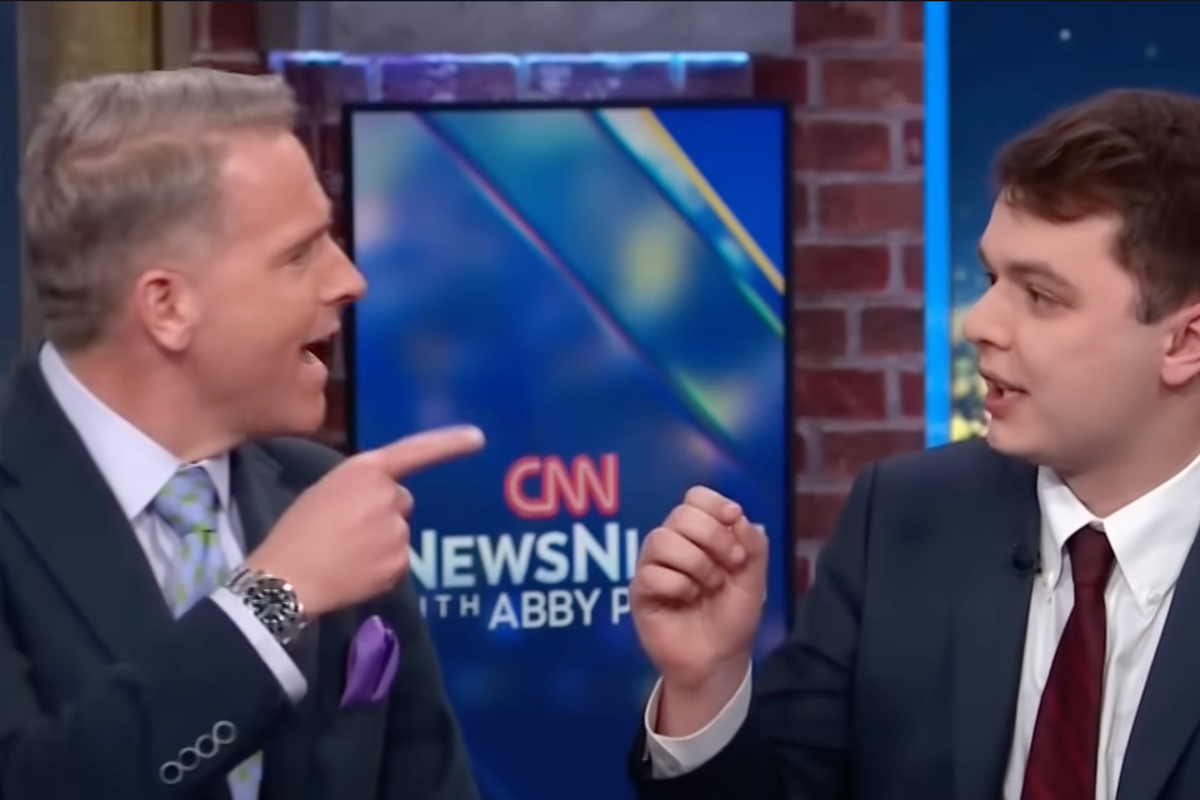
Scott Jennings, a man whose professional life is defined by the calibrated defense of Donald Trump, found himself at the center of a viral moment that wasn't about policy or polling. It was about a word. A sharp, jagged four-letter word that cut through the polished artifice of cable news like a blade through silk. He dropped an F-bomb. Live. To millions of people.
To the casual observer, it was a gaffe. To the internet, it was a meme. But if you look closer at the sweat on the brow and the immediate, stunned silence of the panel, you see something much more human: the total exhaustion of a political discourse that has run out of runway.
The Anatomy of a Crash
Imagine standing on a high-wire every single night. To your left is the base you must satisfy; to your right is the reality of a studio filled with people who fundamentally disagree with your existence. You are paid to be the friction. You are the designated "other" in a room designed to find consensus or, more often, to manufacture conflict.
Scott Jennings has played this role with a certain stoic precision for years. He is the guy who brings the conservative perspective to a network often accused of lacking it. It is a lonely job. You aren't just defending a candidate; you are defending an entire worldview against a phalanx of skeptics.
On this particular night, something gave way. Perhaps it was the sheer repetitive exhaustion of the news cycle. Perhaps it was the specific line of questioning from his colleagues. Whatever the spark, the result was a "crash out." In the parlance of the modern internet, to crash out is to lose your cool so spectacularly that there is no going back. It is the moment the mask slips.
When the profanity left his lips, the oxygen left the room.
Journalist Brian Stelter, a man who has spent more time analyzing the mechanics of cable news than almost anyone alive, was quick to react. He didn't just report the fact that a swear word had been uttered. He tapped into the deeper truth of the moment. He saw the "crash" for what it was: a symptom of a system that is currently red-lining.
The Invisible Stakes of the Panel
We often watch these panels as if they are sporting events. We cheer for our side and hiss at the opponent. We forget that these are people sitting in chairs, under hot lights, experiencing the same psychological toll that any of us would feel if we were forced to argue for our lives every day at 9:00 PM.
Consider the hypothetical producer in the control room. Let's call her Sarah. Sarah sees the waveform of the audio spike on her monitor. She hears the profanity before the delay can catch it—or maybe it doesn't catch it at all. In that split second, her heart drops. Is the FCC going to call? Is the sponsor going to pull out? More importantly, is the guest okay?
Because that’s the part we miss. When a professional communicator loses their grip on the most basic rule of the medium—don't swear—it signals a deeper fatigue. It suggests that the arguments have become so circular, the stakes so high, and the tribalism so intense that language itself is failing us.
The F-bomb wasn't just a lapse in decorum. It was a white flag. It was the sound of a man realizing that the logic he was trying to construct couldn't hold the weight of the moment. When the brain can no longer bridge the gap between a difficult defense and a hostile room, the primitive nervous system takes over. It lashes out.
The Reporter’s Reflection
Brian Stelter’s response to the incident was a masterclass in the very thing the incident lacked: composure. By highlighting the "crash out," Stelter wasn't just poking fun at a rival or a conservative pundit. He was pointing to the absurdity of the entire spectacle.
He was asking us to look at what we’ve built. We have created a media environment that demands 24/7 outrage, that rewards the most extreme version of every argument, and then acts shocked when someone finally snaps. We want the tension, but we pretend to be offended by the release of that tension.
There is a strange hypocrisy in the way we consume these moments. We claim to want "civilized debate," yet the clips that get ten million views are the ones where someone loses their mind. We are the audience in the Roman Forum, claiming to appreciate the architecture while secretly waiting for the lions to be released.
The Weight of the Narrative
Politics in the current era isn't about the "what" anymore. It’s about the "who." It’s an identity struggle played out in three-minute segments.
For someone like Jennings, the weight of representing the pro-Trump wing on CNN is immense. You are the avatar for half the country in a space that feels like enemy territory. Every word you say is scrutinized, clipped, and weaponized. The cognitive dissonance required to navigate that space daily is enough to make anyone’s mental gears grind to a halt.
Think about the last time you had a truly heated argument with a family member over the dinner table. Your face gets hot. Your throat tightens. Your ability to find the "smart" word vanishes, and you reach for the "loud" word. Now, imagine doing that with a camera three feet from your face and a producer screaming in your ear to wrap it up in thirty seconds.
The F-bomb was the most honest thing said on television that night.
It was an admission that the situation is, for lack of a better term, messed up. It was a moment of raw, unvarnished humanity in a medium that is usually scrubbed clean of such things.
Beyond the Profanity
The fallout was predictable. The left-leaning corners of the internet used the clip as proof that the pro-Trump side is "unhinged." The right-leaning corners defended it as a moment of "authentic frustration" against a biased media. Both sides missed the point.
The point is that we are pushing our public figures—and ourselves—into a state of permanent neurological distress. We are living in a world where the quiet part is being said loud, and the loud part is being shouted.
When Stelter noted the crash, he was documenting the breaking point of the American political psyche. It’s not about Scott Jennings. It’s about the fact that we have reached a stage where the only way to express the gravity of our disagreements is to break the rules of the language itself.
We are all sitting in that chair to some extent. We are all trying to navigate a world where the "facts" feel like they are shifting under our feet, where the person across from us feels like an existential threat, and where the red light of social media is always, always on.
The silence that followed the F-bomb was the most telling part of the clip. It was the silence of people who realized, for just a second, that the game had gone too far. It was the silence of a room where the script had been burned, and no one knew what to say next.
We keep waiting for a return to "normalcy," for a time when pundits will trade barbs with a wink and a smile. But that world is gone. The stakes have moved from the cerebral to the visceral. We aren't arguing about tax brackets anymore; we are arguing about the soul of the machine. And machines, when pushed too hard for too long, don't just stop.
They break.
The F-bomb wasn't a mistake. It was a flare sent up from a sinking ship. It was a reminder that behind every talking head, every "pro-Trump pundit," and every "liberal reporter," there is a human being who is just as tired, just as frustrated, and just as overwhelmed as the rest of us.
We watch the crash because we recognize the feeling of the impact.
The screen flickers. The image freezes. The sound cuts to a commercial for a pharmaceutical drug or a luxury car. But the echo of that word lingers in the living room, a small, vibrating reminder that the pressure is still rising, and the vessel is starting to groan.