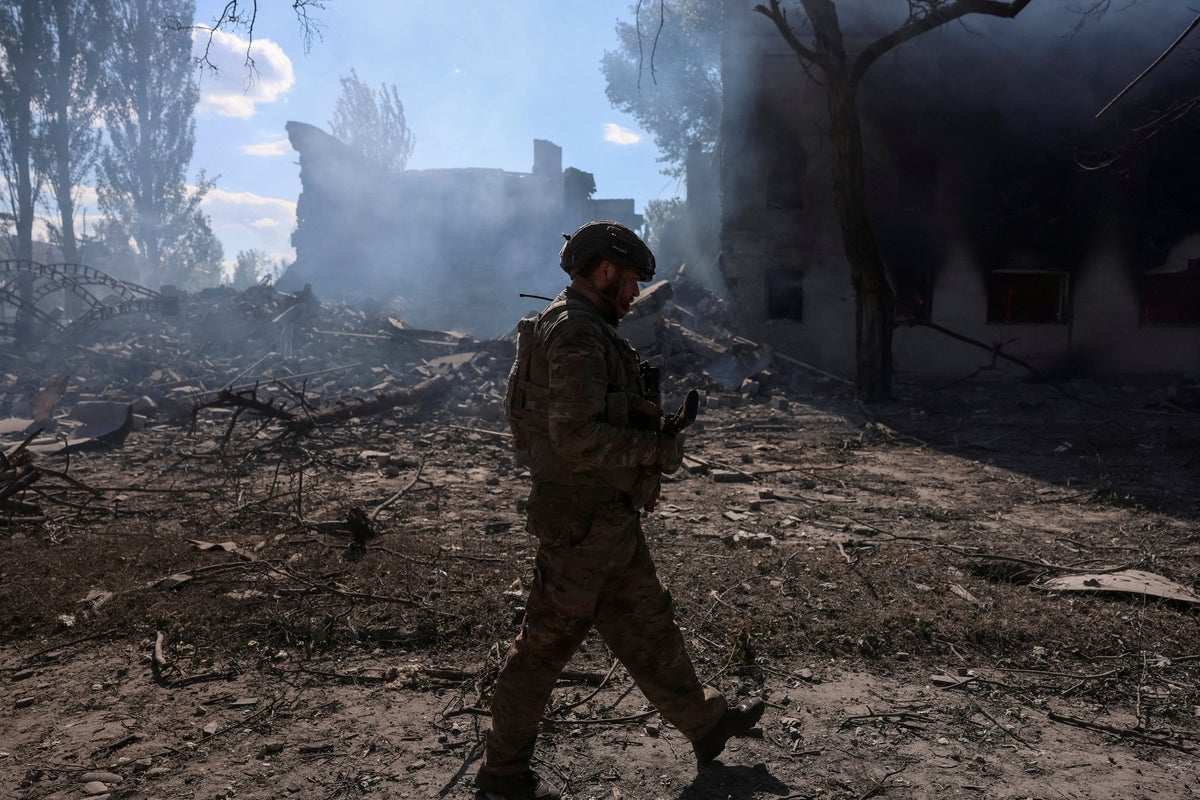
The dirt in eastern Ukraine looks like any other mud when it rains. It turns into a thick, grey paste that clings to the soles of combat boots, clogs the treads of armored vehicles, and fills the deep trenches gouged into the sunflower fields. But for the past six months, this specific stretch of earth has become the most expensive real estate on the planet. Not because of gold or oil, but because of the sheer volume of human life traded to acquire it.
If you stood in the center of a forty-square-kilometer patch of land, you could walk across it in a few hours. It is a speck on a map. It is roughly the size of a small European town, or a fraction of a major western city. Yet, over the last half-year, this minuscule expanse became the focal point of an entire empire's military might. Meanwhile, you can read other stories here: Transatlantic Alignment Mechanics and the Calculus of Strategic Autonomy.
To look at the raw data is to confront a math so brutal it ceases to make sense to the human brain. Half a million casualties. Dead, severely wounded, or missing. Five hundred thousand souls. When a number grows that large, it loses its teeth. It becomes an abstract concept, a column in a spreadsheet, a talking point on an evening news broadcast.
To understand what is happening, we have to shrink the scale. We have to look at the math through a different lens. To understand the bigger picture, we recommend the excellent article by The New York Times.
Consider a hypothetical young man from a small town outside Saratov, thousands of miles from the front lines. Let us call him Dmitry. He is not a career soldier. He was a mechanic who fixed old Ladas and dreamed of buying a house with a small yard. When the mobilization orders came, his life was reduced to a uniform, a rusted rifle, and a seat in the back of an open-top truck heading west.
Dmitry does not see the grand strategy. He does not see the geopolitical chessboards discussed in Moscow or Washington. He only sees the two meters of muddy trench directly in front of him.
When the order comes to advance, Dmitry steps out into the open. The artillery fire has stripped the leaves from the trees, leaving charred splinters reaching toward a grey sky. He runs because running is the only thing keeping the terror from freezing his limbs. He does not make it across the field. A drone, no larger than a child’s toy, drops a small explosive from the clouds.
In the grand ledger of the winter offensive, Dmitry’s life is exchanged for a few centimeters of topsoil.
Multiply Dmitry by hundreds of thousands. That is the reality behind the headline. When you break down the numbers, the Kremlin has traded roughly twelve lives for every single square meter of ground gained over the last six months. Walk into your living room. Look at the rug under your feet. Imagine twelve human histories—births, first steps, schoolyard fights, heartbreak, marriages, quiet Sunday mornings—all erased so that a foreign flag can be planted on a patch of earth no larger than that rug.
This is not warfare in the twenty-first-century sense, where precision weapons and technological superiority dictate the outcome. This is a meat grinder. It is a regression to the worst horrors of the Somme and Passchendaele, where generals measured progress not by strategic breakthroughs, but by how many waves of men they could throw into the fire before the enemy ran out of ammunition.
The true tragedy lies in the absolute asymmetry between the cost and the reward.
For the people living in the path of this advance, the forty square kilometers do not represent a victory. They represent total annihilation. The towns caught in this zone are not captured; they are erased. Avdiivka, Bakhmut, Vovchansk—these are no longer places where people raise children or go to work. They are fields of broken brick, twisted rebar, and unexploded ordnance. The victory is a graveyard.
A volunteer medic working near the front lines recently described the sound of the evening bombardment. It is not a series of explosions, she said, but a continuous, low roar that vibrates through the soles of your feet. It sounds like the earth itself is groaning under the weight of what is being done to it. She spoke of the smell—a mixture of cordite, wet earth, and the unmistakable, sweet scent of decay that hangs over the tree lines where retrieval teams cannot reach.
She confessed that the hardest part is not the blood. It is the notebooks. Every soldier carries a small packet of personal effects. Inside, you find photographs of smiling women, crayon drawings from children wishing their fathers a safe return, and keys to apartments they will never see again. These objects are heavy with unfulfilled futures. They sit in cardboard boxes in makeshift morgues, waiting for families who may not receive official notification for months, if ever.
The strategic reality is even more damning than the moral one. The gain of forty square kilometers does nothing to alter the trajectory of the conflict. It does not secure a major supply line. It does not capture a vital industrial hub. It is a political metric, a way for military commanders to report to the Kremlin that progress is being made, no matter how microscopic.
But the real problem lies elsewhere. The system is designed to consume its own youth to sustain its pride.
In Moscow, the billboards advertise military service as a noble, high-paying career path. The state television networks speak of historical destiny and the defense of the motherland. They do not show the field hospitals filled with amputees. They do not broadcast the quiet weeping in the villages where the young men have simply vanished.
There is an old saying that generals always fight the last war. In this case, they are fighting a war that belongs to a century we thought we had left behind. They are banking on the idea that an authoritarian regime can withstand an infinite amount of grief. They believe that if they pile enough bodies high enough, they can eventually climb over the wall of Ukrainian resistance.
But walls built on bodies are inherently unstable.
The families left behind are beginning to ask questions, even if they must do so in whispers. The mothers of the missing meet in private internet chat rooms, trading fragments of information, trying to trace the last known locations of their sons. They look at the official maps showing the minuscule advances and they try to reconcile those tiny red lines with the vast, empty spaces in their homes.
Consider what happens next: winter will fade, the mud will dry into hard, cracked clay, and a new season of offensives will begin. More columns of armor will roll out of the factories. More men from distant provinces will be handed rifles and told to march toward the horizon.
The conflict has settled into a terrible, rhythmic inertia. It is a machine that requires a constant influx of human fuel just to keep its gears turning. The forty square kilometers gained are not a stepping stone to a grand triumph; they are a monument to the futility of an ambition that refuses to look at its own reflection in the mirror.
On the outskirts of a liberated village just outside the zone of conflict, an elderly woman named Maria stands in what remains of her garden. Her house has no roof. Her windows are covered with plastic sheeting that flaps loudly in the wind. She kneels in the black soil, planting potatoes with gnarled, steady hands.
When asked why she stays so close to the artillery fire, she looks out over the scarred fields toward the horizon where the smoke rises. She says that the dirt belongs to the people who tend it, not the ones who die for it.
The sun begins to set, casting long, dark shadows across the craters that pockmark the landscape. The crows circle overhead, looking for movement in the tall grass. Down in the trenches, the men wait for the night, clutching their weapons, watching the few meters of mud that separate them from eternity.