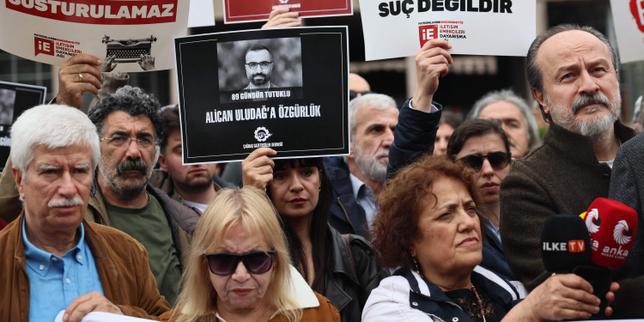
The metal chair in a Turkish courtroom has a specific temperature. It is never warm. For a journalist waiting on a verdict, that cold seeps through layers of clothing long before the judge even looks up from his papers. It is a sensory detail they never teach you in media school, but it is the first thing you notice when the state decides your words are a threat.
We treat press freedom as a grand, abstract concept. We debate it in air-conditioned seminar rooms and write high-minded op-eds about the democratic fabric. But press freedom is not abstract. It is the sound of heavy keys rattling in a corridor. It is the sudden, sickening realization that a tweet written on a rainy Tuesday can determine where you sleep for the next ten years. For an alternative look, see: this related article.
Consider the case of a Deutsche Welle correspondent in Turkey, a reporter whose daily routine of phone calls, coffee, and document-checking was abruptly replaced by the sterile geometry of a courtroom. The official wires reported the facts with clinical detachment: arrested, held, and finally granted conditional release. The headlines were flat. They told us the what but completely abandoned the why.
To understand what actually happened, you have to look past the bureaucratic jargon of the Turkish legal system. Similar coverage regarding this has been published by The Washington Post.
The Illusion of the Open Door
Step into the shoes of a foreign correspondent working in Istanbul. The city is beautiful, a dizzying collision of continents, smells, and history. You wake up, check the wires, and look out over the Bosphorus. But there is a low-frequency hum of anxiety that never quite leaves your ears. You are always balancing on a razor's edge.
On one side is your duty to report the truth. On the other is a penal code that views critical reporting as a form of terrorism.
When the police come, it rarely happens with cinematic drama. There are no flashing lights or sirens. Usually, it is a polite knock early in the morning, or a sudden detour at a passport control desk. The system operates with a terrifying calmness. You are handed papers filled with dense, legalistic prose, accused of spreading propaganda or insulting public officials.
The competitor’s article notes that the Deutsche Welle journalist was released on bail, forbidden from leaving the country, and forced to report to a police station regularly. The wire services frame this as a partial victory. A relief.
It is not a victory. It is a different kind of cage.
Conditional release means the state has simply stretched the walls of your prison to match the borders of the country. You cannot leave. You cannot plan a future. Every week, you must walk into a government building, sign your name on a ledger, and remind yourself that your freedom is a temporary loan, recallable at any moment. The psychological weight of this routine is designed to do one thing: break your will to write.
The Anatomy of the Chilling Effect
How do you silence a room full of people without making a sound? You don't lock everyone up. You just lock up one person, right in the middle of the room, where everyone else can see them.
This is the mechanics of state censorship in the modern era. It relies on a psychological phenomenon known to behavioral scientists as the chilling effect. It is a slow, creeping paralysis.
When a prominent journalist from an international outlet like Deutsche Welle is detained, every independent local reporter in Turkey feels the air grow colder. They look at their own drafts. They delete a sentence. They soften a headline. They ask themselves if a specific quote is worth the risk of a pre-dawn raid.
[The Cycle of Self-Censorship]
High-Profile Arrest -> Public Fear -> Softened Reporting -> Erasure of Truth
The state doesn't need to read your drafts when they can get you to censor yourself. It is an incredibly efficient system. By the time the public notices that the news has grown polite and uniform, the damage is already done. The truth hasn't been banned; it has just been made too expensive to pursue.
The numbers back this up. Year after year, international watchdogs place Turkey near the bottom of the World Press Freedom Index. The country has earned a reputation as one of the world’s leading jailers of journalists. Behind each statistic is a family waiting outside a prison wall, a desk sitting empty in a newsroom, and a story that will never be told.
When the Foreign Desk Goes Quiet
There is a distinct vulnerability that comes with working for a foreign media organization in a hostile environment. You carry a press card that is supposed to shield you, but often acts as a target.
International newsrooms face a brutal dilemma when their staff is targeted. Do they double down on the coverage, risking further retaliation against their people on the ground? Or do they pull back, ensuring safety but leaving a dark spot where information used to flow?
When the Deutsche Welle reporter was detained, it wasn't just an attack on an individual. It was a message sent directly to Bonn and Berlin. It was a statement of sovereignty: Your international status does not protect you here.
The reality of conditional release is that the trial continues. The sword remains suspended over the reporter's neck. The state achieves its goal without the international outcry that accompanies a permanent prison sentence. They look reasonable to the outside world because they granted bail, while still maintaining absolute control over the journalist's life and movement.
It is a sophisticated game of legal cat-and-mouse.
The True Cost of Silence
We live in an age where information feels infinite. We are drowning in content, updates, and opinions. It is easy to assume that if something important happens, we will automatically know about it.
But high-quality, courageous journalism is a finite resource. It requires individuals who are willing to sit in those cold courtroom chairs, who are willing to face the psychological warfare of conditional release, just to tell us what is happening behind closed doors.
When we read a dry five-paragraph story about a journalist's legal troubles in a distant city, it is easy to scroll past. It feels like someone else's problem. A professional hazard for a career choice we didn't make.
But the erosion of free speech is never local. When the light goes out in Istanbul, the shadow stretches everywhere. It distorts the global understanding of politics, economics, and human rights. It alters the decisions made by foreign governments, investors, and international bodies.
The journalist who walks into a Turkish police station this week to sign a registry is not just fighting for their own liberty. They are holding the line for a principle that keeps societies open. They are paying the physical and emotional price for the paragraphs we consume for free while drinking our morning coffee.
The court date will come around again. The lawyers will argue. The judge will look at his papers. And somewhere in the city, a laptop will open, a cursor will blink on a blank page, and a writer will decide whether to tell the truth or stay safe. That silent, agonizing choice is the real story.