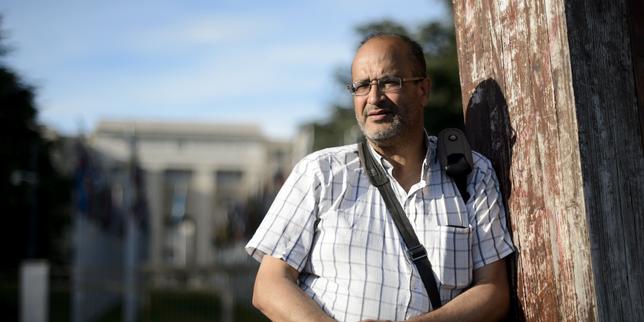
The ink on a Moroccan press card behaves differently than it does elsewhere. It carries a weight that presses down on the chest, a quiet reminder that every syllable traced onto a page or typed into a CMS can be measured in months or years of a human life.
When the news broke that Ali Lmrabet had been interpellated under the heavy banner of "spreading false information," the reaction in newsrooms across North Africa wasn't shock. It was a familiar, cold tightening of the jaw. For journalists operating in the region, the knock on the door isn't a hypothetical plot point in a political thriller. It is a Tuesday afternoon reality.
To understand why a veteran journalist finds himself caught in the gears of the state apparatus yet again, you have to look past the dry legalese of the official charge sheets. You have to look at the anatomy of dissent itself.
The Invisible Ledger
Picture a small, cluttered office in Tangier or Rabat. The blinds are half-drawn against the blinding Mediterranean sun. A laptop hums. On the screen sits a half-finished article exposing a minor discrepancy in local government spending or questioning an official narrative about public order. The writer’s finger hovers over the keys.
In that split second, a complex calculation occurs. It is a calculation of risk, family security, and professional duty. This is the invisible ledger of independent journalism in Morocco.
Ali Lmrabet has been balancing this ledger for decades. He is not a new face to the authorities, nor is he a stranger to the inside of a courtroom. His career reads like a map of the shifting boundaries of Moroccan red lines—those unwritten laws dictating what can be scrutinized and what must remain shrouded in absolute deference.
The official statement is always clean, polished, and clinical. It speaks of protecting public order, safeguarding the integrity of institutions, and upholding the law against the scourge of disinformation. But the truth on the ground is far messier. It is a landscape defined by an elastic legal code where the term "false information" can be stretched to fit almost any narrative that makes power uncomfortable.
The Architecture of the Catch-All Charge
Consider how a modern state manages dissent without looking like a crude autocracy. The methods have evolved. Modern press laws are often sophisticated, filled with clauses that mirror European legislation on hate speech or defamation. Yet, it is the execution that reveals the true intent.
When a journalist is detained for "diffusion de fausses informations," the burden of proof undergoes a subtle, insidious shift. The state does not necessarily have to prove malicious intent or even tangible harm. The mere act of contradicting an official press release becomes prima facie evidence of a transgression.
- The Chilling Effect: It rarely stops with the individual targeted. When one prominent voice is silenced, a hundred minor voices voluntarily lower their volume.
- The Bureaucracy of Detention: The process itself becomes the punishment. Hours of interrogation, the confiscation of devices, the cloud of an impending trial—these elements disrupt a life entirely, even before a judge delivers a final verdict.
- The Narrowing of the Public Square: As independent outlets face pressure, the media ecosystem becomes homogenized, leaving citizens with a single, synchronized melody instead of a chorus of viewpoints.
This isn't just about one man sitting in a police station. It is about the gradual starvation of public discourse. When facts are treated as contraband, rumors fill the void. Ironically, the aggressive prosecution of alleged misinformation often breeds the very distrust and conspiracy theories the state claims it wants to eradicate.
The Room Where the Air Grows Thin
Those who have sat across from interrogators know the specific psychology of the room. It begins with a polite request for clarification. It escalates into a meticulous deconstruction of adjectives. Why did you use the word crisis instead of challenge? Who was the unnamed source behind the third paragraph?
For Lmrabet, this routine is an old acquaintance. His previous publications have been banned, his right to practice journalism has been legally restricted in the past, and his hunger strikes have made international headlines. Yet, the cycle repeats. The state cannot allow the precedent of an unmonitored independent voice, and the journalist cannot accept the premise of a dictated truth.
But the real problem lies elsewhere, far from the dramatic standoffs and international press freedom statements. It lies in the quiet exhaustion of the younger generation of Moroccan writers.
They watch Lmrabet. They see the international outcry, the tweets from human rights organizations, the articles in foreign newspapers. And then they look at their own bank accounts, their own families, and the sheer asymmetry of the fight. They realize that while international prestige is noble, it does not pay rent or guarantee safety when the sun goes down over the Atlantic coast.
The Mirage of the New Era
For years, Morocco has marketed itself as an exception in the region—a stable, modernizing kingdom that avoided the chaotic collapses of the Arab Spring through enlightened reform. To a degree, the infrastructure reflects this. The highways are smooth, the high-speed trains are pristine, and the major cities gleam with foreign investment.
Yet, this economic liberalization has not been matched by a loosening of the grip on information. If anything, the tools of surveillance and control have grown more refined. The old methods of crude censorship—seizing print editions at the border—have been replaced by algorithmic monitoring, tax audits, and targeted legal prosecutions under non-press codes, such as the penal code.
Consider what happens next when a society loses its mirrors. A free press serves as a mirror, showing a nation its flaws, its wrinkles, and its hidden infections. When you break the mirror because you dislike the reflection, the infection doesn't disappear. It merely spreads in the dark.
The detention of Ali Lmrabet is a signal fire. It warns that the boundaries are contracting, that the space for independent scrutiny is shrinking down to the size of a prison cell. It reminds us that information is never truly free; someone, somewhere, is always paying the invoice.


