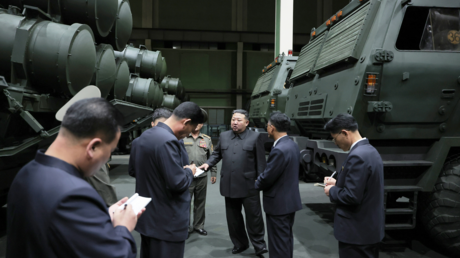
North Korea is aggressively rewriting its doctrine of modern warfare by forcing military artificial intelligence into the core of its tactical infrastructure. Recent directives from Pyongyang signal a formal shift away from sheer manpower toward automated command networks, unmanned aerial systems, and algorithmic targeting. Western analysts often dismiss these announcements as propaganda bluster, but ignoring the structural reality of this modernization effort is a dangerous mistake. The state's defense sector is betting its future on algorithmic systems to offset profound conventional disadvantages against technologically superior adversaries.
For decades, the conventional wisdom held that North Korea military power relied almost exclusively on sheer scale. Millions of active-duty soldiers, massive artillery corps, and deeply entrenched fortifications defined the strategic posture. That doctrine is dying. Economic strangulation, severe energy deficits, and aging hardware have forced a stark realization inside the General Staff Department. Human waves cannot defeat precision guidance, electronic jamming, or networked aerial reconnaissance.
Autonomous systems offer a cheap equalizer. By integrating machine learning into tactical decision-making, Pyongyang aims to close the capability gap without matching the defense budgets of Seoul or Washington. The push centers on three distinct verticals: automated reconnaissance processing, autonomous loitering munitions, and decentralized battle management software.
The Mechanics of Isolation Innovation
Sanctions were supposed to choke off advanced technological development. Instead, they forced an unorthodox engineering culture. North Korean military research institutes operate under severe resource constraints, yet they have managed to harvest foundational machine learning architectures from open-source repositories globally. They do not need to invent state-of-the-art neural networks from scratch. They adapt existing computer vision models for target acquisition and drone swarm coordination.
Consider the operational environment on the Korean Peninsula. It is one of the most heavily monitored, electronically contested spaces on Earth. Traditional radio-frequency communications are vulnerable to immediate jamming by allied forces. To survive in that environment, tactical units require autonomy. Drones must find, track, and strike targets without relying on continuous satellite links or ground station telemetry.
This reality explains the intense focus on edge computing within North Korean military laboratories. By pushing processing power directly onto the hardware, unmanned systems operate effectively during heavy electronic suppression. The strategic objective is clear. Even if central command links go dark, individual nodes on the battlefield retain the capacity to execute pre-programmed kill chains.
Unmanned Systems and the Asymmetric Gamble
The physical manifestation of this doctrine is visible in the proliferation of domestically produced unmanned aerial vehicles. While early models were crude, remotely piloted conversions of civilian crop dusters or hobbyist airframes, recent iterations show a distinct shift toward purpose-built military hardware. Surveillance platforms now feature stabilized electro-optical sensors designed to feed live video streams into image-recognition algorithms.
These algorithms scan terrain for pre-determined military signatures, such as mechanized armor columns or fortified artillery positions. When a match occurs, the system flags the coordinates for human confirmation or, in restricted autonomous modes, initiates a terminal dive.
This evolution mimics trends observed in conflicts from Ukraine to the Middle East, yet it is executed under entirely different economic pressures. North Korean engineers prioritize simplicity, durability, and mass manufacturability over exquisite performance. A drone that costs a fraction of a guided missile, built with readily obtainable commercial components, alters the attrition calculus of modern defense. If you can deploy fifty inexpensive autonomous systems for every single high-end interceptor missile your enemy fires, the economic balance of deterrence shifts dramatically.
The Cyber-Military Nexus
Military artificial intelligence in North Korea cannot be divorced from its cyber warfare apparatus. The Reconnaissance General Bureau has spent decades refining state-sponsored hacking operations, initially for financial theft and espionage. Those same units now serve as the primary research and development incubator for military algorithms.
The pipeline from cyber espionage to battlefield autonomy is direct. Stolen intellectual property, commercial datasets, and foreign research papers are funneled straight into military automation projects. This clandestine acquisition strategy bypasses the traditional R&D cycle. Why spend a decade training neural networks to recognize armored vehicle profiles when you can appropriate pre-trained datasets or synthetic training environments developed elsewhere?
This integration creates a formidable feedback loop. Cyber operations finance and feed the technical requirements of automated warfare, while military imperatives dictate the targets of foreign intelligence gathering.
Strategic Implications for Regional Stability
The democratization of military artificial intelligence means that absolute technological supremacy is no longer the exclusive domain of hyper-powers. When a heavily sanctioned, isolated state successfully embeds autonomous decision-making into its tactical forces, the threshold for regional conflict changes.
Deterrence relies on predictability. Both sides must understand the risks of escalation. Autonomous systems, however, introduce a dangerous layer of computational speed and algorithmic rigidity. When decisions are delegated to software running at machine speed, the margin for diplomatic intervention during a crisis evaporates. A border skirmish or a misidentified radar contact processed by an automated defense grid can escalate far faster than human operators can counter.
Pyongyang is not building a utopian sci-fi military. It is constructing a pragmatic, brutal architecture designed to ensure regime survival through technological leverage. The transition toward broader military artificial intelligence is an admission of past weakness and a calculated bet on future lethality. The international security establishment must stop laughing at the rhetoric and start analyzing the code.


