Silence.
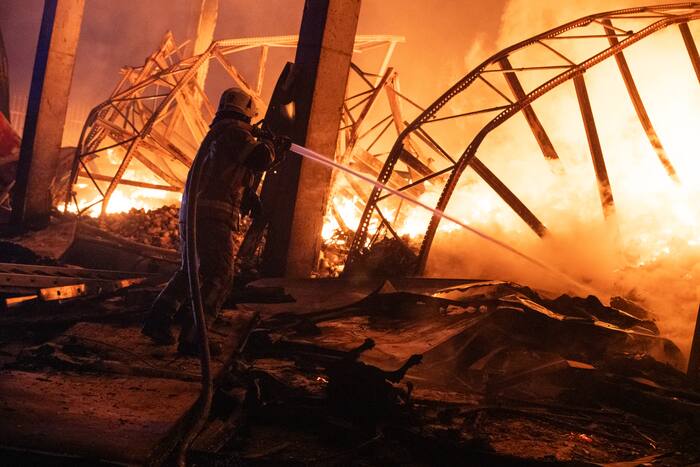
In a war defined by the relentless mechanical hum of reconnaissance drones and the distant, rhythmic thud of artillery across the Dnipro River, silence is never merely the absence of sound; it is a fragile, temporary architecture held up by sheer willpower and back-channel diplomacy. For the residents of Oleshky, a town sitting precariously on the left bank of the Kherson region, silence has been an endangered species for years, replaced by the constant anxiety of living on a contested front line where water levels, power grids, and human lives hang in a permanent state of suspension.
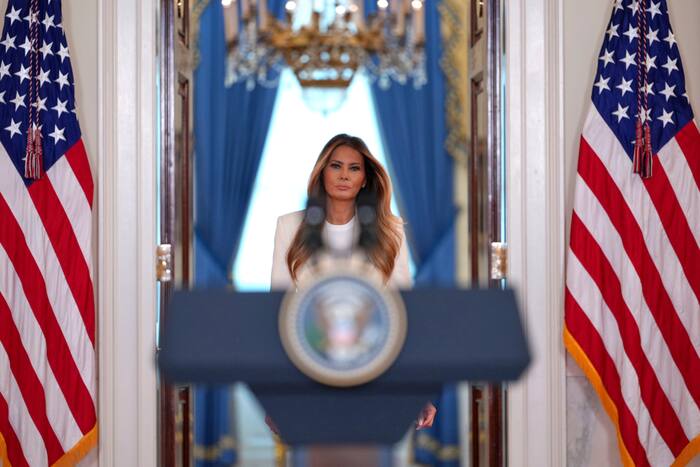
Yet, on a crisp autumn afternoon in Washington, D.C., thousands of miles away from the flooded marshes and shattered concrete of southern Ukraine, that silence found an unlikely stage. Inside the White House, beneath crystal chandeliers and the watchful gaze of portraits painted centuries ago, an envoy dispatched by Vladimir Putin stepped up to a podium. The event was not a grand, sweeping treaty signing between superpowers, nor was it the culmination of months of public summits in Geneva or Vienna; rather, it was a formal acknowledgment of a localized ceasefire in Oleshky, an agreement brokered through the quiet, unexpected intervention of First Lady Melania Trump.
To understand why this moment sent shockwaves through diplomatic circles and left seasoned foreign policy analysts scrambling to rewrite their playbooks, you have to look past the podium. You have to look at the geography of grief.
Consider, for a moment, a hypothetical resident of Oleshky—let us call her Olena, a retired schoolteacher whose world has shrunk to the reinforced concrete cellar beneath her ruined apartment block. To grasp the reality of modern siege warfare, imagine living inside a glass jar while two giants tap on the sides with iron hammers; every vibration threatens to crack your shelter, yet stepping outside means exposing yourself to the elements and the crossfire. For Olena, geopolitical strategy is not an abstract chessboard of NATO expansion or Black Sea naval dominance. It is whether the water pump down the street works on Tuesday, whether an ambulance can reach a neighbor with a failing heart without being mistaken for a military transport, and whether the roof over her head will survive another night of shelling.
For years, Oleshky has existed in a brutal twilight zone. Following the destruction of the Kakhovka Dam in 2023 and the subsequent shifting of the front lines along the Dnipro River, the town became a grim bottleneck of humanitarian need and military fortification. Humanitarian corridors repeatedly collapsed under mutual accusations of bad faith, leaving international aid organizations paralyzed at the water's edge while thousands of civilians—many of them elderly, immobile, or simply unwilling to abandon the only homes they had ever known—remained trapped in the crossfire.
So how did a localized pause in hostilities in a scarred Ukrainian river town end up as the centerpiece of a White House briefing featuring a Kremlin representative and credited to the First Lady of the United States?
The answer lies in the unwritten rules of informal diplomacy, a space where traditional statecraft often stalls and unconventional channels quietly thrive. Throughout history, when formal diplomatic machinery locks up under the weight of public posturing and rigid preconditions, leaders have turned to back channels—emissaries who carry no official portfolio in the military chain of command, allowing both sides to test the waters of compromise without losing face before their domestic audiences. Think of it like a pressure valve on a sealed boiler: when the main pipes are welded shut by political dogma, a secondary, unassuming vent prevents the entire system from blowing apart.
Melania Trump’s involvement in the Oleshky ceasefire did not emerge out of thin air, nor was it a sudden foray into military strategy. Born in Slovenia, raised behind the Iron Curtain in the former Yugoslavia, and acutely aware of the fractured histories of Eastern and Central Europe, she has long maintained a deliberate, enigmatic distance from the daily political brawls of Washington. That very distance became her primary diplomatic currency. Unlike career diplomats or defense secretaries, whose every syllable is parsed as an official shift in American military posture, a First Lady focusing strictly on humanitarian relief—specifically the protection of displaced families, children, and the elderly trapped in war zones—occupies a moral territory that is notoriously difficult for adversaries to attack outright without looking callous on the global stage.
According to accounts surrounding the White House event, the groundwork for the Oleshky agreement began months earlier, rooted in quiet conversations concerning child welfare, medical evacuations, and the preservation of civilian infrastructure along the Dnipro. By framing the Oleshky corridor not as a territorial concession or a strategic pause, but as a strictly humanitarian imperative, the back channel bypassed the paralyzing deadlocks that had doomed previous negotiations. It offered Moscow a way to signal flexibility to Washington without appearing to yield to Pentagon pressure, while giving the White House a tangible, human-scale breakthrough in a conflict that had grown increasingly intractable.
Still, watching a Putin envoy speak inside the White House is a jarring visual, one that naturally triggers deep skepticism and discomfort among observers who have watched years of broken promises and shattered ceasefires. If you feel a knot of doubt tightening in your stomach when you hear the words "Kremlin envoy" and "ceasefire" in the same sentence, you are not alone; history gives us every reason to be wary. From the failed Minsk agreements to the repeated collapse of localized truces in Mariupol and Bakhmut, the landscape of this war is littered with the wreckage of inked promises that lasted barely longer than the press conferences announcing them.
Critics immediately pointed out the obvious risks. Does hosting a Russian representative at the White House lend legitimacy to an occupation? Could a localized pause in Oleshky simply allow Russian forces along the left bank of the Dnipro to rotate troops, repair logistics lines, and dig deeper trenches under the cover of humanitarian goodwill? These are not cynical questions; they are the exact calculations military planners make every hour of the day. In warfare, charity and strategy are rarely separated by a clean line.
But the real problem lies elsewhere, hidden beneath the binary arguments of hawks and doves: the assumption that doing nothing is somehow safer than risking an imperfect truce.
When diplomacy freezes entirely, the only remaining language is ammunition, and the people paying the translation fees are the ones living in the cellars of Oleshky. A localized ceasefire is not a grand peace treaty, nor does it magically resolve the profound questions of sovereignty, justice, and accountability that hang over Eastern Europe. Rather, it is an emergency tourniquet applied to a bleeding artery—it does not heal the wound, and it cannot stay on forever, yet without it, the patient dies before ever reaching the operating table.
During the White House event, the Russian envoy’s remarks were characteristically measured, stripped of the fiery rhetoric usually reserved for state television broadcasts in Moscow, focusing instead on the technical logistics of the Oleshky corridor: demining routes, establishing neutral inspection checkpoints, and allowing international medical teams to cross the river without threat of drone strikes. Standing just steps away from the symbols of American executive power, the envoy acknowledged the direct role played by Melania Trump’s office in keeping the communication lines open when official channels had gone entirely dark.
The contrast could not have been sharper. On one hand, you had the rigid, transactional language of Kremlin statecraft; on the other, an initiative driven by a First Lady who rarely grants interviews, speaking through actions that bypassed the traditional State Department apparatus altogether.
The Anatomy of a Back-Channel Breakthrough
To understand why this specific arrangement worked where larger summits failed, we have to look at the mechanics of trust in high-stakes conflict. In traditional negotiations, both sides arrive with exhaustive lists of non-negotiable demands. Ukraine rightly demands the restoration of its territorial integrity and the withdrawal of invading forces; Russia demands security guarantees and the recognition of its territorial claims. When those two maximalist positions collide at a negotiating table, the table breaks.
Back-channel diplomacy shrinks the room. Instead of trying to solve the entire war in a single stroke, it isolates a single, undeniable human crisis—in this case, the suffocating humanitarian siege of Oleshky—and asks a much simpler question: Can we stop shooting in this specific five-mile radius for long enough to let doctors in and civilians out?
Historically, this approach has precedent. During the Cuban Missile Crisis in 1962, when formal cables between the White House and the Kremlin were taking hours to decode and translate while the world stood minutes away from nuclear annihilation, back-channel meetings between Robert Kennedy and Soviet Ambassador Anatoly Dobrynin—and even informal intermediaries like ABC News correspondent John Scali—provided the off-ramp that saved millions of lives. Decades later, during the height of the Cold War, First Ladies from Eleanor Roosevelt to Nancy Reagan used cultural and humanitarian initiatives to humanize the stakes of superpower rivalry, creating subtle atmospheric shifts that made harder political compromises possible down the road.
Melania Trump’s intervention in Oleshky follows that exact lineage, adapted for the chaotic, hyper-mediatized reality of the twenty-first century. By keeping the negotiations strictly out of the press until the framework was already locked in place, her team denied hardliners on both sides the opportunity to sabotage the talks through public grandstanding. There were no leaked draft memos, no breathless cable news countdowns, and no performative walkouts. The first time the public truly grasped the scope of what had been built was when the Putin envoy stepped up to the microphone at the White House to confirm that the guns in Oleshky were going quiet.
What Silence Sounds Like on the Left Bank
Let us return to Olena, our hypothetical schoolteacher in her concrete cellar, because the true measure of any White House press event is not found in Washington punditry, but in the mud and shattered brick of Kherson.
When a ceasefire takes hold in a place like Oleshky, the transformation is not cinematic. Nobody marches through the streets waving flags or singing anthems; years of occupation and bombardment beat that kind of theatrical optimism out of people long ago. Instead, the change is measured in small, almost imperceptible permissions.
It is the permission to walk outside at noon without scanning the gray sky for the tiny, fatal silhouette of a quadcopter. It is the sound of diesel generators humming steadily at a field hospital without the immediate fear that their heat signature will draw a mortar strike. It is the arrival of heavy trucks bearing insulin, antibiotics, clean drinking water, and winter blankets across a river that has served as a watery grave for far too long. For the aid workers of the International Committee of the Red Cross and local volunteers who have spent years waiting at checkpoints with idling engines and expiring medical supplies, a ceasefire is the difference between watching a crisis on a monitor and actually touching a patient's wrist.
Of course, the fragility of such an arrangement cannot be overstated. In any active war zone, peace is an uninvited guest that every stray bullet threatens to evict. A single rogue commander, a misunderstood drone flight, or a sudden shift in tactical priorities along the southern front could shatter the Oleshky truce before the ink on the logistical annexes is fully dry. We have seen localized ceasefires collapse within hours, leaving civilians stranded in the open when the shelling abruptly resumes. Acknowledging that terror—the sheer vulnerability of trusting an adversary to hold their fire while you step out from behind a concrete wall—is essential to understanding the courage required of the people on the ground.
Yet, dismissing the Oleshky ceasefire because it is small or fragile misses the entire point of how wars actually begin to end. Rarely does a brutal, multi-year conflict stop all at once across a thousand-mile front. More often, peace begins as a series of localized experiments—a single port opened for grain shipments, a single prisoner swap completed at a border crossing, a single river town granted a reprieve from the artillery. Each small agreement tests whether the opposing side can enforce discipline within its own ranks; each successful day of quiet builds a microscopic layer of precedent that makes the next conversation slightly less impossible.
The Shift in Diplomatic Gravity
In Washington, the spectacle of a Russian envoy addressing reporters from the White House grounds forced an immediate recalibration among foreign policy insiders. For months, the prevailing wisdom in think tanks and editorial boards had been that diplomacy with Moscow was completely dead, locked in a deep freeze until decisive battlefield victories forced one side to capitulate. Melania Trump’s quiet brokerage shattered that orthodoxy, demonstrating that unconventional actors—operating outside the rigid hierarchies of the National Security Council and the State Department—can sometimes unlock doors that career diplomats cannot even approach.
It also revealed a deeper truth about power and perception. In an era where every political gesture is instantly weaponized on social media, the most effective statecraft often happens in the shadows, driven by individuals who do not need daily applause to validate their relevance. By anchoring the Oleshky initiative firmly in humanitarian relief rather than political triumphalism, the First Lady created a rare diplomatic space where saving human lives took precedence over scoring ideological points.
Consider what happens next along the Dnipro River, not in the briefing rooms of Washington or the gilded halls of the Kremlin, but in the quiet hours just after dawn in Oleshky.
For the first time in years, the morning mist rises off the dark, slow-moving water without being torn apart by the shriek of incoming shells. Along a narrow, freshly demined road leading toward the river crossing, an elderly woman steps out from the doorway of a scarred brick building, blinking against the pale light, her hand resting on the doorframe as she listens to the strange, unfamiliar sound of wind moving unobstructed through the bare branches of the trees.