Seven seconds.
That is roughly the time it takes to tap a transit card, step through a metal turnstile, and emerge from the cool, fluorescent hum of an underground rail station into the blinding, relentless glare of a Southern California afternoon. You blink against the sun. You adjust the strap of a heavy backpack or shift a bag of groceries from one aching hand to the other. You are thinking about dinner, or a delayed paycheck, or the simple, muscle-memory relief of finally heading home. You are standing on concrete, surrounded by dozens of strangers sharing the exact same mundane transition, completely certain that the four-inch curb at your heels is an impenetrable wall separating your fragile body from two tons of moving steel.
Until it isn't.
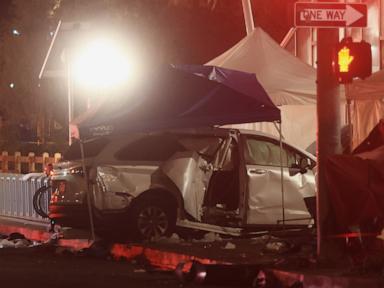
When a minivan jumped the curb outside a Los Angeles Metro station, striking a crowd of commuters and killing three people on the spot, the local news cycle processed the tragedy with its usual, practiced efficiency. Helicopters hovered. Traffic anchors pointed at red dots on digital maps. Headlines reduced a violent, shattering rupture in the fabric of a neighborhood into twelve sterile words about a vehicle, a transit hub, and a body count. We read the dispatch, wince at the bad luck of the victims, and scroll onward, subconsciously filing the event away as an unpredictable act of god—a freak mechanical failure, a sudden medical emergency, a random lightning strike on a Tuesday afternoon.
We lie to ourselves that way because the alternative is too terrifying to hold. If a crash outside a Los Angeles Metro station is not a freak accident, then it is a design flaw. And if it is a design flaw, then every single one of us who has ever stood waiting for a bus, unlocked a bike from a rack, or walked up the stairs from a subway platform is standing on a stage built for a tragedy that hasn't quite happened yet.
The Architecture of Exposure
To understand what really happened on that concrete plaza, you have to stop looking at the minivan and start looking at the asphalt around it.
Consider a hypothetical commuter—let’s call her Elena, though she could be any of the hundreds of thousands of riders who rely on Los Angeles Metro every day. Elena works a double shift in a downtown hotel kitchen. Her feet ache before she even reaches the train. When she climbs the station stairs into the open air, she is stepping into a zone of total sensory overload. Los Angeles does not build its transit hubs in quiet, pedestrian-only sanctuaries; it drops them directly into the throats of multi-lane arterial boulevards that function less like city streets and more like high-speed racetracks.
Picture the geometry of that space. Four, sometimes six lanes of traffic surge past the station entrance at forty-five or fifty miles per hour, separated from Elena’s shins by nothing more than a sliver of painted white line and a concrete lip no higher than a coffee mug. To an engineer, that four-inch curb is a drainage channel meant to guide rainwater toward a storm grate. To the human brain, it is a psychological security blanket. We treat that tiny step as if it were a fortress wall.
It is an illusion. A modern minivan weighs roughly 4,500 pounds. Moving at forty miles per hour, it carries enough kinetic energy to turn a four-inch concrete curb into a launchpad rather than a barrier. Without steel bollards, reinforced planters, or grade-separated walkways, the space outside a station is completely defenseless against human error. A driver glances down at a glowing phone screen for two seconds. A tie rod snaps. A heart skips a beat. A foot slips from the brake to the accelerator in a moment of panic. In the blink of an eye, the boundary between the highway and the sidewalk vanishes, and the people waiting for a ride home become collateral damage in a system that prioritized vehicle throughput over human survival.
I have stood on those exact station plazas hundreds of times, feeling the chest-rattling thrum of passing semi-trucks vibrating through the soles of my sneakers, watching SUVs whip around right-turn corners inches from toddlers holding their mothers' hands. You learn to develop a sixth sense in Los Angeles—a constant, low-grade vigilance where your eyes flick toward oncoming headlights even when the walk signal is bright white. You tell yourself that paying attention will keep you safe. Yet when a vehicle leaves the roadway at speed, reaction time is a myth. There is nowhere to run when your back is against a concrete station wall or a crowded bus shelter.
The Numbers Behind the Asphalt
If you ask why a transit agency would place thousands of vulnerable pedestrians inches away from fast-moving traffic without physical protection, the answer reveals a deep, historical schizophrenia in how American cities are built.
For decades, Los Angeles was engineered exclusively around the private automobile. Streets were widened, corners were smoothed into sweeping curves so cars wouldn't have to slow down to turn, and sidewalks were shaved down to narrow strips of leftover real estate. Then, belatedly, the city began pouring billions of dollars into a sprawling rail and bus network, trying to stitch a modern transit system onto a street grid designed for 1950s car culture.
The result is a dangerous collision of two incompatible worlds. Transit riders are, by definition, pedestrians at both ends of their trip. Every single train ride begins and ends on foot. Yet the moment a passenger exits Metro property and steps onto the municipal sidewalk, responsibility fractures. The transit agency controls the underground tunnels and the ticket machines; the city’s department of transportation controls the streets and curbs. Between those two jurisdictions lies a deadly gray zone where safety improvements stall in endless environmental reviews, budget debates, and fears of slowing down commuter traffic.
The statistics tell a bleak, undeniable story. Across the United States, pedestrian fatalities have surged to their highest levels in forty years, and Los Angeles consistently ranks among the deadliest major cities for people on foot. According to data tracked by safety advocates and municipal reports, roughly 65 percent of severe and fatal traffic crashes in Los Angeles occur on just 6 percent of the city's streets—the exact high-speed, multi-lane corridors where Metro stations are concentrated.
Even more troubling is who bears the brunt of this exposure. Transit ridership in Southern California is overwhelmingly working-class, disproportionately Black and Latino, and heavily reliant on walking to reach their destinations. When a crash happens outside a Metro station, it is rarely a random distribution of risk. It is the predictable consequence of placing our least-protected infrastructure in the communities that rely on public transit the most.
What Happens in the Split Second
People often ask what causes a driver to plow into a crowd on a sidewalk, searching for a villain to blame so the rest of us can feel absolved. Was the driver intoxicated? Distracted? Reckless?
Sometimes the answer is yes. Negligence behind the wheel is real, and accountability matters. Yet focusing solely on the driver’s moral failings misses the larger, more uncomfortable truth: human beings are fallible, and we will never achieve perfection behind the wheel. People will always sneeze, drop their keys, misjudge a turn, or suffer sudden medical episodes. A safe transportation system does not assume that drivers will never make mistakes; it assumes that mistakes are inevitable and designs the physical environment so that a single lapse in judgment does not become a triple homicide.
Consider the physics of impact. When a pedestrian is struck by a vehicle traveling at twenty miles per hour, the survival rate is roughly 90 percent. At thirty miles per hour, that survival rate drops to around 50 percent. At forty miles per hour—the routine cruising speed on almost every major boulevard flanking a Los Angeles rail station—the odds of surviving a direct impact plummet to less than 15 percent.
Now add the weight and front-end geometry of modern vehicles. Over the past fifteen years, American roads have been overtaken by heavier, taller minivans, SUVs, and pickup trucks with high, blunt hoods. Unlike older sedans, which tended to strike an adult pedestrian below the center of gravity—causing them to roll onto the hood—tall, flat-fronted vehicles strike victims directly in the chest and head, throwing them forward onto the pavement where they are far more likely to be run over. When a heavy minivan mounts a curb into a dense cluster of people waiting near a station entrance, the physics are merciless. There is no crumple zone for a human ribcage.
The Concrete Remedy
The most infuriating aspect of a crash outside a Metro station is not that it happened, but that we already know, with absolute certainty, how to stop it from happening again.
Walk through the plazas outside government buildings, major sports arenas, or high-end retail districts in the very same city, and you will see a completely different visual language. There, sidewalks are lined with heavy, steel-reinforced bollards anchored four feet into the earth, thick concrete planters, and raised curbs engineered to stop a speeding truck dead in its tracks. We know how to protect buildings and VIPs from errant vehicles. We simply choose not to extend that same physical armor to the ordinary workers waiting for a train.
Changing that reality does not require futuristic technology or sci-fi infrastructure. It requires political will and a shift in what we value:
- Physical perimeter hardening: Installing crash-rated bollards and reinforced concrete barriers along the curb edges directly adjacent to all Metro station entrances, bus bays, and pedestrian queuing areas.
- Speed management on station corridors: Narrowing travel lanes, tightening corner turning radii so cars cannot whip around intersections at high speeds, and enforcing automated speed limits within a quarter-mile radius of every transit hub.
- Dedicated pedestrian plazas: Reclaiming adjacent slip lanes and underused asphalt around station portals to create buffered, car-free buffer zones where riders can gather, orient themselves, and transfer between buses and trains without standing inches from live traffic.
Some drivers will complain that narrower lanes and tighter turns add ninety seconds to their morning commute. Traffic engineers will warn about level-of-service delays at peak hours. Those arguments evaporate the moment you stand at a makeshift memorial of wilted flowers, melted prayer candles, and handwritten cardboard signs taped to a scuffed concrete wall outside a train station. No one’s five-minute convenience is worth three lives.
The Empty Space on the Platform
In the days after a fatal crash, the news vans pack up their satellite dishes and roll away. City crews sweep up the shattered headlight glass, scrub the dark stains from the concrete, and replace any bent metal signposts. By the following Monday, the station looks identical to the way it did before. The turnstiles still beep. The escalators still rumble. The afternoon sun still hits the pavement at the exact same blinding angle.
Three families, meanwhile, are learning how to navigate a silence that will never be filled. Somewhere across the city, a dinner table has an empty chair. A phone buzzes with unanswered text messages. A set of house keys sits untouched on a hallway counter, belonging to someone who did everything right—who bought a fare card, walked to the station, stood on the sidewalk where they were told to stand, and trusted that the city around them was built to keep them alive.
The next time you step out of a station into the daylight, pause for a second before you walk toward the street. Look down at the thin line of concrete beneath your shoes, look out at the river of steel rushing past your knees, and ask yourself what is actually standing between you and the road.


