Diplomacy usually smells like stale coffee and dry-cleaned wool. It happens in windowless rooms where people in identical dark suits trade rehearsed smiles, carefully calibrated handshakes, and paragraphs of dense, bloodless prose. We watch it on the evening news and feel nothing, because nothing in those frames looks like a human life.
Then, someone opens a wooden box.
Inside rests a square of hand-knotted silk from Srinagar, or a sheet of beaten gold pressed onto black cloth in Rajasthan. Suddenly, the temperature in the room shifts. The cameras zoom in. A prime minister leans forward, pointing at the microscopic loops of a Kashmiri carpet or the heavy, metallic sheen of a Golden Pichwaai painting. For thirty seconds, the geopolitics of trade tariffs, defense pacts, and border disputes step back. In their place stands an old woman in a stone courtyard, her fingers stained with natural indigo, or a fourth-generation painter grinding mineral pigments with a mortar and pestle.
This is the quietest weapon in modern statecraft. Over the past decade, Prime Minister Narendra Modi has turned the ancient Indian tradition of upahaar—the ceremonial gift—into a deliberate, unmistakable foreign policy signature. While standard diplomatic protocol often defaults to crystal vases, commemorative coins, or generic luxury pens, New Delhi has spent years curating a traveling gallery of rural Indian craftsmanship.
To understand why a piece of painted cloth or a woven rug matters on the global stage, you first have to understand what happens when those gifts are missing.
The Weight of the Generic
Consider a hypothetical scenario that plays out in diplomatic corridors every single week. Imagine two heads of state meeting in Geneva or Brussels. Their aides have spent months negotiating a bilateral agreement. When the cameras finally click on for the photo opportunity, the visiting leader hands over a silver-plated bowl manufactured in an automated factory three hundred miles from their capital. The host smiles, accepts it, and hands it off to an assistant before the door even closes. Within forty-eight hours, that bowl is cataloged in a government basement archive, stripped of any memory, destined to gather dust beside a hundred other identical bowls.
No story was told. No bridge was built. The transaction was sterile.
When I first started reporting on international summits years ago, I used to treat the gift exchange as the most boring five minutes of the press schedule. I would use that time to check my phone, verify the spelling of a minister's name, or hunt for a power outlet. To me, it was pure pageantry—filler between the speeches that actually moved markets.
I was wrong. I realized just how wrong I had been during a winter trip to Kashmir, sitting on the cold concrete floor of a tiny workshop in Budgam.
The air in the room smelled of damp wool and kerosene heaters. Across from me sat a master weaver in his late sixties, his knuckles swollen from four decades of pulling knots tight against a vertical wooden loom. He wasn't reading a pattern. A young boy sat beside him, chanting a coded rhythmic song—the talim—that translated mathematical coordinates into color changes. Two red, four saffron, one midnight blue. The old man's fingers moved faster than my eyes could track, tying up to four hundred knots per square inch.
When I asked him how long a single six-by-four-foot carpet took to finish, he didn't look up from the warp threads. "Fourteen months," he said softly. "Sometimes two years, if the winter is hard and my hands stiffen."
Months later, sitting in a press briefing room halfway across the world, I saw that exact style of carpet—a vibrant, silk-on-silk Kashmiri masterpiece—unrolled between Prime Minister Modi and a foreign dignitary. Watching the broadcast, I couldn't see the statesman anymore. I could only see the cold concrete floor in Budgam, the swollen knuckles, and the boy singing numbers into the dusty air.
Gold Leaf and Temple Walls
To grasp the strategy behind Modi's gift list, you have to look closely at the objects themselves. They are rarely chosen at random, and they almost never come from metropolitan luxury boutiques. Instead, they are pulled directly from the districts of India where survival depends on keeping dying art forms breathing.
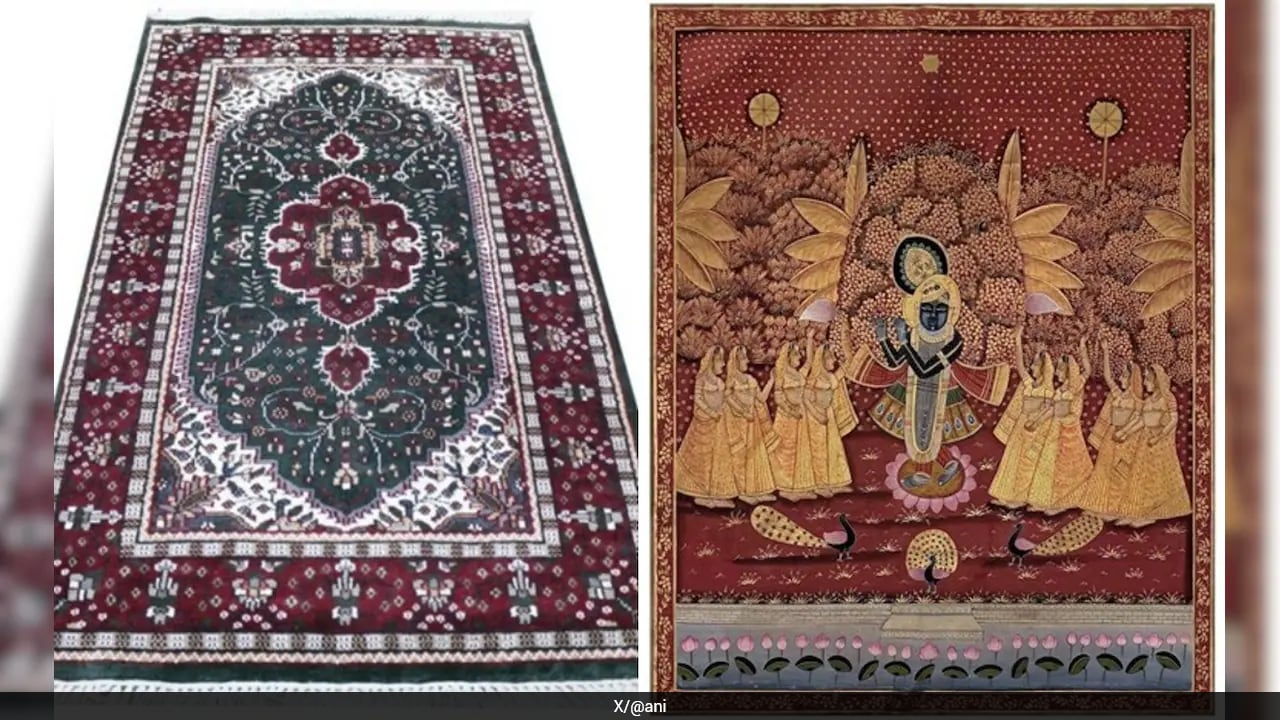
Take the Golden Pichwaai painting, a gift Modi has presented to select world leaders, including during high-stakes European and G20 summits. To an untrained eye, a Pichwaai looks like an opulent, decorative wall hanging. In reality, it is a four-hundred-year-old devotional technology born in the temple town of Nathdwara, Rajasthan.
Originally painted on heavy starched cotton to hang behind the idol of Shrinathji—a manifestation of Lord Krishna—Pichwaai art was designed to tell stories to worshippers who could not read. The word itself comes from pich (back) and wais (hanging). When artisans create a Golden Pichwaai, they are not using synthetic metallic paint. They use real, twenty-four-karat gold leaf and stone pigments crushed from lapis lazuli, malachite, and cinnabar.
Think about the audacity of placing that object into the hands of a Western technocrat or a Gulf monarch.
A modern leader lives in a world of quarterly projections, digital dashboards, and rapid news cycles. A Golden Pichwaai takes months of agonizing, meditative labor. The artist must burnish the gold with an agate stone until it catches the slightest flicker of candlelight. By gifting it, India is making a subtle, unspoken argument: We are not a newly minted economic upstart. We are a civilization that measures time in centuries, and we still possess the patience to turn raw stone and gold into devotion.
It is soft power stripped of arrogance. Instead of lecturing a foreign counterpart about India's gross domestic product or manufacturing capacity, the gift places the physical evidence of Indian skill directly into their palms.
The Geography of a Suitcase
If you map out the origins of the gifts Modi has carried across the globe over the last ten years, you end up drawing a detailed economic atlas of rural India. Every item carries a hidden political and economic payload.
Consider the sheer variety of what has left New Delhi in diplomatic cargo holds:
- From Gujarat: Rogan paintings from Kutch, where artisans boil castor oil for two days until it turns into a thick, glossy paste, then pull it into hair-thin threads using a metal stylus to draw intricate Tree of Life motifs. Or Patan Patola textiles, double-ikat silk saris so mathematically complex that a single miscalculation in dyeing the threads ruins six months of work.
- From Uttar Pradesh: Gulabi Meenakari brooches and cufflinks from Varanasi—delicate pink enamel work on pure silver that traces its lineage back to Persian craftsmen invited to the Mughal court, kept alive today by a handful of families near the Ganges.
- From Himachal Pradesh and Ladakh: Hand-knitted Kullu shawls and Pashmina stoles, woven from the fine undercoat of Changthangi goats living at fourteen thousand feet above sea level.
- From Tamil Nadu and Karnataka: Channapatna lacquerware toys turned from ivory wood and colored with turmeric and indigo, alongside intricate Thanjavur paintings inlaid with semi-precious stones.
Notice a pattern here? None of these items are mass-produced. Almost all of them carry Geographical Indication (GI) tags—legal protections that certify an object could only have been made in one specific valley, village, or cluster of streets.
This is where the human narrative collides with hard economics. India's handicraft and handloom sector is the second-largest employer in the country after agriculture, supporting millions of households, predominantly women and marginalized rural communities. Yet for decades, these artisans lived on the edge of financial collapse. Cheap synthetic knockoffs flooded local bazaars. Young people abandoned family looms to drive delivery scooters in Bengaluru or lay bricks in Dubai because art couldn't pay for school fees.
When the Prime Minister of India hands a Rogan painting to a foreign president, the photograph flashes across every major newspaper from Mumbai to Madurai the next morning. Suddenly, a craft that urban Indians had dismissed as "old-fashioned" becomes aspirational. The phone in a tiny mud-walled studio in Kutch starts ringing. Export orders trickle in. The value of the craft rises, not because of a government subsidy, but because of global prestige.
Reading the Room Through Objects
What fascinates me most isn't just that these gifts are Indian; it's how sharply they are tailored to the psychology and history of the recipient. Great diplomacy requires empathy—the ability to step inside another nation's skin and see what it values most.
Let's look at how this plays out in practice.
When Modi gifted a pair of Kashmiri carpets to international counterparts during recent global summits, the choice carried an unmistakable geopolitical subtext. Kashmir is often reduced in international headlines to a flashpoint of security tensions and territorial disputes. By presenting a luxury silk carpet woven in the Kashmir Valley—and highlighting the artisan community behind it—New Delhi subtly reframed the region's story. The message wasn't delivered through a defensive press release; it was woven into the silk itself. Look at this beauty. This is what happens when peace and tradition hold.
Or consider the gifts chosen for leaders in East Asia, such as Japan or South Korea. Here, the diplomatic thread shifts from shared commerce to shared spiritual ancestry. Modi has frequently presented Bodhi tree saplings, sandalwood Buddha statues from Karnataka, or Dokra metal-cast sculptures—a four-thousand-year-old lost-wax casting technique practiced by tribal artisans in Chhattisgarh and West Bengal.
A Dokra figurine is rough, raw, and unmistakably ancient. It looks nothing like the polished chrome of modern Seoul or Tokyo. Yet to a Japanese or Korean leader, a statue of the Buddha carved in Indian sandalwood touches a deep cultural nerve, recalling the monks who carried texts across the Himalayas two millennia ago. It reminds both sides that their relationship predates modern borders by thousands of years.
Even when the recipient comes from a culture with vastly different aesthetic traditions, the matching is surgical. When gifting to leaders in the Middle East, the selection often leans toward intricate calligraphy-adjacent geometric patterns, marble inlay work from Agra—the direct descendants of the craftsmen who built the Taj Mahal—or pure saffron from Pampore. When meeting leaders in Africa or Latin America, the focus frequently turns to tribal Gond paintings from Madhya Pradesh, vibrant depictions of nature, animals, and community life that resonate across continents.
The Vulnerability of the Gesture
Still, I sometimes wonder if the gesture gets lost in the noise of modern politics. We live in a cynical age. Critics often dismiss diplomatic gift-giving as empty theater—a shiny distraction meant to soften hard-edged negotiations over oil prices, immigration visas, or climate financing.
There is truth in that skepticism. A hand-woven Pashmina shawl will not resolve a trade deficit. A Golden Pichwaai will not alter a country's voting record at the United Nations Security Council. If the underlying strategic interests clash, all the gold leaf in Rajasthan won't glue them together.
I've watched press conferences where a foreign leader accepts an extraordinary piece of Indian heritage, praises its beauty for ten seconds, and then immediately pivots to a tough, unyielding question about market access. In those moments, the gift looks fragile. Almost naive.
Yet, dismissing it entirely misses how human beings actually make decisions. Nations don't sign treaties; people do. And people are creatures of memory, pride, and sensory experience.
Think of an analogy from everyday life. Suppose you are negotiating a difficult business partnership with someone you barely know. The numbers are tight, the trust is thin, and both sides are guarded. If they hand you a printed corporate brochure, you toss it on your desk and forget it. But if they bring you a jar of honey harvested by their grandfather, or a hand-carved wooden pen from their hometown, and explain how it was made, the dynamic shifts. You still negotiate hard on the numbers. You don't give away the store. But you stop viewing the person across the table as an abstract adversary. You see them as someone who belongs to a specific place, with roots that run deep.
That is the exact psychological space where cultural diplomacy operates. It doesn't replace hard power; it lubricates it. It creates a sliver of warmth in rooms designed to be cold.
The Hands Behind the Curtain
To appreciate the full arc of this story, you have to follow the object backward—away from the red carpets of Washington, Paris, or Tokyo, back down the supply chain to the workshops where the dust settles on the floor.
In the town of Varanasi, down an alley too narrow for a motorcycle, an artisan works under a single bare LED bulb. He is applying gulabi meenakari—translucent pink enamel—onto a tiny silver peacock. The heat from his small furnace makes the tiny room stifling even in January. If he leaves the silver in the fire three seconds too long, the delicate glass powder bubbles and ruins the piece. If he pulls it out too early, the color stays dull and chalky.
For years, his craft was fading. Young people in his neighborhood didn't want to burn their fingers over a tiny furnace for a few hundred rupees a day. Then, a few years ago, the Indian government began sourcing his family's work for state gifts—cufflinks for visiting dignitaries, brooches for heads of state.
Suddenly, the local newspapers printed his name. Tourists began walking down his narrow alley, asking to see the workshop where the "Prime Minister's gifts" were made. Apprentices started knocking on his door again.
This is the invisible stake of the entire enterprise. When a Golden Pichwaai or a Kashmiri carpet travels aboard Air India One, it isn't just carrying India's diplomatic goodwill outward. It is pulling global oxygen back into rural workshops that were suffocating from neglect.
Every knot tied in Srinagar, every flake of gold leaf hammered in Nathdwara, every drop of boiled castor oil stretched across cotton in Kutch becomes a quiet act of survival. The artisan doesn't attend the G20 summit. They don't sit at the banquet table, and their names rarely make it into the official joint statements released to the press.
Yet, when the cameras flash, and two of the most powerful people on earth lean over a wooden box to admire the shimmer of thread and gold, it is the artisan's fingerprints that hold the room together.