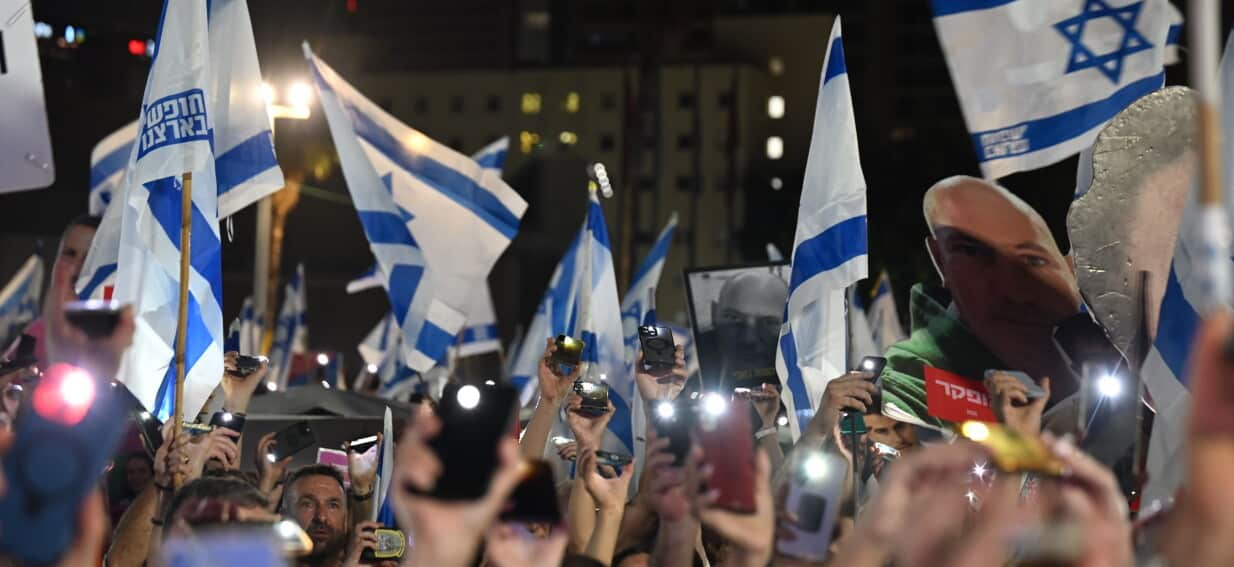
Cold rain has a particular way of settling into the cobblestones of Wenceslas Square. It does not pour. It lingers, soaking through wool coats and turning the breath of thousands of strangers into a single, rising cloud against the pale gray sky of Prague.
They came carrying cardboard signs with hand-painted letters, umbrellas slick with mist, and memories that stretched back much further than the evening news cycle. To an outsider glancing at a brief wire dispatch, the gathering looked like a routine dispute over bureaucratic accounting—another European capital arguing over television taxes and state budgets.
Look closer.
Nobody stands in the freezing drizzle for three hours over a line item on a government spreadsheet unless that line item holds the oxygen of their democracy.
For months, a quiet battle has been unfolding inside the halls of the Czech parliament over the future of Czech Television and Czech Radio. The proposals on the table—debated fiercely by lawmakers, media unions, and civic groups—center on sweeping changes to how public service broadcasters are funded, governed, and held accountable. On paper, the reforms promise modernization, fiscal discipline, and relief for households tired of paying mandatory broadcast fees. In the streets of Prague, however, thousands of citizens saw something entirely different taking shape beneath the polite language of administrative restructuring.
They saw a leash being fitted around the neck of independent journalism.
The Architecture of a Slow Silencing
To understand why a crowd swells in the heart of Bohemia over television funding, you have to strip away the jargon of media policy and look at how power actually operates in the twenty-first century.
Tanks no longer roll up to radio stations at dawn. Censors rarely sit in newsrooms with red pencils, crossing out forbidden paragraphs before the morning edition goes to press. Modern pressure on public media is infinitely more subtle, wrapped in the language of efficiency, taxpayer fairness, and budget reform.
Consider a hypothetical evening in a small apartment in Brno—a composite of thousands of real households across the Czech Republic. Let us call the resident Hana, a retired high school history teacher who remembers the days when the evening broadcast was scripted by party officials and scrubbed clean of any uncomfortable truth. Every month, a modest fee goes toward funding Czech Television and Czech Radio. It is not a subscription to a streaming service; it is a civic utility, paid directly by citizens so that journalists answer to the public rather than to whichever political coalition happens to hold power that season.
Now imagine what happens when that direct cord between the citizen and the newsroom is severed.
Under proposals that have sparked intense debate in Prague—ranging from shifting funding directly into the central state budget to altering the fee structures and expanding political oversight through parliamentary boards—the financial survival of public broadcasters becomes tethered to the annual goodwill of politicians. If an investigative program uncovers a conflict of interest in a ministry, nobody has to ban the broadcast. Nobody has to arrest the reporter. All a government has to do is trim the budget allocation the following autumn, delay an inflation adjustment, or stack the oversight council with compliant voices.
Self-censorship does the rest.
Editors begin to hesitate before greenlighting a sensitive inquiry. Producers start calculating the political cost of a tough interview. Slowly, almost imperceptibly, sharp investigative reporting softens into harmless cultural programming and polite panel discussions that offend no one in power.
That is what brought the protesters out into the damp Prague air. They were not marching to defend bureaucrats or bloated studio budgets. They were marching because they recognized the early tremors of a pattern that has already reshaped Central Europe.
Ghosts on the Cobblestones
Memory in Prague is not an abstract museum exhibit; it is architectural, carved into the facades of buildings that still bear the pockmarks of 1968.
Less than a kilometer from where demonstrators gathered, the historic headquarters of Czech Radio stands on Vinohradská Street. In August 1968, when Warsaw Pact tanks rolled into Czechoslovakia to crush the Prague Spring, unarmed citizens built barricades of overturned buses and cobblestones outside that very building. Broadcasters stayed on the air until soldiers breached the doors, whispering coordinates and pleading with the world to watch as their country went dark.
Twenty-one years later, during the Velvet Revolution of November 1989, the battle for truth returned to the streets. For days, state television ignored the massive demonstrations shaking the country, broadcasting banal entertainment while hundreds of thousands of people jingled their keys in Wenceslas Square. Only when journalists inside the television headquarters revolted against their own managers and broadcast live footage of the protests did the regime’s monopoly on reality finally shatter.
When Czechs talk about public media, they are not talking about a theoretical civic ideal borrowed from a political science textbook. They are talking about a battle they bled for twice in living memory.
I still remember the first time I walked past the memorial plaques outside the Czech Radio building on a gray November afternoon. Tourists were rushing past with cameras, snapping photos of the Art Nouveau facades, completely unaware of the names etched into the stone beside the entrance. Those names belonged to ordinary people—students, drivers, clerks—who died defending a microphone because they understood that whoever controls the signal controls what a nation believes is real.
You carry that awareness with you when you listen to politicians argue that public media funding is "outdated" or "unfair to taxpayers." The words sound reasonable. Even persuasive. Until you remember what silence sounds like when the signal goes dead.
What Is Actually at Stake in the Reforms
Strip away the political theater, and the conflict in Prague comes down to two competing visions of what public media is supposed to be.
For years, the Czech Republic relied on a household license fee model—a system common across much of Europe, including Britain’s BBC and Germany’s ARD and ZDF. Every household with a television or radio receiver paid a fixed monthly fee directly to the broadcasters. Because the fee had remained frozen for over a decade while inflation climbed steadily, Czech Television and Czech Radio faced shrinking real budgets, forcing them to cut regional bureaus, scale back original programming, and stretch newsroom resources thin.
When lawmakers began debating reforms, the friction erupted on multiple fronts.
On one side, critics of the current system—including populist opposition figures and some fiscal conservatives—argued that forcing citizens to pay a mandatory fee regardless of whether they watch public channels is an anachronism in the age of on-demand streaming. Some proposed abolishing the license fee altogether and funding public broadcasters directly from the state budget. Others pushed to narrow the definition of public service, restrict digital expansion, or overhaul the councils that appoint directors and audit finances.
On the other side, journalists, media unions, cultural figures, and tens of thousands of citizens sounded the alarm.
Why does moving funding from a household fee to the state budget matter so much? Because a state budget is a political weapon.
When money flows directly from households to a public broadcaster, the government of the day cannot easily turn off the tap without passing new legislation in full view of the public. When money comes out of the central treasury, however, public media has to line up every year alongside hospitals, highways, defense ministries, and pension funds, begging the finance minister for its survival. Even the implicit threat of a budget cut acts as a quiet brake on aggressive journalism.
We do not have to guess how this story ends. We only have to look across the borders.
In Hungary, state-funded public media was systematically hollowed out over a decade, transformed into an echo chamber where opposition voices receive minutes of airtime while government narratives dominate around the clock. In Poland, years of political capture turned public television into a partisan megaphone before a fierce, messy battle to restore independence began. In neighboring Slovakia, sweeping legislative changes abolished the existing public broadcaster altogether and replaced it with a new entity under tighter state control, triggering mass resignations and international condemnation.
Prague looked at Bratislava, Budapest, and Warsaw—and saw a mirror of its own possible future.
The Invisible Anchor in a Fractured Information World
It is easy to dismiss public television as a relic. Younger generations get their news from algorithmic feeds, short-form videos, and encrypted messaging channels. Why fight over traditional broadcasters when anyone with a smartphone can launch a podcast from their bedroom?
Because algorithms do not send correspondents to flood-ravaged villages in Moravia at three in the morning.
Private media companies, squeezed by collapsing advertising revenues and tech monopolies, have spent the last fifteen years shuttering local desks and cutting expensive investigative units. Clicks reward outrage, speed, and tribal validation; they rarely pay for six months of document digging into public procurement fraud or a dedicated correspondent reporting from a war zone.
Public service media, at its best, does the unglamorous, expensive work that the market refuses to subsidize. It maintains regional reporters in forgotten industrial towns. It produces documentaries on history and science that would never survive commercial ratings pressure. It provides a shared factual baseline—an imperfect, argued-over, yet indispensable common ground where citizens of opposing political views still encounter the same verified reality.
Without that anchor, a society does not simply enjoy more "media choice." It fractures into isolated informational tribes, each fed a customized stream of grievances, where compromise becomes impossible because nobody agrees on the basic facts of the day.
Let us be honest about the flaws, too. Public broadcasters are never above criticism. They can be bureaucratic, slow to adapt, occasionally blind to perspectives outside urban centers, and frustratingly defensive when challenged. Anyone who has watched debates over public media knows that defenders sometimes romanticize institutions that desperately need modernization and sharper accountability.
Acknowledging those flaws does not weaken the case for independent public media; it makes the argument honest. You do not fix a leaky roof by burning down the house. You repair the structure while keeping the foundation intact.
The Sound of Keys and Cardboard
By late afternoon in Prague, the dampness had seeped into everyone’s boots.
Speakers took the stage—actors, historians, union representatives, young students who had grown up in a free republic and older citizens who had spent half their lives waiting for one. Between speeches, the crowd murmured, shifted weight from one cold foot to the other, and lifted their signs whenever cameras panned across the square.
One handwritten placard near the front edges of the crowd carried just four words in bold black ink: Public, not state.
The distinction fits on a piece of cardboard, yet entire democracies rise and fall on the space between those two words. State media belongs to the rulers. Public media belongs to the people—messy, imperfect, fiercely contested, and accountable to the citizens who pay for it coin by coin.
When the speeches ended and the crowd began dispersing toward the metro stations and narrow side streets of the Old Town, nothing in the parliamentary statute books had changed overnight. No bill had been withdrawn on the spot. The committees would still meet; the amendments would still be debated; the political maneuvering would continue behind closed doors in the weeks ahead.
Yet something unmistakable had been registered in the cold air above the square.
A warning had been delivered without a single raised fist. Thousands of ordinary people had stepped away from their warm kitchens, their weekend errands, and their screens to stand together in the rain and remind their leaders of a simple, stubborn truth: you can rewrite the budget lines, and you can redraw the organizational charts, but you cannot quietly turn off the lights while the whole city is watching.