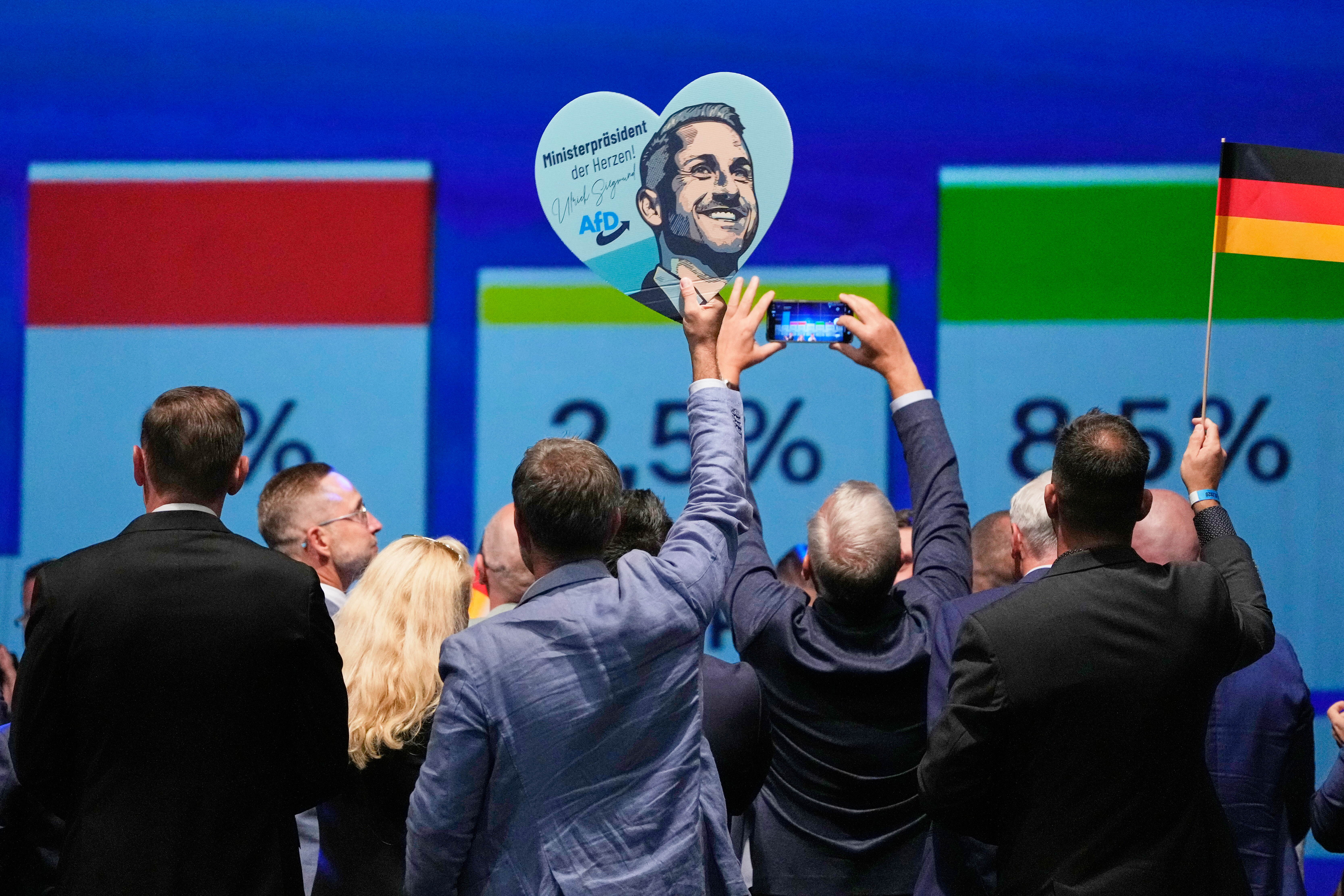
The air in Magdeburg smelled faintly of diesel exhaust and damp autumn leaves as the digital clock above the municipal square ticked past six. Across the flat, wind-swept plains of Saxony-Anhalt, the polling stations locked their heavy wooden doors. Inside the makeshift television studios of Berlin, broadcasters braced themselves for numbers that would rewrite the grammar of modern German politics. When the projections flickered onto the screens, they revealed a tectonic shift.
For thirteen years, the Alternative for Germany had existed on the outer fringes of the democratic experiment, treated by the political establishment as a loud, unwelcome ghost at the feast. But on this Sunday evening, that ghost materialized with undeniable weight. Exit polls showed the far-right party surging to roughly forty-four percent of the vote, more than doubling its previous share. In towns where abandoned factories rust beneath gray skies, the ballot box became a blunt instrument of accumulated grievance.
Consider the ordinary rhythm of life here. A local baker named Thomas, whose family has kneaded bread in the shadow of the Harz mountains for three generations, watched his monthly gas bill climb while his profit margins vanished. To talk to Thomas about macroeconomic indicators is to speak a foreign language. He does not care about federal growth forecasts or distant parliamentary debates in Berlin. He cares about the price of flour, the empty storefronts on his local high street, and a persistent, gnawing sense that the world his parents built after the reunification has quietly eroded away.
This is the emotional core of the surge. It is not born of sudden ideological radicalization, but of a profound, marrow-deep exhaustion. For decades, the eastern states absorbed the shocks of deindustrialization, population drain, and a cultural transition dictated almost entirely from the wealthy west. When mainstream parties promised renewal, the promises arrived late and felt hollow. Into that vacuum stepped a political movement offering simple, unfiltered anger packaged as salvation.
The architectural shield of post-war German democracy has always been the Brandmauer—the political firewall designed to isolate the radical fringe and prevent any cooperation with extremist elements. Mainstream leaders from Chancellor Friedrich Merz’s Christian Democratic Union insisted the wall would hold. They repeated the vow that no coalition would ever be formed, no compromise ever struck. Yet walls look very different when the ground beneath them is liquefying. With the CDU’s support cut in half, tumbling down to eighteen percent after ruling the region for nearly a quarter-century, the arithmetic of governance threatens to break the old certainties.
Ulrich Siegmund, the thirty-five-year-old face of the regional party, represents a new breed of populist operator. Polished, camera-ready, and fluent in the algorithmic rhythms of social media, he arrived to cast his ballot not in a sleek ministerial limousine, but on a vintage East German moped. The theater was deliberate. It bridged the nostalgic ache for a simpler past with a sharp, uncompromising posture toward the present. His platform is built on sweeping promises of rapid deportations, the dismantling of progressive educational curricula, and a direct challenge to the federal status quo.
Behind the soaring rhetoric lies a logistical nightmare for the rest of the country. Even with a commanding plurality, the path to actual power remains tangled in procedural deadlock because other political forces refuse to yield. This creates a dangerous political suspension. The voters have spoken with thunderous volume, demanding radical change, yet the institutional machinery resists absorption.
History teaches us that societies do not fracture overnight. They fray slowly, thread by thread, until a single evening exposes the vast distance between the governing class and the governed. Standing in the chilly dusk outside a polling station in Tangermünde, watching supporters cheer under the glare of camera lights, the reality settles in. Germany has entered uncharted territory. The debate is no longer about whether the political center can hold, but what will rise in its place when the walls finally give way.