Silence.
That is the first thing you notice when a political storm hits the corridors of Washington—not the shouting on cable television, not the frantic typing in press rooms, but the sudden, heavy quiet that settles over the people whose actual lives hang in the balance of what happens next. Read more on a related subject: this related article.
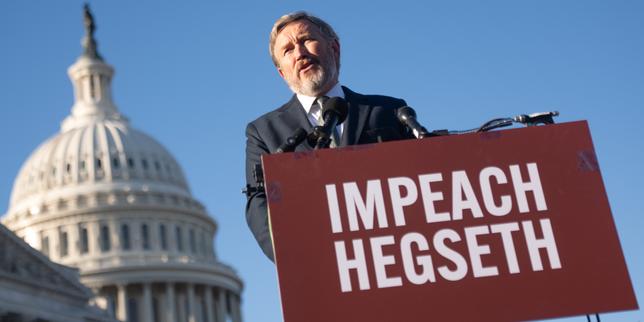
Consider a hypothetical defense analyst, we will call her Elena, sitting in a windowless office inside the E-Ring of the Pentagon. She is thirty-four years old, drinks lukewarm coffee out of a chipped ceramic mug, and spends twelve hours a day tracking logistics chains in the Indo-Pacific. When news breaks that members of Congress are pushing to impeach Secretary of Defense Pete Hegseth—and that Hegseth himself has dismissed the entire effort as a "farce"—Elena does not immediately turn on a pundit panel. She stares at her spreadsheet. She wonders which procurement sign-offs will stall while senior leadership prepares for oversight hearings. She wonders how an ally in Tokyo or Manila reads the headline.
To understand why a single word like "farce" carries so much weight right now, you have to step outside the partisan arena and look at the machinery underneath. Further analysis by Reuters delves into comparable views on this issue.
The Weight of a Word in Washington
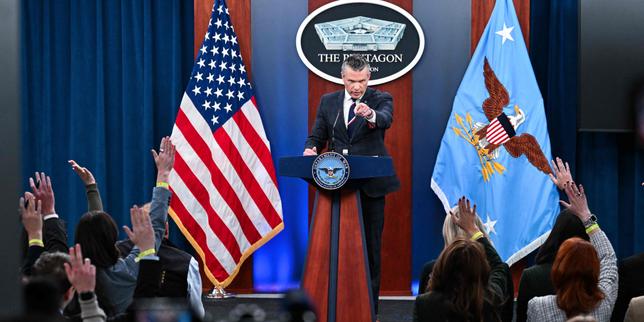
When Defense Secretary Pete Hegseth publicly characterized the impeachment push against him as a "farce," he was employing one of the oldest and sharpest rhetorical shields in American political history. According to public statements and reporting surrounding the Congressional efforts, Hegseth and his defenders argue that the move is purely theatrical—a partisan weapon wielded by political opponents rather than a legitimate constitutional check on executive authority.
On the other side of the aisle, the lawmakers leading the charge frame the situation in starkly different terms. In their public filings and floor speeches, Democratic critics and oversight advocates contend that the impeachment inquiry is a necessary response to serious questions regarding leadership conduct, policy execution, and accountability at the highest level of the Department of Defense.
Two completely irreconcilable realities. One side sees a constitutional emergency; the other sees a political circus.
For anyone who has ever worked inside a large institution—whether a military command, a public hospital, or a sprawling school district—this kind of deadlock feels painfully familiar. Think of the Pentagon not as a monument of concrete and steel, but as an enormous, intricate clock. Thousands of tiny gears turn in unison so that a supply ship leaves San Diego on time, a cyber-defense unit patches a vulnerability before dawn, and a service member stationed overseas receives their pay on the first of the month. Impeachment is the constitutional equivalent of pulling the emergency brake on that clock to inspect the mainspring.
If the mainspring is broken, pulling the brake saves the mechanism from destroying itself. If the mainspring is fine, pulling the brake simply grinds everything to a halt for nothing. That disagreement over the state of the mainspring is the exact fault line dividing Capitol Hill today.
How We Got Here Without Noticing the Drift
To see why this confrontation feels both shocking and strangely inevitable, it helps to look at how the constitutional tool of impeachment has evolved over the past two centuries.
When the framers of the United States Constitution drafted Article II, Section 4, they deliberately left the phrase "high Crimes and Misdemeanors" open to interpretation. They knew they could not predict every future abuse of power, so they trusted Congress to exercise sober judgment. For nearly two hundred years, that mechanism remained locked behind thick glass, used only in the rarest moments of national crisis.
In the case of a Cabinet official, the precedent is even rarer. Only once in American history has a Cabinet secretary been impeached: Secretary of War William Belknap in 1876, who resigned minutes before the House voted on articles accusing him of taking kickbacks in exchange for trading-post appointments. For nearly a century and a half afterward, Cabinet impeachments existed largely as footnotes in constitutional law textbooks.
Then the temperature in Washington began to rise. Over recent decades, and accelerating sharply in the modern media era, the threshold for invoking impeachment has shifted. What was once treated as a last resort after exhaustive bipartisan investigation increasingly became an early-stage political battleground. Critics of recent impeachment drives argue that turning an extraordinary constitutional remedy into a routine tool of political combat dilutes its power—much like crying wolf until nobody looks up from their phone when real danger arrives.
Yet defenders of the current push against Hegseth counter that history judges inaction just as harshly as overreach. In their view, failing to use constitutional oversight tools when facing what they describe as unacceptable governance sets a precedent that executive officials are entirely beyond reach.
I remember sitting in a briefing room years ago during an earlier congressional standoff, watching a senior civil servant try to explain to a group of junior staffers why a budget freeze had nothing to do with their performance reviews. You could see the exhaustion in his posture. When political warfare becomes permanent, the people tasked with keeping the country running learn to keep their heads down, delay bold decisions, and wait for the storm to pass. That hesitation has a real, measurable cost, even if it never shows up on a balance sheet.
Inside the Oversight Battle
So what is actually happening behind closed doors as this dispute unfolds?
In the House of Representatives, proponents of the impeachment effort have focused on building a formal record, pointing to specific decisions, public controversies, and administrative actions during Hegseth’s tenure that they argue violate public trust or undermine military readiness. Under the Constitution, a simple majority vote in the House is required to impeach a federal official, which sends the matter to the Senate for a trial. There, a two-thirds supermajority is required for conviction and removal from office.
Given the current political arithmetic in Congress, even many political analysts who track Capitol Hill closely note that the path to actual removal in the Senate faces steep mathematical odds. Hegseth and his allies point directly to those numbers as proof of their argument. If the votes to convict are not there, they ask, what is the point of the exercise other than generating headlines and fundraising emails?
That question cuts to the heart of why so many ordinary citizens feel disillusioned when they read the news. It is genuinely confusing—and more than a little unsettling—to watch two groups of elected leaders look at the exact same set of facts and arrive at opposite conclusions about what loyalty to the Constitution demands. You do not have to be a cynic to wonder whether the truth is being served or simply drafted into a partisan army.
Yet political scientists and constitutional scholars often point out that impeachment proceedings serve functions beyond the final Senate tally. Historically, formal inquiries compel document production, force sworn testimony under penalty of perjury, and place disputed actions permanently into the Congressional Record. Supporters of the inquiry argue that transparency itself is the objective—that the public deserves answers under oath, regardless of how the final vote breaks down along party lines.
The Invisible Stakes Beyond the Beltway
Step back for a moment from the procedural chess match and look at the human geography of the Department of Defense.
Roughly three million people—active-duty service members, reservists, National Guard troops, and civilian employees—work under the umbrella of the Pentagon. Most of them do not live in Washington, D.C. They live in places like Fayetteville, North Carolina; Killeen, Texas; Bremerton, Washington; and overseas bases from Ramstein to Okinawa.
Picture a young sergeant in an armored brigade in Texas, cleaning gear after a field exercise while a television in the breakroom flashes a chyron about the Defense Secretary calling impeachment a farce. For that sergeant, national politics is not an abstract debate over constitutional theory. Chain of command is the bedrock of military life. Clarity, stability, and trust in leadership are what allow people to follow difficult orders in dangerous places.
When leadership at the very top becomes consumed by existential political battles, the friction travels downward. Senior commanders spend hours preparing talking points and fielding inquiries instead of focusing exclusively on training and readiness. Foreign partners watch closely, calculating whether American defense policy will remain consistent six months from now or veer sharply depending on which political faction gains the upper hand.
At the same time, ignoring legitimate accountability concerns carries its own corrosive danger. A military and defense establishment that answers to civilian oversight is one of the defining pillars of American democracy. If service members and citizens alike come to believe that high-ranking officials operate without meaningful checks and balances, trust erodes from the inside out.
What Comes Out of the Smoke
There is no clean, cinematic resolution waiting at the end of a showdown like this. Real governance rarely offers the neat moral clarity of a courtroom drama.
What happens next will likely unfold across two parallel tracks. On Capitol Hill, lawmakers pushing the impeachment effort will continue pressing for hearings, documents, and floor action, testing whether they can build enough momentum to force a formal vote. Inside the Pentagon, Pete Hegseth and his team will continue dismissing the campaign as political theater while attempting to project business-as-usual authority over defense policy, budgets, and global operations.
Both sides are betting on the same ultimate judge: the American public. They are gambling that voters will look at the conflict and see either a principled stand for accountability or a reckless abuse of congressional power.
Back in that hypothetical windowless office in the E-Ring, Elena eventually finishes her cold coffee, saves her logistics spreadsheet, and locks her workstation for the night. Outside the Pentagon walls, traffic crawls across the Potomac bridges under a gray autumn sky. Inside, the lights stay on, the secure phones keep ringing, and millions of small gears keep turning—waiting to see whether the people at the top are fixing the clock, or tearing it apart to prove a point.