The man who raked his leaves every Tuesday in a quiet American suburb looked like anyone else’s grandfather. He wore faded flannel shirts, waved at the postal carrier, and kept his porch light on until ten. For decades, his neighbors knew him only as a soft-spoken immigrant who had escaped unspeakable violence in East Africa, a survivor who rarely spoke of the past and always returned a borrowed snow shovel clean.
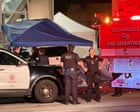
Then, on a crisp morning, unmarked federal sedans pulled up to the curb. For another view, read: this related article.
Silence.
Within hours, the routine of a suburban cul-de-sac collided with the blood-soaked ledger of 1994, when a Rwandan man living quietly in the United States was taken into custody and placed on a trajectory back toward Kigali to face genocide charges. To read the standard wire reports about a Rwandan deportation is to encounter a sterile procession of immigration statutes, visa fraud indictments, and extradition treaties. Those reports tell you what happened. They rarely tell you what it feels like to stand in the doorway of a life built on an omission, watching thirty years of carefully constructed normalcy dissolve into handcuffs and boarding passes. Further insight on the subject has been provided by BBC News.
The Architecture of a Borrowed Life
Consider a hypothetical scenario—a composite drawn from the documented patterns of dozens of real immigration fraud and human rights prosecutions over the past twenty years. Imagine a man we will call Jean-Baptiste. In the spring of 1994, Jean-Baptiste was a mid-level administrator in a Rwandan commune, a man with a stamp, a ledger, and a position of local authority. When the machetes came out and the radio broadcasts turned neighbors into targets, survival and complicity became tangled in the red dust of the hills.
Four years later, sitting across from a consular officer at an American embassy or a refugee processing center, Jean-Baptiste faced a single sheet of paper. On that form sat a routine question about past military service, political affiliation, or participation in the persecution of others. A checkmark in one box meant immediate rejection and a return to a devastated country where retribution was swift. A checkmark in the other meant a plane ticket to Minneapolis, or Ohio, or New Jersey—a chance to bag groceries, drive a delivery van, send children to public school, and let time wash the memory clean.
He checked No.
That single stroke of blue ink is the invisible hinge on which almost every American genocide extradition turns. The United States does not possess universal jurisdiction to prosecute a foreign national for crimes committed entirely on Rwandan soil thirty years ago unless specific statutory triggers are met. Instead, the legal machinery relies on a domestic truth: lying to get into the country is a crime, and obtaining citizenship or residency through fraud voids the shield of American protection.
I remember the first time I sat in a federal courtroom watching an immigration fraud trial tied to the 1994 Rwandan genocide. The air smelled of stale coffee and floor wax. On the defense table sat a defendant in an ill-fitting suit, his hands folded with the practiced stillness of a man who had spent decades trying not to draw attention to himself. Across the aisle sat prosecutors surrounded by cardboard bankers' boxes shipped from Kigali—faded carbon copies of checkpoint rosters, handwritten minutes from sector meetings, and witness affidavits translated from Kinyarwanda into stiff legal English. Watching the slow collision of those two worlds, I felt a strange, unsettling vertigo. You look at an aging man with reading glasses perched on his nose and try to reconcile him with the twenty-something official described in the transcripts, standing at a roadblock with a clipboard while families pleaded for their lives.
One Hundred Days That Never Ended
To understand why federal agents still spend millions of dollars tracking down elderly men in American strip malls and apartment complexes, you have to understand the sheer scale of the fracture that occurred in Rwanda between April and July of 1994. Over roughly one hundred days, approximately 800,000 Tutsis and moderate Hutus were slaughtered. That is an average of eight thousand human beings murdered every single day—a killing rate faster than the mechanized industrial apparatus of the Holocaust, carried out largely face-to-face with farm tools, clubs, and small arms.
History has a habit of turning mass atrocity into round numbers. Eight hundred thousand is a statistic the human brain cannot truly hold; it slides off the mind like rain off glass.
Think of it instead like a small city vanishing from the map between Easter and the Fourth of July, except every single resident knew the name of the person who came to their door. Because the violence in Rwanda was intimate, neighbor-on-neighbor, and community-driven, the perpetrators did not wear uniforms that could simply be burned when the Rwandan Patriotic Front took control of the country in July 1994. They blended into the two million refugees who poured across the borders into Zaire, Tanzania, and Burundi. From those sprawling camps, armed with new stories and freshly minted biographies, a small fraction navigated the humanitarian resettlement pipelines leading to North America and Europe.
For the survivors left behind in Kigali, the silence from abroad was its own kind of wound. Imagine walking past the mass grave holding your parents and siblings every morning on your way to work, knowing that the local official who organized the patrols now lives in a split-level house in the American Midwest, collecting a pension and posting photos of his grandchildren online.
Why It Takes Thirty Years to Knock on the Door
A common question lingers whenever news breaks of another Rwandan man in the US sent back home to face genocide charges: Why did it take so long? If the crimes happened in 1994, why is the deportation happening in the 2020s?
The answer lies in the slow, grinding friction between memory, bureaucracy, and international law.
In the late 1990s and early 2000s, American immigration screening was built on paper files and trust. When tens of thousands of refugees fled Central Africa, consular officers had no digitized databases from Kigali to cross-reference. Rwanda’s own judicial system had been obliterated; judges, lawyers, and clerks were among the primary targets of the genocide. The country had to invent the Gacaca court system—community-based tribunals held on patches of grass—just to process hundreds of thousands of suspects without waiting a century for formal trials.
As those Gacaca hearings unfolded across Rwandan hillsides in the 2000s, names began to surface. A witness in a rural parish would testify about a specific checkpoint commander. Another witness in a neighboring village would corroborate the name. Eventually, a prosecutor in Kigali would realize the man wasn't in a local prison—he had vanished in 1994 and resurfaced on a visa application in Washington.
Even then, turning a whisper from a Rwandan village into an American removal order is like trying to build a watch while wearing winter gloves. Investigators from Homeland Security Investigations and the Justice Department’s Human Rights and Special Prosecutions Section have to fly to East Africa, locate witnesses who have moved or changed names, verify that testimonies haven't been contaminated by local rivalries or political pressure, and authenticate thirty-year-old paper documents stamped in fading purple ink. Every witness must be interviewed multiple times. Every inconsistency becomes ammunition for defense attorneys in the United States, who rightly argue that human memory degrades over three decades and that mistaken identity in the chaos of war is a terrifyingly real possibility.
I have wrestled with that doubt myself. Sitting with legal briefs late at night, reading conflicting accounts of who stood at which roadblock in May 1994, you feel the weight of what happens if the system gets it wrong. Deporting a man to face life imprisonment in a foreign prison on the strength of thirty-year-old recollections requires an extraordinary standard of proof. Yet when you cross-reference a survivor’s testimony with an original 1994 municipal payroll, a travel permit signed in the suspect's own hand, and the lies told on a 1998 asylum form, the fog begins to burn away.
The Invisible Weight of Impunity
What happens to a community when serious crimes go unanswered for a generation? Criminologists and historians have a term for it—the culture of impunity—but you don't need an academic textbook to understand how it works.
Think of a neighborhood where someone burns down a row of houses, walks across the street, changes his coat, and demands to be treated as the new block captain. If no one ever calls the fire department, and no one ever asks where the smell of smoke came from, the unspoken rule of the street changes forever. The victims learn that their pain is negotiable. The perpetrators learn that distance and patience are stronger than the law.
When the United States removes an individual implicated in the 1994 genocide—whether through formal extradition or immigration deportation—it is performing a quiet, vital act of civic hygiene. The message is not merely aimed at Kigali. It is aimed at every future warlord, militia commander, or state torturer who looks at an American visa application and sees a laundromat for their past. Safe harbor is conditional on honesty. If the foundation of your American life is a lie told to conceal mass murder, the house has no floor.
Of course, the legal journey rarely ends with a single arrest. Once an immigration judge strips a respondent of residency or citizenship, years of appeals often follow. Defense counsel routinely argue that returning a suspect to Rwanda violates the United Nations Convention Against Torture, raising alarms about prison conditions, judicial independence, and the political climate under President Paul Kagame’s government.
These are not trivial objections. American courts have scrutinized Rwanda’s legal reforms for decades, examining the high-security wing of Mpanga Prison—built specifically to meet international standards for suspects transferred from the UN International Criminal Tribunal for Rwanda and Western democracies—and weighing guarantees that deportees will receive fair trials without the death penalty, which Rwanda abolished in 2007. Sometimes judges delay removals for years while demanding diplomatic assurances. Sometimes, only after every appellate avenue is exhausted, does the final transfer take place.
The Long Walk Across the Tarmac
The mechanics of the final day are deliberately unremarkable. There are no television cameras on the tarmac at dawn. Usually, it begins in a holding cell at a federal detention facility, where a man who once held power over life and death is handed a clear plastic bag containing his personal effects—a watch, a pair of laces, a few folded bills of currency that will soon be exchanged.
Escorted by federal agents, he boards a commercial or chartered flight heading east across the Atlantic. Somewhere over the ocean, the geography of his immunity expires. The suburban cul-de-sac, the Tuesday leaf-raking, the grocery store aisles, the three decades of quiet anonymity—all of it shrinks into the contrail behind the wing.
When the cabin door opens in Kigali, the air hits differently. It smells of red earth, woodsmoke, and rain on warm asphalt—the exact scent of the country he left behind when the world was burning. Waiting at the bottom of the stairs are officers of the Rwanda Investigation Bureau, holding a warrant that has been waiting for him since before his grandchildren were born.
Two handcuffs click shut in the bright equatorial sun, and the thirty-year silence finally breaks.