Saltwater smells sharper at midnight.
You can stand on a bluff above a low-lying coast, listening to the tide slap against riprap that was never meant to hold back a winter surge, and feel the arithmetic of the atmosphere in your teeth. For years, I have watched people treat climate diplomacy the way they treat a rain forecast on a Sunday afternoon: either they complain about the gloom or they scroll past it because nothing outside their window seems on fire right this second.
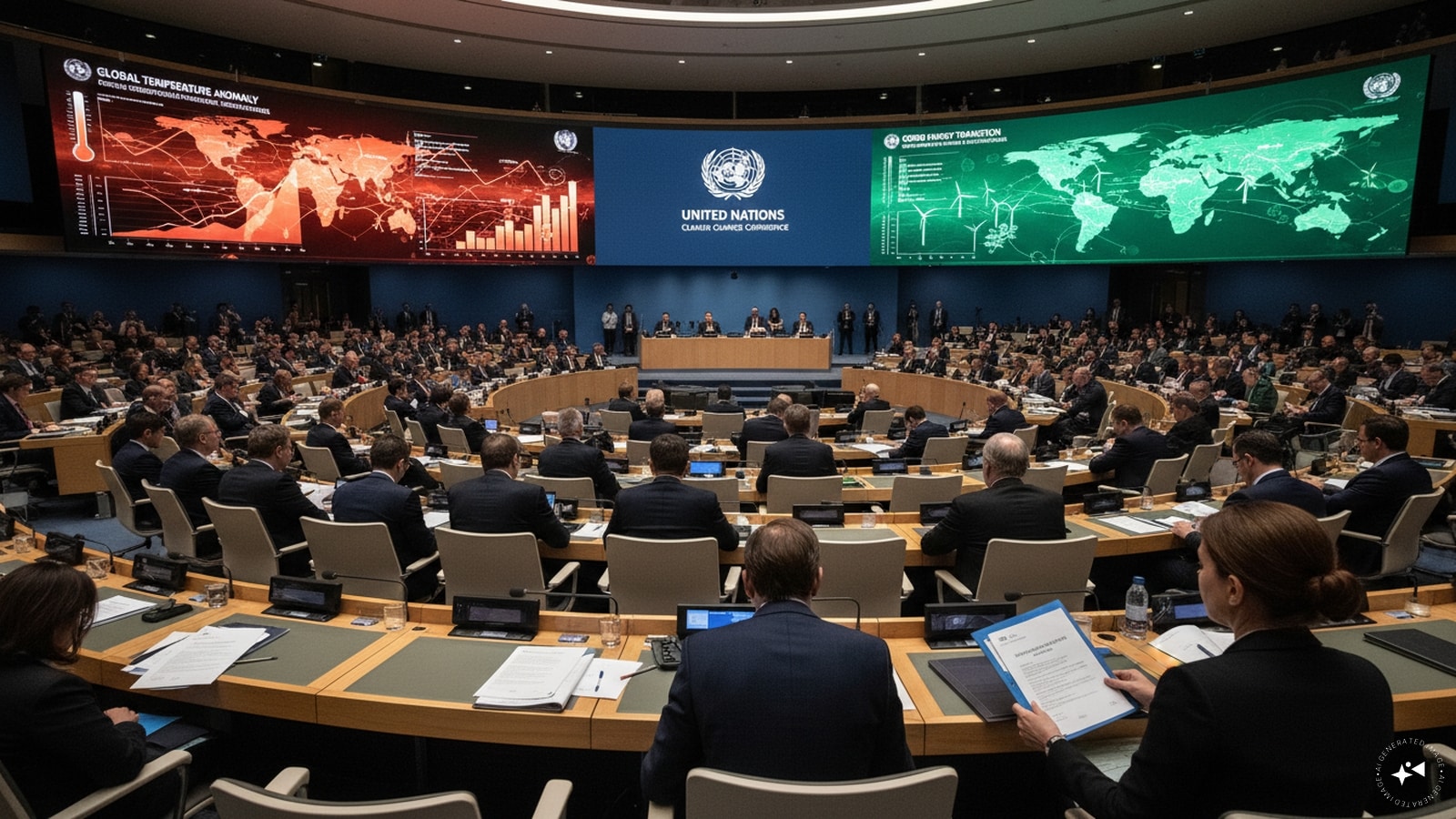
Yet every autumn, diplomats gather under harsh fluorescent lights and temporary convention banners to argue over commas, footnotes, and billions of dollars that sound like monopoly money until you trace them to a concrete seawall, a broken supply chain, or a family's insurance renewal. That gathering is the Conference of the Parties—known to almost everyone as COP—and when COP31 arrives in 2026, it will not simply be another round of speeches in a distant city. It will be a stress test of whether nations still believe their promises have teeth.
To understand why COP31 matters, you have to strip away the acronym. It is not a world government. It does not pass laws that police can enforce on every street corner tomorrow morning. At its core, the United Nations climate summit is a massive, exhausting negotiation table where nearly two hundred countries try to align their survival with their immediate self-interest.
Why Footnotes Turn Into Floodwaters
Suppose we create a hypothetical character to make the machinery easier to see—let us call her Nadia, a municipal budget director in a coastal town that relies on fishing and light manufacturing. Let us be clear: Nadia is a composite figure invented here to show how international text hits local pavement, though her dilemma mirrors real town halls from East Asia to the North Sea.
When Nadia opens her spreadsheet in the spring, she does not see "carbon markets" or "nationally determined contributions." She sees a pump station that needs replacing before August, a warehouse roof that buckled during last year's freak hailstorm, and a local shipyard wondering if its next export order will face a border carbon adjustment because the power grid still burns too much coal.
That is what a UN climate summit actually negotiates. Not poetry. Not vibes. Rules of accounting.
Under the Paris Agreement of 2015, countries agreed to hold global warming well below 2 degrees Celsius above pre-industrial levels and to pursue efforts to limit the increase to 1.5 degrees Celsius. That benchmark was never a magic force field; it was a warning light on a dashboard. Passing 1.5 degrees Celsius does not flip a switch where the sky turns red overnight, yet every tenth of a degree above it ratchets up the odds of severe heatwaves, erratic monsoons, crop stress, and coastal inundation.
Even when governments sign pledges, reality lags behind rhetoric. Scientific assessments from bodies like the Intergovernmental Panel on Climate Change have repeatedly shown that current national commitments—even if fulfilled in full—have left the world on track for warming well above the 1.5-degree mark this century. The gap between what leaders promise at a podium and what factories, power plants, and cars actually emit over the next ten years is where the real story lives.
I have sat in rooms where people roll their eyes at that gap. "They've been talking for thirty years," someone says, stirring lukewarm coffee. "Why should this summit be any different?"
Fair question. Honestly, cynicism is earned. Summits have produced plenty of soaring communiqués followed by quiet backsliding when energy prices spike or elections loom. Still, dismissing the process altogether misses what happens behind the closed doors of working groups. Without a shared ledger, every country grades its own homework. With it, rivals are forced to defend their numbers in front of each other, reporters, investors, and vulnerable nations that have contributed a tiny fraction of historical emissions yet pay first when storms hit.
The Tug of War at COP31
Consider what happens next when nearly two hundred delegations sit in the same complex with wildly different starting lines.
A wealthy industrial economy looks at its domestic voters, worried about utility bills, manufacturing jobs, and grid reliability. A fast-growing developing nation looks at millions of citizens still waiting for reliable air conditioning during brutal summers or stable electricity for small workshops, and asks why it should freeze its growth when rich nations burned fossil fuels for a century to build their wealth. A low-lying island state looks at the waterline creeping closer to its sole freshwater lens and sees no room for patience at all.
COP31 sits right inside that friction.
Think of the negotiations like a long-distance relay race where different runners are holding batons made of different materials. One runner carries a heavy steel pipe representing legacy coal and gas infrastructure; another carries a fragile glass vial representing adaptation grants that were promised years ago and arrived late; another carries a bundle of cables representing solar panels, wind turbines, and battery storage that are suddenly cheaper than fossil alternatives in many markets.
You cannot hand off those batons smoothly without arguing over pace, rules, and fairness.
Three fault lines usually define the drama of a summit at this stage:
- Cutting emissions fast enough: Moving from long-term pledges in 2050 to concrete, verifiable cuts over the next decade—the window that actually determines peak warming.
- Paying for the transition and the damage: Closing the chasm between what developing economies need to build clean power and adapt to climate impacts, and the public finance plus private capital actually flowing across borders.
- Keeping promises honest: Tightening transparency rules so a company or country cannot call a creative accounting trick a real emission reduction.
Notice how none of those points is an abstract moral debate. Every one of them is a fight over money, timeline, and trust.
Inside the Grid, Outside the Headlines
Here is a metaphor that helps me make sense of the energy shift happening right now: imagine trying to swap out the engine of a passenger train while it is rolling down the tracks at seventy miles an hour.
If you yank the engine out too fast without laying down stronger track and upgrading the signals, the train jerks and stalls. If you refuse to touch the engine because changing parts is annoying, you eventually run out of fuel in the middle of nowhere.
That is the real bind of the green transition. Solar and wind power have surged across global markets because their costs fell dramatically over the past decade and a half, turning clean energy from an expensive idealism into a hard-nosed industrial bet. Yet building transmission lines takes years of permitting. Upgrading substations takes skilled technicians. Storing power when the wind drops for four days in winter requires massive battery capacity or firm clean backup.
Sometimes the hardest part isn't the technology. It's the wiring.
When delegates at COP31 argue over targets and timelines, they are colliding with that physical reality. A diplomat can write "triple renewable capacity" or "transition away from fossil fuels" into a draft text in ten minutes. An engineer still has to pour concrete, string high-voltage lines across farmland without sparking local revolt, and keep the lights flickering on during a July heatwave.
I have felt that tension firsthand when covering infrastructure projects. On paper, everything looks neat—charts curve downward, timelines align, budgets balance. Out in the field, a transformer shortage delays a substation by nine months, or a dry river slows hydropower output, or a farmer asks why a high-voltage tower is going up next to his orchard while city dwellers forty miles away argue over which electric SUV to lease.
Ignoring those friction points makes climate coverage sound naive. Obsessing over them to the exclusion of progress makes it sound hopeless. The truth sits in the messy middle: clean power is scaling faster than many skeptics expected even ten years ago, yet total planet-warming emissions have been stubbornly slow to fall fast enough to match the physics.
Who Pays When the Bill Comes Due
Let us return to Nadia—our hypothetical municipal budget director—to see how diplomacy lands on ordinary people.
Suppose a severe flood knocks out a regional highway and two hundred homes in Nadia's district. Even if a climate fund exists on paper at the international level, getting money from a multilateral pledge into a local repair crew's hands involves layers of bureaucracy, matching rules, and competing emergencies elsewhere on the map. Meanwhile, homeowners face higher property insurance premiums—or policies that refuse to renew at all—and small shopkeepers wonder whether to rebuild on the same lot or pack up and leave.
Climate change does not hit everyone equally. It acts like a magnifying glass on existing inequalities. Wealthier households and better-capitalized cities can buy cooling, elevate foundations, diversify supply chains, and absorb price shocks. Lower-income neighborhoods, informal settlements, and small agricultural communities often sit in more exposed spots with thinner financial cushions.
That is why climate justice—a phrase that sometimes gets dismissed as political jargon—has become central to every COP. To a vulnerable country, asking it to curb emissions while offering pennies to help it survive rising seas or failing harvests feels like asking a drowning person to mind their posture.
At the same time, major emitters face domestic politics that are anything but simple. Leaders get voted out over grocery prices, fuel costs, and industrial layoffs long before voters feel a tenth of a degree of warming over a decade. Any climate agreement that ignores economic security for working families risks a populist backlash that torpedoes the agreement itself.
So the summit becomes a high-wire act: how do you move fast enough to respect atmospheric physics without blowing up social stability along the way?
There is no easy trick. Anyone who claims there is a painless shortcut is selling something.
What Changes If We Pay Attention
Why should you—sitting wherever you are right now, with your own bills, deadlines, and worries—care whether negotiators at COP31 reach a strong deal or limp out of town with watered-down language?
Because the decisions made in these summits ripple into markets you interact with every single week.
They shape how fast automakers shift factories toward electric or hybrid vehicles, how utilities price electricity, how banks evaluate loans for new factories or coastal real estate, and whether agricultural supply chains get hammered by extreme weather that pushes up food prices. Even more quietly, they shape whether the next generation inherits a world with manageable seasonal extremes or a world locked into relentless, expensive adaptation.
Still, I won't pretend a single UN meeting is a silver bullet. Summits do not pull carbon out of the air. People do. Engineers do. Voters do. Regulators do.
What a climate summit can do is set the direction of travel, establish shared rules so laggards face real diplomatic and economic friction, and keep the spotlight on promises that would otherwise fade behind louder news cycles. When pressure lets up, ambition tends to drift downward. When scrutiny stays sharp, laggards feel the heat.
If you want to read the headlines from COP31 like an insider rather than a bystander, skip the grand speeches at first. Look at three unglamorous details instead:
- The numbers with dates: Watch for specific near-term targets and concrete funding commitments rather than vague aspirations decades away.
- The enforcement and reporting teeth: Pay attention to how countries and corporations must track and verify their claims so "net zero" means actual cuts rather than clever offsets.
- Who gets left out: Notice which regions, sectors, or communities are absent from the payout table—because unresolved grievances have a way of returning as bigger crises later.
None of this requires you to become a climate scientist or a policy wonk. It just asks you to look past the theater and see the leverage points.
The Tide Does Not Wait for Consensus
Somewhere along a coastline tonight, water is rising a fraction of an inch against stone, sand, and pilings. Somewhere inland, a grid operator is balancing kilowatts against heat, wind, and demand while a diplomat thousands of miles away argues over a single word in a draft text that could shift billions of dollars over the next decade.
Diplomacy moves at the speed of committee votes and cautious compromises. Physics moves on its own schedule, indifferent to speeches, adjournments, or political calendars.
Watch the clock, listen to the tides, and remember that the loudest arguments in the conference hall rarely tell the whole story—the real measure of COP31 is what changes on the ground the morning after the cameras pack up and go home.