At 6:45 AM on a humid Tuesday in Yuen Long, the platform is already a wall of damp polyester and quiet resignation.
If you stand near the yellow safety line at the Tuen Ma Line station, you can feel the vibration in the soles of your shoes three seconds before the train arrives. When the doors slide open, nobody rushes. Rushing implies hope. People simply fold their shoulders inward, tuck their elbows against their ribs, and compress themselves into the warm, recycled air of the carriage for a forty-five-minute crawl toward Kowloon.
For years, that commute has been the unspoken tax of living in Hong Kong’s New Territories. And for years, the proposed cure—a massive, multi-billion-dollar railway artery meant to stitch the northern border into the city’s economic heart—looked less like a lifeline and more like a financial sinkhole.
When the Hong Kong government announced it had slashed the estimated cost of the Northern Metropolis rail link by 28 percent, bringing the bill down to HK$86.2 billion, the headlines read like an accounting ledger. Dry. Bloodless. A victory for spreadsheets and civil engineers.
They missed the point entirely.
Because behind that 28 percent reduction lies a quiet, hard-won rebellion against the way mega-cities build their futures—and a direct answer to whether a city famous for the most expensive infrastructure on earth can still afford to build a home for its own people.
The Architecture of Sticker Shock
To understand why HK$86.2 billion feels like a miracle, you first have to understand the trauma of Hong Kong’s recent construction history.
Spend enough time watching public works hearings in Legislative Council chambers, and you develop a cynical muscle memory. You hear an initial estimate. You nod politely. Then, three years later, you watch that number balloon by thirty, fifty, sometimes eighty percent while engineers blame geological surprises, labor shortages, and the mysterious alchemy of global supply chains.
Think back to the Express Rail Link to Guangzhou, or the Shatin to Central Link. Those projects delivered world-class transit, eventually, yet they left behind a bitter aftertaste of budget overruns that topped HK$90 billion and HK$80 billion respectively. By the time the Northern Link—the flagship rail spine of the Northern Metropolis—entered public debate, taxpayers had grown numb to twelve-figure price tags. Early projections hovered near HK$120 billion.
Numbers that large stop being real money. They become weather patterns. Uncontrollable, looming, inevitable.
Consider a hypothetical family to make that abstraction hurt. Call them the Chans. David works in logistics near Kwai Chung; his wife, Mei, is a nurse in Sha Tin. They bought a cramped, forty-year-old walk-up in Fanling because it was the only place in the territory where a down payment didn't require winning the lottery. Every morning, David spends nearly two hours in transit. Every evening, he misses dinner with his seven-year-old son.
To David, a HK$120 billion railway wasn't an exciting piece of urban planning. It was a threat. A price tag that high meant either the project would stall in endless committee debates while his son grew up without him, or the government would drain public reserves to pay for it, leaving less for hospitals, schools, and the very clinics where Mei worked twelve-hour shifts.
When a city’s infrastructure becomes too expensive to build, the people who pay the price aren't the contractors. They are the commuters standing on the platform at 6:45 AM.
How You Shave HK$33 Billion Off a Railroad
So how does a government suddenly find nearly HK$34 billion in savings without shrinking the ambition of the line?
It wasn't magic. It was the decision to stop building the way Hong Kong has always built.
For decades, the city treated every railway project like a bespoke luxury watch—hand-crafted from scratch inside dense, unforgiving urban rock, bound by regulatory standards written in the twentieth century, and priced accordingly. Tunneling under Hong Kong is notoriously brutal. You aren't digging through soft prairie dirt; you are blasting through fractured granite while skyscrapers rest delicately on foundations fifty meters above your drill bit.
To break the cost curve on the Northern Link—which connects the existing Kam Sheung Road station on the Tuen Ma Line to Kwu Tung on the East Rail Line, alongside a crucial spur into the Huanggang Port in Shenzhen—planners had to dismantle three sacred cows of local engineering.
First, they changed who builds and how they import expertise. Instead of relying exclusively on traditional local tendering models where every bolt and beam is priced at Hong Kong’s sky-high domestic labor rates, authorities opened the door to mainland Chinese engineering standards and integrated construction methods. Think of it like switching from custom tailoring to modular architecture. When you pre-fabricate massive concrete tunnel segments and station components across the border in Guangdong, where factories operate at an industrial scale Hong Kong simply doesn't have the land to match, the unit cost drops off a cliff.
Second, they altered the alignment and construction methodology itself. Deep-bore tunneling—sending massive tunnel-boring machines sixty meters underground—is the gold standard for avoiding surface disruption, yet it is astronomically expensive. Where the Northern Link passes through open, undeveloped land in the New Territories, engineers shifted toward cut-and-cover techniques and shallower alignments. Dig a trench, build the box, cover it back up. Less romantic. Infinitely cheaper.
Third, and perhaps most quietly transformative, was the integration of the main line and the cross-border spur into a unified delivery package under the MTR Corporation’s oversight. By bundling the procurement and synchronizing the timeline with Shenzhen’s side of the border, Hong Kong eliminated the administrative friction that usually bleeds billions in consultancy fees and idle machinery.
"We used to design for perfection before we ever broke ground," one veteran civil engineer who has worked on three major Hong Kong rail lines told me over lukewarm milk tea in Wan Chai, asking not to be named because his firm bids on government contracts. "The mentality was: cost is secondary to zero-risk bureaucracy. This time, somebody finally walked into the room and said, 'If this costs HK$120 billion, it dies. Make it work for under ninety.'"
The Invisible Stakes of the Northern Metropolis
To a casual observer reading the news in London or New York, a 28 percent discount on a suburban railway sounds like good housekeeping. In the context of Hong Kong’s existential pivot, it is survival.
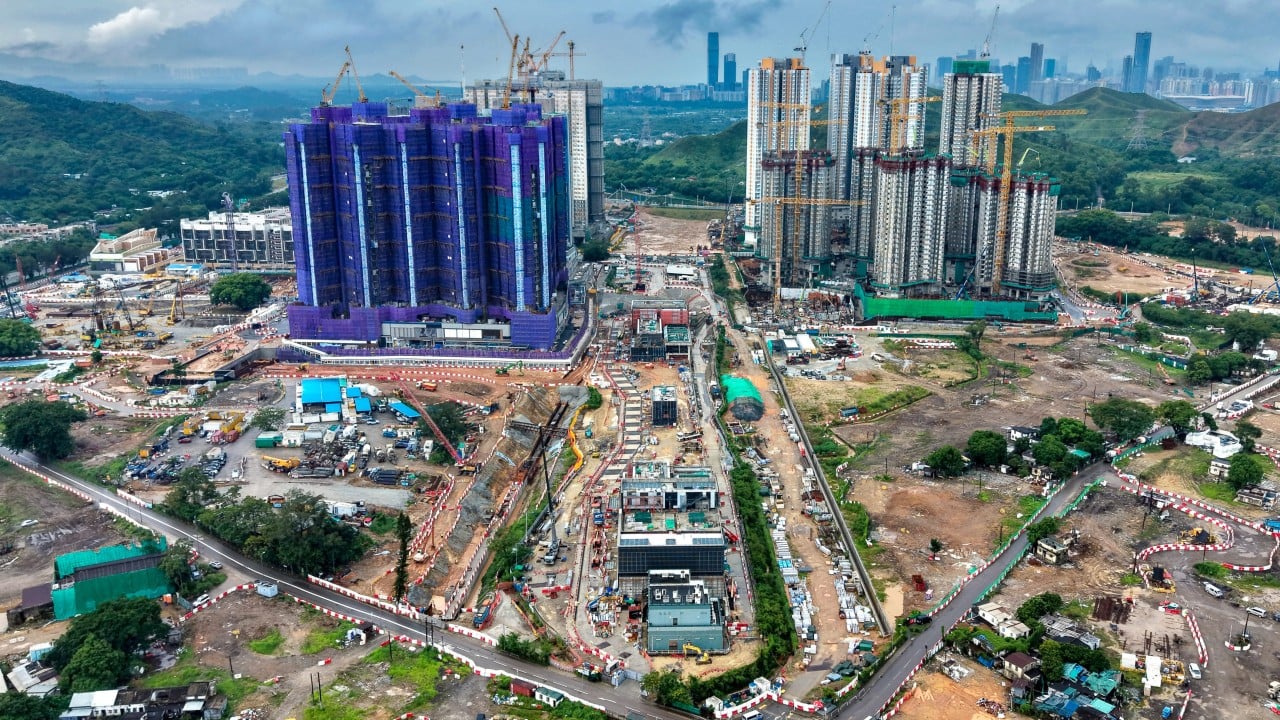
The Northern Metropolis isn't merely a housing estate with a few extra bus stops. Covering roughly 30,000 hectares along the northern edge of the New Territories—nearly a third of Hong Kong’s total land area—it is the city’s most audacious attempt in half a century to escape its own geography.
For generations, Hong Kong’s wealth was concentrated along a narrow, glittering strip on either side of Victoria Harbour. Finance in Central. Shipping in Kwai Tsing. Retail in Tsim Sha Tsui. Meanwhile, the northern border remained a sleepy buffer zone of fishponds, container yards, and village houses—a place you passed through on a train to Shenzhen, never a destination in its own right.
That model hit a wall. You cannot build a twenty-first-century innovation economy when tech startups pay the highest commercial rents on the planet and young engineers live in subdivided flats the size of parking spaces.
The Northern Metropolis is designed to house 2.5 million people and generate 650,000 jobs, anchored by the San Tin Technopole—a sprawling research and development hub meant to link Hong Kong’s universities with Shenzhen’s hardware manufacturing powerhouse.
Without the Northern Link, that vision is an island without a bridge.
Picture a biotech researcher arriving at Hong Kong International Airport, or a software architect commuting from an apartment in Tsuen Wan to a lab in San Tin. Without a high-capacity rail spine connecting the western and eastern corridors of the New Territories, those 2.5 million future residents would be dumped onto aging highways like the Tolo Highway and San Tin Highway—roads that already seize up into red-taillight parking lots every time a minor fender-bender occurs in the rain.
A railway isn't concrete and steel. It is time given back to human beings.
The Doubts Nobody Likes to Print
Still, if you have lived in Hong Kong long enough, optimism feels like a gamble you have to hedge.
Saving HK$33.8 billion on paper is thrilling, yet paper doesn't pour concrete. The skeptic in me—and in millions of tax-paying residents—looks at that HK$86.2 billion figure and asks the uncomfortable questions that press releases gloss over.
What happens when the first tunnel boring machine hits an unmapped fault line beneath the wetlands near Mai Po? What happens if adopting mainland construction standards sparks friction over safety inspections, quality assurance, or local union pushback? Hong Kong’s regulatory culture exists because mistakes in a vertical city are unforgiving; cutting red tape is brilliant until the day someone realizes a rule was written in blood.
There is also the quiet anxiety of the fiscal deficit. Hong Kong’s government reserves, once an unassailable fortress of cash, have been steadily eroded by pandemic relief spending and sluggish land-sale revenues. Even at a discounted HK$86.2 billion, paying for the Northern Link—whether through direct government funding, rail-plus-property development rights handed to the MTR, or bond issuances—requires walking a tightrope. If property developers remain hesitant to bid aggressively on land parcels above the new stations, the traditional Hong Kong model of letting real estate profits subsidize railway construction could sputter.
I don't have a crystal ball that guarantees the final invoice in 2034 won't creep upward. Nobody does. Mega-projects carry a gravitational pull toward delay.
Yet ignoring the significance of this reset would be equally dishonest. For the first time in memory, Hong Kong’s leadership looked at an eye-watering infrastructure bill, refused to shrug, and fundamentally re-engineered the delivery machine before the concrete hardened.
A Different Kind of Morning
Return for a moment to the Chans in Fanling.
David doesn't care about the terminology of "integrated procurement" or "cross-boundary regulatory alignment." He couldn't tell you the difference between a deep-bore tunnel and a cut-and-cover box if you drew him a diagram on a napkin.
What he understands is geography. He understands that right now, getting from his front door to the western side of the New Territories requires a convoluted, multi-transfer loop that feels like traveling between two different countries. He understands that his son’s future job might not be in a glass tower in Central, surrounded by bankers, but in a laboratory ten minutes north of their home—if only there is a train that goes there.
The real story of the Northern Metropolis rail link isn't that Hong Kong saved HK$33.8 billion.
It is that a city trapped by its own reputation for impossible costs finally proved it could bend the curve. It proved that ambition doesn't have to mean financial recklessness, and that progress doesn't have to bankrupt the people it is meant to serve.
Years from now, nobody standing on the platform at Kwu Tung or San Tin will think about the spreadsheets from 2026. They won't recite the percentage of cost reduction or debate the procurement contracts that made it possible.
They will simply step across the yellow line, feel the rush of cool air as the train glides smoothly to a halt, and get home in time for dinner.