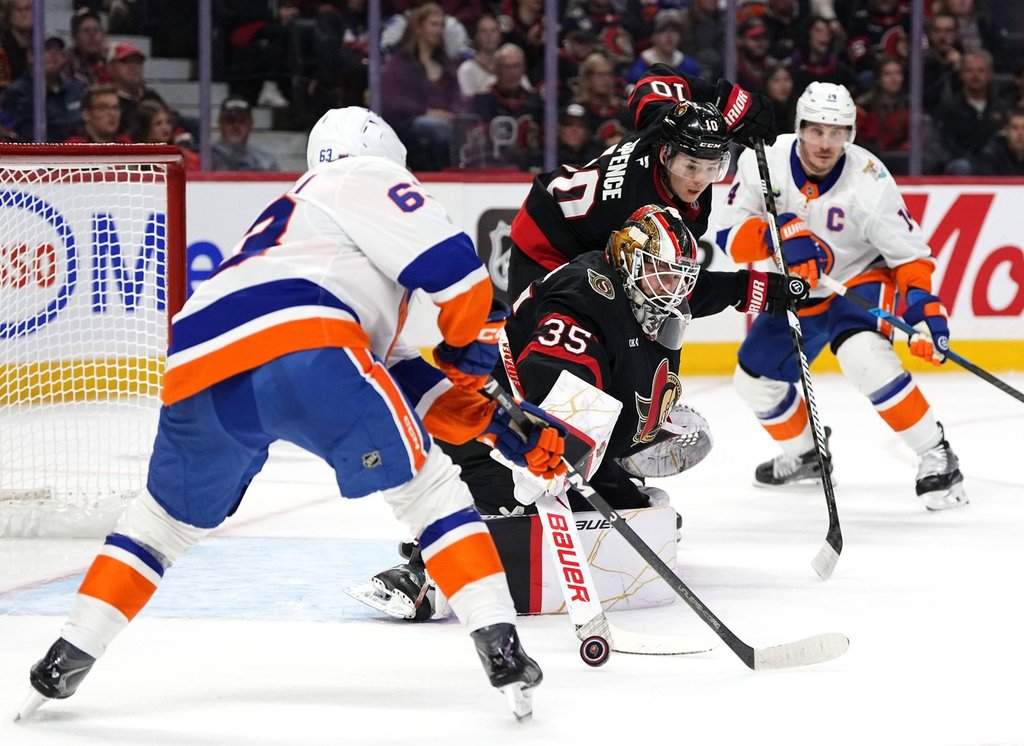
Silence.
That is the rarest currency in a building holding eighteen thousand screaming souls, brass horns blaring, skates carving white rooster tails across frozen water, and twenty-two men colliding at thirty miles an hour. Yet right there, wedged between two steel posts and a pair of thick leather pads, a goalie builds a quiet room. When Linus Ullmark drops into his stance at the start of an Ottawa Senators season, you do not just see a tall netminder tracking a puck. You see a franchise exhaling after years of holding its breath.
For a long time, watching hockey in Ottawa felt like standing on a porch during a prolonged squall. Every autumn arrived with bright optimism and fresh sticks, only for the crease to turn into a revolving door of uncertainty. Fans squinted at shot charts, winced on odd-man rushes, and waited for the other shoe to drop whenever a defenseman coughed up the puck at the blue line. Good shifts by the forwards felt fragile. A single breakdown in coverage could unravel an entire period because nobody in the room quite trusted that the last line of defense would bail them out when the dam cracked.
That is the hidden weight of goaltending. Outsiders look at save percentage and goals-against average and treat the position like a slot machine that either pays out or eats quarters. Inside a dressing room, though, a steady netminder changes the emotional physics of the bench. When the Senators reap the reward of Ullmark’s strong start, the prize is not merely two points in the standings on a crisp November night. The prize is permission. Permission for young forwards to take smart risks with the puck. Permission for blue-liners to step up and pinch without flinching at the thought of a two-on-one going the other way.
When the Crease Stops Being a Question Mark
To understand why a fast start from a veteran goaltender matters so deeply to a rebuilding or rising club, picture a hypothetical fan—let us call him David—sitting in row 14 of the lower bowl during a midweek game in October. David has spent years riding the emotional roller coaster of Ottawa hockey. He knows the sting of early-season deficits that turn a fun night out into a quiet trudging walk back to the parking lot by the second intermission. When the opposition comes flying over the boards on the opening shift, David’s shoulders tense before the puck even reaches the slot.
Watch what happens to David—and to the players on the ice—when Linus Ullmark is dialed in early. The first shot comes from the right circle, sharp and low. Ullmark swallows it cleanly into the leather pocket of his catching glove, no rebound kicking out into the paint, no frantic scramble in front. A whistle blows. The crowd lets out a low murmur of approval.
Now let us use a metaphor to see what just shifted. Think of a team’s defensive structure like a suspension bridge swaying slightly in crosswinds. A great goaltender is not a concrete wall that stops the wind from blowing; he is the anchor cable that keeps the deck steady so cars can keep moving smoothly across. When the goalie is shaky or fighting the puck, every gust feels like a crisis. Every shot looks dangerous. Players start gripping their sticks too tight, curling back toward their own zone out of fear rather than skating with purpose.
When Ullmark starts strong, that swaying stops. The skaters feel the difference immediately in their legs and lungs. When a defenseman loses an edge or a pass gets deflected in the neutral zone, the skater does not panic. He hustles back into the play knowing he has a chance to recover because the man behind him reads angles calmly and stays square to the shooter.
Consider what happens next: a shift that used to end in a hemmed-in icing call now ends with a clean breakout.
The Craft Behind Calmness
Calmness on skates is an illusion built out of thousands of invisible micro-adjustments. It looks effortless from the upper deck, almost lazy in its economy of motion, which is why casual observers sometimes underestimate what a veteran goaltender is actually doing.
Stand in front of a slap shot from thirty feet away—even with full gear strapped across your shins, thighs, chest, and throat—and you quickly learn how loud the world gets. A vulcanized rubber disc traveling near ninety miles an hour carries an intimidating thud. Instinct screams at your body to flinch, turn away, or shrink. Overcoming that wiring takes years of repetition until muscle memory takes over from fear.
Ullmark’s size—listed around six-foot-four or six-foot-five depending on which program you check—gives him natural coverage, yet height alone never survives modern NHL puck movement. East-west passes across the royal road force goalies to glide laterally with precision while keeping their hips aligned so five-hole gaps do not open up mid-slide. If a netminder pushes too hard, he over-slides past the post and leaves half the net yawning open. If he pushes too softly, he arrives late and gets beaten clean over the blocker.
Early in a season, timing is notoriously slippery for everyone. Skaters are still finding their stride; passes zip slightly off the tape; goalies are calibrating depth in the crease against shooters whose habits shift from game to game. When a goaltender hits his stride right out of the gate, it usually means his footwork, rebound control, and sightlines are locking in ahead of schedule.
I have stood on cold arenas watching practices where pucks peppered the netting until my toes went numb, and I have felt that strange, electric hush that falls over a rink when a goalie is in a groove. You hear the crisp clack of the stick blade, the scrape of steel, the heavy breathing of players leaning over the boards. When pucks hit a hot goalie’s pads with a deadened thud and drop harmlessly to the ice instead of caroming into danger, the entire rhythm of the drill changes. Shooters start aiming for corners rather than just firing hope-and-pray wrist shots. Teammates tap their sticks against the boards—not out of pity, not out of politeness, but out of genuine respect for a standard being set right in front of their eyes.
What Strong Starts Actually Buy a Locker Room
Hockey seasons are marathons disguised as sprints every eighty-two nights. A rough October does not mathematically end a team’s chances—history is full of clubs that clawed out of early holes—yet early points carry a psychological weight that late-season points rarely match.
In the fall, every team in the league still believes it belongs in the conversation. Standards are being forged in real time. Coaches are testing line combinations, evaluating young defensemen under live pressure, and trying to build habits that hold up in February and March when fatigue sets in and travel wears everyone down.
When the Senators ride Ullmark’s strong start to early wins or competitive points, they buy something priceless: breathing room.
Imagine a young forward—let us call him a hypothetical second-year winger feeling the pressure to justify his ice time. Early in the year, every mistake feels magnified under the bright lights of a hockey-mad city. If his team is losing four-to-one after twenty minutes every other night, the locker room gets heavy. Frustration creeps into voices. Veterans start pressing; youngsters start looking over their shoulders every time they turn the puck over at the offensive blue line.
Now flip the script. Because Ullmark keeps the score close—stealing a breakaway in the second period, tracking traffic through a screen on the penalty kill, holding the line during a chaotic six-on-five finish—that young winger stays engaged in a tight game. His late-game shift matters. His backcheck in the final three minutes actually has stakes attached to it. Growth happens faster in competitive environments where effort is rewarded with a fighting chance to win.
A steady goaltender does not erase every flaw on a roster, but he shines a spotlight on what is real and hides what is still growing.
That distinction matters. Sometimes a hot goalie can mask deeper structural issues—too many high-danger chances allowed, sloppy neutral-zone gaps, undisciplined penalties—if a team leans on him too heavily without fixing its habits. Honest hockey people know that truth well. Even the best netminder cannot stand on his head for eighty-two games without paying a physical or mental toll.
Still, there is a massive difference between a goalie putting out five-alarm fires every shift and a goalie rewarding good defensive structure while erasing occasional mistakes. When Ottawa’s skaters play hard in front of Ullmark, box out rebounds, and clear lanes, his job becomes sharper and cleaner. In turn, when a skater makes a rookie mistake, Ullmark gives him a second life. That reciprocity—trust flowing both ways between the crease and the bench—is how a collection of individuals starts feeling like a real team.
The Vulnerability Beneath the Mask
We tend to talk about athletes as if they are made of titanium and willpower, especially when they are rolling early in a campaign. Put on a goalie mask, step between the pipes, and watch how quickly that armor looks thin when things go south.
Goaltending is the loneliest job in team sports. A center can have a quiet night and still skate off with a win because his linemates clicked. A defenseman can get walked once and recover two shifts later. When a goaltender lets in a soft goal from distance or misplays a puck behind the net, there is nowhere to hide. The red light flashes. The crowd groans. Every camera in the arena zooms in on a guy standing alone in a white rectangle while teammates skate past toward the bench.
That vulnerability is why strong starts feel so earned—and why they can also stir a quiet, nagging doubt in fans who have been burned before. We have all seen hot streaks cool off. We have all watched a goalie look unbeatable in November only to fight traffic or tweak a groin muscle in January. Admitting that uncertainty is part of being honest about the sport. Confidence in hockey is never permanent; it has to be re-earned every single night against shooters who study video, look for tendencies, and test weaknesses relentlessly.
Yet doubting a good thing just because it could end is no way to watch a game. The joy of sports lives in the present moment—in the crispness of a pad save across the crease, the roar of a home crowd rising to its feet as the clock ticks down on a one-goal lead, the quiet satisfaction of seeing a team finally look comfortable in its own skin.
For a franchise longing for sustained relevance and meaningful spring hockey, watching Ullmark set a tone early is more than a statistical footnote. It is a reminder of what stability looks like when it arrives. It looks like a calm silhouette in the blue paint. It looks like a bench full of players standing tall instead of hanging their heads.
When the horn sounds on another hard-earned victory, the noise in the arena swells back up—horns blaring, music pounding, eighteen thousand voices celebrating a night that went right. Right at the center of it all, peeling off a heavy mask after sixty minutes of pure focus, stands the quiet anchor who helped make the noise possible.