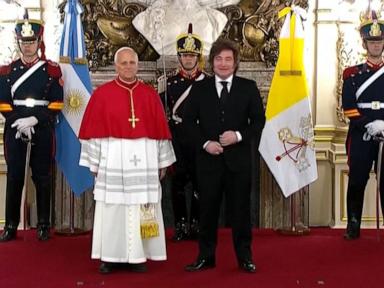
Two men from Buenos Aires stand on opposite sides of a moral chasm, separated by an ocean and a philosophy of survival.
One wears white cassocks and speaks in the slow, deliberate cadence of a parish priest who once rode the subways through the poorest neighborhoods of the Argentine capital. The other wears a leather jacket, wields a metaphorical chainsaw on campaign stages, and views the state not as a shepherd, but as a parasite.
When Pope Francis stepped before an audience in the Vatican recently, he did not utter the name Javier Milei. He did not need to. In the diplomatic geometry of Rome, silence is often the sharpest blade, and a general principle spoken with pointed timing lands with the force of a decree. The pontiff warned against an economic idolatry that worships the market while discarding human beings, condemning austerity policies that balance spreadsheets on the backs of the vulnerable.
To understand why those words rattled windows from the Vatican to the Casa Rosada, you have to step away from the macroeconomic charts and stand inside a kitchen in La Matanza, the sprawling, working-class belt surrounding Buenos Aires.
The Arithmetic of an Empty Pot
Consider a hypothetical mother—let us call her Elena—standing before a battered gas stove at six in the evening. Elena is not an economist. She does not track sovereign bond yields, nor does she debate the nuances of the Austrian School of economics. What Elena tracks is the price of a liter of milk, the weight of a bag of potatoes, and the terrifying speed at which a crumpled stack of pesos loses its purchasing power before she can walk from the bus stop to the corner market.
For decades, Argentina has lived inside a fever dream of inflation. Successive governments printed money to pay for promises they could not keep, creating a sugar high of subsidies followed by the inevitable, agonizing crash. By the time Javier Milei took office in late 2023, annual inflation was barreling past 200 percent. The currency was confetti. Something had to break.
Milei arrived with a brutal, uncompromising diagnosis. The patient was dying of fiscal poison, and the only cure was shock therapy. No gradualism. No gentle weaning off state support. He slashed public spending with historic ferocity, froze pensions, halted public works, deregulated prices, and allowed the peso to devalue sharply.
Within months, Argentina achieved something it had not seen in over a decade—a fiscal surplus. Wall Street applauded. Bond markets rallied. The International Monetary Fund nodded in approval. On paper, the patient’s vital signs were stabilizing.
Inside Elena’s kitchen, however, the cure felt indistinguishable from the disease.
When subsidies for electricity and public transit vanished overnight, the cost of simply getting to a minimum-wage job consumed a staggering fraction of the paycheck. Real wages collapsed. Poverty rates surged past fifty percent in the first half of 2024, pushing millions of Argentines into the ranks of the newly destitute. Soup kitchens—the comedores that serve as the last safety net in the villas miserias—suddenly found their government food deliveries frozen amid audits and bureaucratic restructuring.
A Collision of Two Argentinas
This is the exact terrain where Jorge Mario Bergoglio spent his life before becoming Pope Francis.
Long before he was the Bishop of Rome, he was the Archbishop of Buenos Aires, walking the mud streets of the villas, drinking mate with cartoneros—the cardboard scavengers who pick through the city's trash at night—and celebrating Mass in makeshift chapels where the roofs leaked when it rained. That experience forged a theology rooted in the messy, unglamorous reality of the periphery. For Francis, an economy is not a self-correcting machine governed by immaculate mathematical laws; it is a moral ecosystem. If a policy leaves an elderly woman choosing between heart medication and heating oil, the policy is broken, regardless of how tidy the treasury’s balance sheet looks.
Milei’s worldview could not be more opposite.
Raised in a turbulent household and trained as an economist, Milei views the state through the lens of radical libertarianism. To him, taxation is theft, social justice is a linguistic fraud used by politicians to buy votes, and the free market is the only truly moral mechanism for organizing human cooperation. During his campaign, his rhetoric toward his fellow Argentine in the Vatican turned venomous. He called the Pope an "imbecile" for defending social justice and accused him of being a representative of "the evil one on Earth" for meddling in economic affairs.
Yet power has a way of tempering volume, if not conviction. When Milei traveled to Rome in early 2024, the cameras captured a warm embrace between the libertarian president and the Jesuit pontiff. It looked like a truce. Many observers assumed the two men had agreed to stay in their respective lanes—the president tending to the ledger, the Pope tending to the soul.
That assumption underestimated the fundamental incompatibility of their definitions of human dignity.
The Theology of the Trickle-Down
Why did the Pope choose this moment to deliver his veiled rebuke? Because in the quiet corridors of the Vatican, reports from the Argentine bishops have grown increasingly urgent.
When Francis speaks against "trickle-down" economics—a metaphor he has dismantled repeatedly since his 2013 apostolic exhortation Evangelii Gaudium—he is challenging a specific faith. He has often compared that economic theory to a glass that is supposed to overflow once it is full, only for the glass to magically grow larger every time it nears the brim, ensuring nothing ever spills down to the thirsty mouths waiting below.
In his recent remarks to social movements and economic thinkers, the Pope sharpened that critique. He warned against the temptation to treat human suffering as temporary collateral damage on the road to macroeconomic equilibrium. He pointed out the moral absurdity of cutting support for the poorest citizens while leaving entrenched privileges intact, and he condemned the criminalization of social protest—a direct nod to the strict anti-picket protocols enacted by Milei’s security apparatus in Buenos Aires.
Listen closely to the subtext of Rome's message. The Vatican is not arguing for a return to reckless money printing or corrupt state patronage. Francis knows better than anyone how inflation acts as a cruel, invisible tax on the poor; he watched it devour the savings of his own working-class congregation for decades. What the Pope is challenging is the sequence and the heart of the adjustment.
There is a profound difference between tightening a belt and tightening a noose.
Living Inside the Shock
I remember speaking with a retired schoolteacher from Córdoba during an earlier wave of Argentine economic turmoil, watching her count out coins at a pharmacy counter to buy half a blister pack of blood pressure pills because she could not afford the whole box. Her hands shook—not from anger, not from political ideology, just from the sheer exhaustion of calculating survival every single morning.
That memory haunts any honest analysis of what is happening in Argentina today.
When economists discuss "demand destruction," it sounds clinical, almost architectural, like clearing brush to prevent a forest fire. In practice, demand destruction means a family skipping dinner. It means a small neighborhood hardware store turning off half its fluorescent lights to survive the utility bill before finally pulling down the metal shutters for good. It means young engineers and doctors packing two suitcases at Ezeiza International Airport, joining an exodus of talent that drains a nation of its future far faster than any fiscal deficit ever could.
Supporters of Milei’s shock therapy have a compelling counterargument, and intellectual honesty requires facing it squarely. They ask: What was the alternative?
For twenty years, Argentina tried the gradual path. It tried price controls, which only created empty shelves and black markets. It tried subsidizing everything from beef to bus fares, which bankrupted the central bank and drove inflation into the stratosphere. Under the previous administration, poverty was already rising relentlessly, masked only by printing money that lost value by the hour. From the libertarian perspective, the pain happening now is not caused by the chainsaw; it is the inevitable withdrawal symptom of an economy addicted to state spending. Without a stable currency and a balanced budget, they argue, there can be no investment, no growth, and no real reduction in poverty.
Both arguments carry a terrifying weight of truth. That is what makes the Argentine tragedy so agonizing. It is not a simple morality play between heroes and villains; it is a collision between two irreconcilable truths. One truth says you cannot spend money you do not have without destroying the currency. The other truth says you cannot starve the vulnerable today to pay for a prosperity promised tomorrow.
The Invisible Stakes Beyond Argentina
If this were merely a domestic quarrel between an Argentine president and an Argentine pope, the rest of the world might watch it as an intriguing political drama and move on.
It is not. Argentina has become the world’s premier laboratory for radical austerity.
From Europe to North America, governments drowning in post-pandemic debt and sluggish growth are watching Buenos Aires with intense curiosity. Tech billionaires and free-market thinkers hail Milei as a visionary who dared to take an axe to the bloated modern welfare state. If his experiment succeeds—if inflation collapses, foreign capital floods in, and the economy rebounds into sustained growth—his blueprint will be exported across the globe.
And if it succeeds by pushing millions into prolonged misery while dismantling the social fabric of the nation, what kind of victory will that be?
This is the invisible stake that brought Pope Francis to the microphone. When the leader of 1.3 billion Catholics raises his voice against the idolization of the market, he is firing a warning shot across the bow of a global trend. He is reminding world leaders that an economy exists to serve human beings, never the other way around.
The View From the Periphery
In the end, history rarely judges an era by the elegance of its fiscal spreadsheets. It judges an era by what happened to the people standing at the edges of the frame.
Back in our hypothetical kitchen in La Matanza, Elena does not read Vatican transcripts or Wall Street analyst notes. She hears the radio playing softly on the counter while she stretches a single pot of stew with extra water and rice so there will be enough for her two children and her aging father.
She hears the announcer summarize the Pope’s warning about the poor being left behind. Then she hears a government spokesperson respond, insisting that the sacrifice is necessary, that the light at the end of the tunnel is finally visible, that the numbers are turning green.
Elena turns down the volume. She picks up a ladle. Outside her window, the evening train rattles past, packed with workers heading home through the gathering dusk, each of them carrying the weight of a great economic experiment on their shoulders.
A ledger can be balanced with the stroke of a pen, in a single fiscal quarter. A generation lost to hunger and despair takes lifetimes to rebuild.