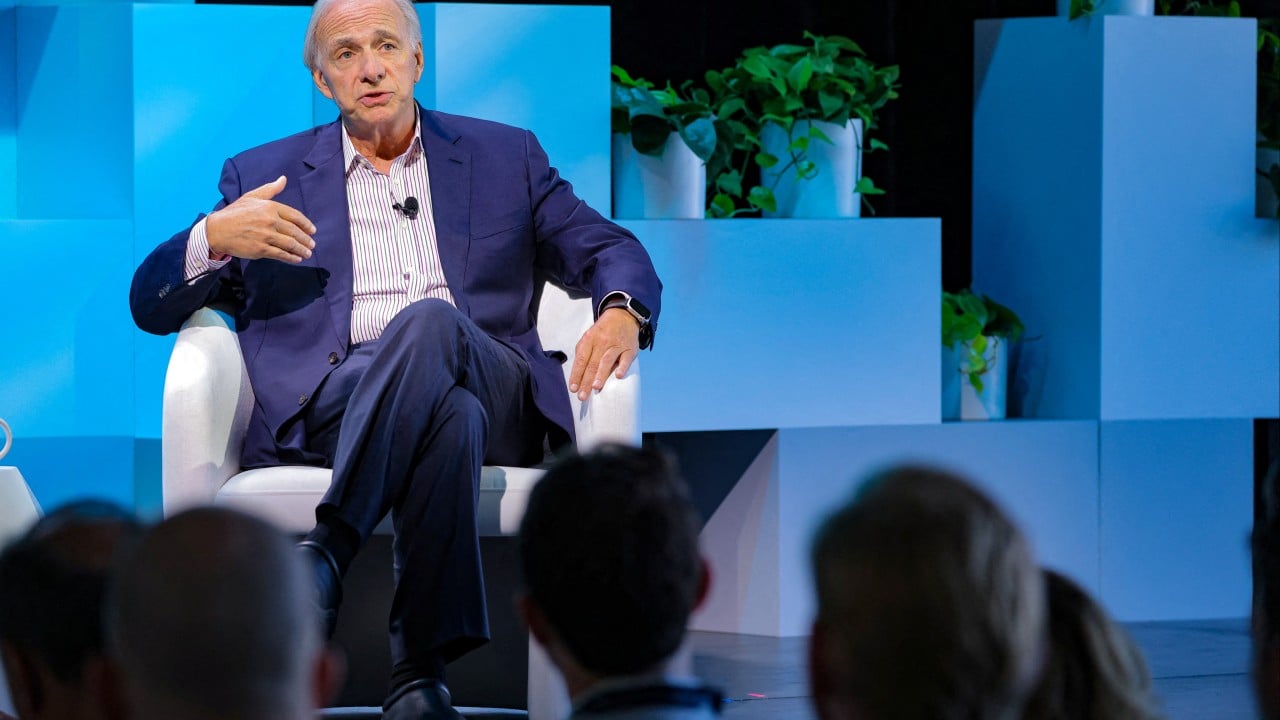
Ray Dalio doesn't mince words when he looks at a map of the world. The billionaire founder of Bridgewater Associates sees a machine with gears grinding against each other, and right now, the biggest gears—the United States and China—are locked in a friction that could break the whole system. He isn't just talking about trade wars or semiconductor bans. He’s talking about a "dangerous new era" where the risk of total conflict is higher than most of us want to admit.
If you're looking for a sunny forecast, Dalio isn't your guy. He tracks the "Big Cycle," a historical pattern of rising and falling empires that he’s studied for decades. According to his metrics, we’re currently in the part of the cycle where a dominant power (the US) is being challenged by a rising power (China). This isn't a theory for him. It's a data-driven reality. When these two giants clash, it changes everything from the price of your groceries to the stability of global peace.
The Brink of a Great Power Conflict
The tension between Washington and Beijing has moved past simple competition. We’re seeing a structural shift. Dalio points out that both sides are now preparing for the worst-case scenario. It’s a classic Thucydides Trap, where a rising power creates fear in an established power, often leading to a clash that neither side originally wanted.
He identifies five types of war that are already happening or are on the horizon:
- Trade War: We’ve seen this since 2018. Tariffs, export controls, and "de-risking" are the tools here.
- Technology War: This is the fight for AI, quantum computing, and chips. If you lose the tech race, you lose the military race.
- Geopolitical Influence War: This is the struggle over who controls the South China Sea, influence in Africa, and the loyalties of the Global South.
- Capital War: Sanctions and the weaponization of the dollar. China is moving toward "de-dollarization" because they don't want their assets frozen like Russia's were.
- Military War: This is the one everyone fears. While we aren't in a direct "hot" war yet, the posturing around Taiwan and the Philippines makes it a constant threat.
Dalio isn't saying war is inevitable, but he’s saying the margin for error has basically vanished.
Why the Next Few Years are Critical
The internal politics of both nations make compromise difficult. In the US, being "tough on China" is one of the few things both political parties agree on. Any leader who tries to bridge the gap risks being called weak. In China, President Xi Jinping is doubling down on national security and self-sufficiency.
Dalio notes that the world has entered a "dangerous new era" because the buffers are gone. In the 1990s and 2000s, the economic benefits of cooperation were so huge that they outweighed political grievances. That’s not true anymore. Now, "national security" is the justification for every economic decision.
This shift creates a feedback loop. As the US restricts high-end chips, China invests more in its own military-tech complex. As China builds its navy, the US strengthens alliances like AUKUS. It’s a spiral. Dalio’s concern is that one small spark—a mid-air collision of jets or a naval mishap—could trigger a massive escalation because there’s no trust left to de-escalate.
The Debt Crisis and Internal Conflict
Dalio’s perspective isn't just about foreign policy. He links the US-China relationship to internal stability. The US is facing a massive debt burden. When a country spends more than it earns and has deep internal polarization, it becomes vulnerable.
"The greatest power is the power to be productive," Dalio often says. If the US can’t fix its internal divisions and manage its balance sheet, it loses the ability to project power abroad effectively. China has its own internal demons, including a massive real estate bubble and a shrinking population.
When both powers are under internal stress, they often look for external enemies to unify their people. This is a historical pattern that Dalio has documented in his book Principles for Dealing with the Changing World Order. It’s a recipe for disaster.
How to Protect Your Assets in a Fragile World
You might wonder what a geopolitical standoff means for your portfolio. Dalio’s advice is rooted in diversification. He famously said "cash is trash" (though he later walked that back when interest rates rose), but his core message remains: don't put all your eggs in one basket.
If the US-China relationship collapses, global supply chains will shatter. Companies that rely heavily on Chinese manufacturing or American consumers will see their margins evaporate.
- Diversify Geographically: Look at "neutral" countries. Nations like India, Singapore, Vietnam, and Mexico are benefiting from companies moving production away from China. These are the "safe harbors" of the new era.
- Hard Assets: In times of high conflict and high debt, gold and other tangible assets tend to hold value better than paper currency.
- Avoid the Extremes: Don't bet everything on a total US collapse or a total China victory. The most likely scenario is a long, grinding "cold war" that lasts decades.
Reality Check on De-risking
Politicians love the word "de-risking." It sounds safer than "decoupling." But Dalio is skeptical. He knows the world economy is an intertwined mess of dependencies. You can’t just flip a switch and move all iPhone production to India. It takes years, billions of dollars, and a massive amount of infrastructure.
The attempt to de-risk is actually inflationary. When you move production from a low-cost area (China) to a higher-cost area for "security" reasons, someone has to pay for it. That someone is you. We’re moving from a world of "just-in-time" efficiency to "just-in-case" resilience. It’s safer, but it’s a lot more expensive.
The Role of Leadership
Dalio believes the path forward depends on the "rationality" of the leaders involved. He’s met with top officials in both countries. He knows they understand the stakes. A full-scale war would be a "lose-lose" on a scale we haven't seen since the 1940s.
However, leaders are often pushed by the "mood of the people." If the American or Chinese public becomes hyper-nationalistic, the leaders might feel they have no choice but to take a hard line. This is why Dalio emphasizes the need for "smart" competition—competing fiercely in tech and trade without crossing the line into kinetic warfare.
Stop Ignoring the Signs
The world isn't going back to the era of easy globalization. That's over. We are in a period where politics trumps economics.
Keep an eye on the "red lines." For China, it's Taiwan's sovereignty. For the US, it's the freedom of navigation and the technological edge. As long as these two giants are shouting at each other across the Pacific, the global market will remain twitchy.
Don't wait for a formal declaration of a "new era" to change your strategy. The data is already there. Watch the capital flows. Watch the chip bans. Watch the naval drills. The world is changing, and as Dalio warns, the cost of being wrong about this shift is higher than ever.
Get your finances in order. Build some redundancy into your life. Understand that the peace of the last thirty years was an anomaly, not the rule. We’re back to the historical norm of great power competition, and it’s going to be a bumpy ride.