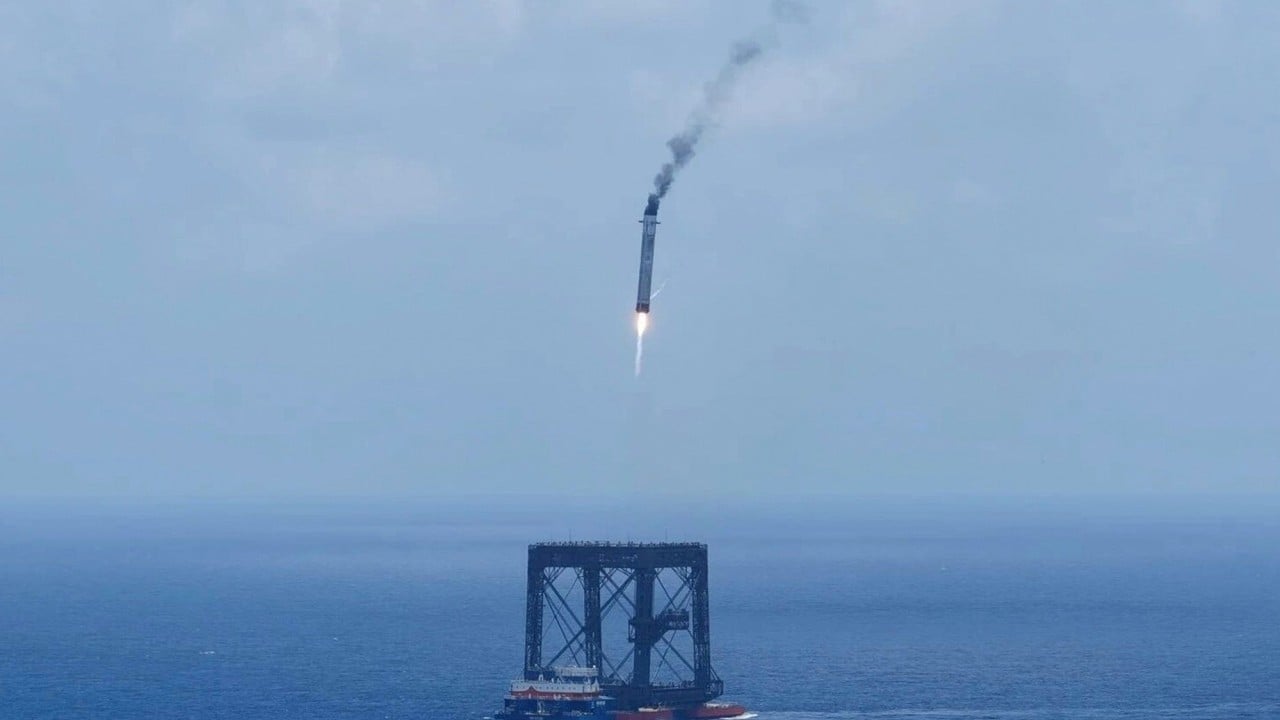
Western observers spent a decade assuming China would copy the SpaceX blueprint line for line. They expected deployable carbon-fiber landing legs, massive autonomous drone ships, and precision vertical landings on concrete pads. Instead, on July 10, 2026, the state-owned China Aerospace Science and Technology Corporation (CASC) shattered that expectation. The maiden flight of the Long March 10B did not end with a rocket standing upright on a deck. It ended with a 63-meter booster dropping from the sky over the South China Sea and snagging itself in a massive, tensioned steel net suspended across a specialized vessel named the Linghangzhe.
With a single flight, China became the second nation to recover an orbital-class booster. More importantly, it demonstrated a completely different philosophy of spaceflight economics. Social media immediately filled with breathless commentary asking if SpaceX was about to lose its crown. The short answer is no, not tomorrow. The longer, far more consequential answer is that the American monopoly on reusable spaceflight is officially over, and the hardware driving this shift looks nothing like what Elon Musk built in Texas and Florida.
To understand why Beijing chose nets over legs, one must look past the immediate spectacle of the catch. The decision exposes a deep structural divergence in how the two superpowers calculate the weight, cost, and ultimate purpose of a launch vehicle.
The Tyranny of the Landing Leg
Every gram carried into orbit requires an exponential amount of fuel to get there. Aerospace engineers refer to this as the rocket equation, a mathematical reality that punishes unnecessary weight with brutal efficiency.
When SpaceX designed the Falcon 9, it opted for landing legs that fold against the base of the rocket during ascent and deploy just seconds before touchdown. These legs, built from high-strength carbon fiber and aluminum honeycomb, are mechanical marvels. They are also incredibly heavy. A full set of landing legs, along with the hydraulic systems, deployment mechanisms, and structural reinforcements needed to absorb the impact of a 30-ton cylinder hitting a deck, siphons away significant payload capacity.
Every pound of landing gear is a pound of satellite that cannot be sent to orbit. For a commercial company like SpaceX, which operates under intense market pressures, this was a trade-off worth making to achieve rapid reusability.
China looked at the same math and chose a different path. By removing the landing legs entirely and replacing them with lightweight, retractable hooks near the top of the booster, CASC stripped hundreds of kilograms of dead weight from the vehicle. The heavy lifting of absorbing the kinetic energy of a falling rocket was transferred entirely to the ground station—or, in this case, the deck of the Linghangzhe.
The ship uses a flexible network of cables hooked to heavy-duty hydraulic dampers. When the Long March 10B dropped into the net, the machinery on the vessel did the hard work of cushioning the impact. The rocket itself remained structurally lean. This mass efficiency means the Long March 10B can lift at least 16 metric tons to low Earth orbit even in its reusable configuration. It is an engineering choice that prioritizes the rocket's primary job—carrying cargo—over the convenience of how it lands.
Shifting the Margin for Error
Landing a 15-story building vertically on a moving ship in the middle of the ocean requires terrifying precision. The Falcon 9 must hit a specific spot on a drone ship with almost zero lateral velocity, or the legs will buckle, tipping the vehicle into an explosive fireball. SpaceX spent years perfecting this choreography, losing multiple boosters to rough seas and minor guidance deviations before making it look routine.
The net system built for the Long March 10B fundamentally changes the geometry of recovery. A net offers a wider, more forgiving target area than a flat metal deck.
When the booster made its final approach off Hainan Island, it did not need to balance perfectly on a single point. It merely needed to fall within the perimeter of the suspended grid. As the rocket descended, the hooks on the hull engaged the tensioned lines. The net system allowed for a higher degree of lateral sway and gave the guidance computers a wider margin for error during high-wind recoveries.
According to technical briefs released by the China Academy of Launch Vehicle Technology, the recovery platform is equipped with dynamic positioning thrusters to counter wave action, while the net itself uses auxiliary securing cables that automatically snap into place to lock the booster down immediately after capture. This protects the structural integrity of the tanks from the lateral forces of ocean swells. It is a system built specifically for the rough, unpredictable waters of the South China Sea, where standard vertical landings would face severe seasonal disruptions.
The Lunar Subplot
The Long March 10B is not an isolated science project. It is the cargo-carrying workhorse of a tightly coordinated lunar architecture.
Beijing has committed to landing taikonauts on the Moon before 2030. The crewed variant of this rocket family, the Long March 10, will utilize a three-core configuration to launch the Mengzhou spacecraft and the Lanyue lunar lander. The 10B variant exists to test the components, flight software, and recovery pipelines that will make that lunar program economically sustainable.
By testing these technologies on commercial cargo flights now, China is de-risking its crewed infrastructure. The liquid oxygen and kerosene first stage used in the July 10 launch is identical to the boosters that will eventually push Chinese astronauts toward the Moon.
While the American Artemis program relies on a complex web of legacy contractors, solid rocket boosters, and the massive, non-reusable Space Launch System, Beijing is building a consolidated, reusable pipeline. If CASC can routinely recover and reuse these five-meter-diameter boosters, the cost of sustained lunar exploration drops dramatically.
The Scale of the Challenge
It is easy to get caught up in the geopolitical drama of a successful test flight, but a single recovery does not equal an operational fleet. SpaceX launched over a hundred missions in the past year alone. Its refurbishment cycle is a well-oiled machine, sometimes turning boosters around in less than three weeks.
China has accomplished the first phase: catching the hardware. Now comes the much harder part of the problem.
Kerosene-burning engines, like the YF-100K units powering the Long March 10B, leave behind significant amounts of soot and carbon deposits inside the combustion chambers and turbopumps. Cleaning and inspecting these engines for reflight is a labor-intensive process. SpaceX managed to streamline this, but it took them a decade of constant trial and error to master the metallurgy and maintenance protocols.
CASC officials have stated an aggressive goal to fly the exact booster recovered on July 10 before the end of 2026. If they meet that deadline, it will signal that their refurbishment pipeline is moving at a pace that took Western aerospace companies years to achieve. If they miss it, or if the booster requires extensive rebuilding behind closed doors, the net recovery system remains a brilliant prototype rather than a commercial threat.
The true test will be the deployment of China’s planned megaconstellations. Beijing has filed paperwork for tens of thousands of low-Earth orbit satellites to compete directly with Starlink. Launching those assets requires a relentless, assembly-line cadence of rocket flights.
The net-capture method avoids the need to build complex, heavy landing legs for every single rocket coming off the factory floor, potentially speeding up production timelines. The bottleneck moves from the manufacturing plant to the recovery fleet. China will need multiple ships like the Linghangzhe stationed across the Pacific to support a high-frequency launch schedule.
A single successful catch in the South China Sea has changed the conversation from whether China can build reusable rockets to how fast they can scale them. The United States no longer owns the monopoly on returning from orbit intact. The space race is no longer a story about one company running laps around a sleeping industry. It is a clash of two distinct engineering philosophies, and the net has just been cast.