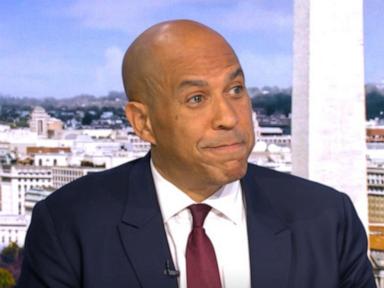
When Senator Cory Booker steps in front of a cable news camera and declares that a recent Democratic election victory signals a "big realignment" in American politics, he is engaging in one of Washington’s oldest traditions. He is attempting to turn a single tactical win into a permanent ideological mandate. While Booker’s optimism reflects genuine enthusiasm among party faithful following competitive off-year or midterm races, hard historical data and modern voter behavior suggest the American electorate is not realigning toward any single party. Instead, voters are locked in a state of high-frequency, low-loyalty churn that punishes whoever holds the keys to the White House.
Understanding the gap between campaign-trail rhetoric and actual structural realignment requires looking past the celebratory headlines. In political science, a true realignment—like the New Deal coalition of 1932 or the Reagan revolution of 1980—reshapes the electoral map for a generation. What Booker is describing looks far more like the modern era of negative partisanship and thermostatic public opinion, where wins are borrowed rather than owned. Meanwhile, you can read related stories here: What Most People Miss About Historic Firsts in U.S. Midterm Elections.
The Anatomy of a Modern Political Realignment
Politicians throw around the word realignment the way tech founders throw around the word disruption. It sounds grand. It implies inevitability. Yet if you examine the last three decades of American elections, from the Republican wave of 1994 to the Democratic surge of 2006, and from the Tea Party backlash of 2010 to the anti-Trump coalition of 2018, a very different pattern emerges.
A genuine realignment requires two simultaneous shifts. First, a massive, durable migration of key demographic blocs from one party to the other. Second, a fundamental consensus on a new governing philosophy that forces the opposing party to adapt or die. To understand the bigger picture, check out the detailed report by TIME.
Look at the actual mechanics of recent Democratic victories. Rather than forging an unbreakable new coalition, Democrats have largely succeeded by assembling temporary alliances of convenience. Suburban moderates, frustrated by cultural extremism or economic uncertainty, pull the lever for blue candidates in one cycle, only to snap back toward fiscal conservatism or border enforcement concerns two years later. Calling a narrow, turnout-dependent victory a realignment ignores the sheer fragility of the coalition that produced it.
Thermostatic Voting Explains the Pendulum
Political scientists use the term thermostatic public opinion to describe how the electorate reacts to power. Think of the public as a thermostat set to a comfortable room temperature. When Democrats take control and turn up the heat with progressive legislation, voters feel the room getting too warm and dial it back by electing Republicans. When Republicans take over and push hard to the right, the public gets too cold and dials it back toward the Democrats.
Booker’s framing treats the voters' decision to adjust the thermostat as a permanent decision to tear out the furnace. That misreading has burned both parties repeatedly over the last twenty years. Following the 2008 election, Democratic strategists famously declared the emergence of an "Emerging Democratic Majority," convinced that demographic changes guaranteed permanent dominance. Two years later, in 2010, Democrats suffered their worst House losses since 1938. Republicans made the exact same mistake after 2016, assuming working-class shifts in the Rust Belt had locked in a new era, only to lose the House in 2018 and the presidency in 2020.
Why Cory Booker Makes This Argument Now
If the historical precedent argues so strongly against premature victory laps, why does a seasoned operator like Cory Booker push the realignment narrative so aggressively? The answer lies in the mechanics of political momentum, fundraising, and narrative control.
In Washington, perception often dictates reality long before the next election cycle begins. By framing a win as a structural shift, Booker accomplishes three immediate strategic objectives:
- Donor Confidence: Major financial backers do not like throwing money into bottomless pits. Convincing donors that the tectonic plates are shifting unlocks checkbooks early in the cycle, starving the opposition of early financial oxygen.
- Candidate Recruitment: Strong local leaders—mayors, state senators, business owners—only risk their careers running for Congress when they believe the wind is at their backs. A realignment narrative persuades top-tier talent to jump into tough districts.
- Media Framing: Cable networks and national outlets love a clean, sweeping storyline. If Booker can get pundits debating how the country is realigning rather than whether Democrats simply got lucky with candidate quality or opponent missteps, he has already won the news cycle.
Booker is a master of aspirational messaging. Throughout his career, from his days as mayor of Newark to his presidential campaign and his tenure on the Senate Judiciary Committee, his political brand has been built on projecting moral and electoral inevitability. Declaring a realignment is entirely consistent with his political DNA, even when the underlying precinct data tells a far messier story.
The Demographic Mirage and Educational Polarization
To test whether a real realignment is underway, you have to look under the hood at who is actually moving between the parties. Over the past decade, the single biggest predictor of how an American votes has shifted from income or religion to educational polarization.
College-educated voters, particularly in affluent suburbs around cities like Atlanta, Phoenix, Philadelphia, and Detroit, have moved steadily into the Democratic column. Simultaneously, non-college-educated working-class voters across rural America and post-industrial towns have swung hard toward the Republican Party. This sorting process is real, and it has scrambled traditional state maps. States like Virginia and Colorado, once reliable GOP strongholds, have turned reliably blue, while former battlegrounds like Ohio and Iowa have drifted out of Democratic reach.
However, trading working-class voters for suburban professionals creates a massive structural headache for Democrats—especially in the United States Senate, where Cory Booker serves.
The Senate Math Problem
The U.S. Senate does not care about the national popular vote. It rewards geographic breadth over population density. As Democratic coalitions become increasingly concentrated in urban centers and high-education suburbs, the party piles up massive margins in states it already wins, while struggling to compete in rural, less-educated states that carry equal weight in the upper chamber.
Consider the math. California, with nearly 40 million residents, gets two senators. Wyoming, Vermont, Alaska, North Dakota, and South Dakota combined have a fraction of California’s population, yet they command ten Senate votes. When Booker celebrates a Democratic win as a grand realignment, he is glossing over the reality that the party's current coalition is deeply inefficient for winning and holding Senate majorities. A coalition that dominates the suburbs of New Jersey or Illinois cannot automatically replicate that success in Montana, West Virginia, or rural Pennsylvania.
What the Data Says About Non-White Working-Class Voters
Another glaring hole in the "Democratic realignment" thesis is the ongoing erosion of Democratic margins among Black, Hispanic, and Asian American voters without college degrees. For decades, Democrats treated near-unanimous support from minority voters as an unshakeable floor. That floor is cracking.
Recent election cycles have repeatedly demonstrated that working-class Hispanic voters in places like South Texas, Florida, and Nevada, as well as younger Black men in urban centers, are increasingly open to conservative economic arguments and skeptical of progressive cultural messaging. Even in elections where Democrats win the top-line race, the underlying cross-tabs often show the party bleeding support among the very groups that powered the original Obama coalition.
A hypothetical example illustrates this dynamic clearly. Imagine a Democratic candidate wins a statewide race in a battleground state by two percentage points. On the surface, it looks like a solid victory. Yet when analysts break down the precinct data, they discover the candidate won college-educated white suburbs by twenty points—up five points from four years ago—while winning Hispanic precincts by only twelve points, down from thirty points a decade earlier. That is not a realignment toward the Democratic Party. It is a messy, unpredictable trade of voters that leaves the party completely exposed if suburban turnout dips by even three percent in the next cycle.
The Role of Candidate Quality and Opposition Missteps
When politicians claim victory is the result of a broad ideological shift, they almost always underplay the most decisive factor in modern elections: candidate quality.
American voters have grown fiercely pragmatic in swing districts. While partisan loyalty remains rigid at the presidential level, down-ballot voters routinely split their tickets or stay home if one party nominates an extreme, out-of-touch, or scandal-plagued candidate. Time and again, Democratic victories hailed as progressive breakthroughs have actually been referendums on flawed Republican nominees who alienated moderate swing voters.
When you win because your opponent tripped over their own shoelaces, you have not realigned the electorate. You have simply survived another round. Relying on the opposition to nominate unelectable candidates is not a sustainable long-term strategy, because political parties eventually adapt. Sooner or later, the opposing party nominates disciplined, mainstream contenders who focus relentlessly on inflation, crime, and border security—issues where Democratic majorities routinely face fierce headwinds.
The Danger of Misreading an Electoral Mandate
History is ruthless to political parties that believe their own spin. The greatest danger for Democrats following a high-profile win is falling into the trap of mandate overreach.
When leaders like Booker frame a narrow victory as a generational realignment, activist wings of the party inevitably demand sweeping, transformative legislation. They argue that if the country has truly realigned, there is no reason to compromise or govern from the center. Yet when a party governs as if it holds a twenty-point mandate after winning by two points, the backlash is swift and brutal.
Swing voters—the independent-minded suburbanites who decide every close American election—rarely vote for radical transformation. Most often, they vote for stability, competence, and a check on whatever excess they dislike most at that specific moment. Treating their conditional support as an ideological blank check is the fastest way to send them running back to the opposition in two years.
Why Volatility is the Only Real Constant
If we are not living through a Democratic realignment, and we are not living through a Republican realignment, what actually defines the current era of American politics? The answer is structural parity and chronic volatility.
The United States is divided down the middle with remarkable precision. Look at the razor-thin margins in the House of Representatives, the constant back-and-forth control of the Senate, and presidential elections decided by a few tens of thousands of votes across five or six swing states. Neither party has been able to build a durable governing majority capable of holding power for more than two consecutive cycles.
This equilibrium persists because both parties are trapped in coalitions that pull them away from the median voter. Democrats face relentless pressure from their progressive urban base to embrace cultural and economic policies that alienate rural and working-class moderates. Republicans face equally intense pressure from their populist base to embrace hardline stances that drive away educated suburbanites. As a result, whichever party wins power immediately begins alienating the exact swing voters who put them over the top.
The Independent Voter Wildcard
Further complicating any talk of realignment is the steady rise of self-identified independents. Across national polling, more Americans now identify as political independents than as either Democrats or Republicans. While political scientists rightly point out that most "independents" still lean toward one party or the other, their willingness to sit out elections—or punish an incumbent party when gas prices spike or international crises erupt—creates massive cycle-to-cycle swings.
These voters are not pledging allegiance to a new political movement. They are acting as ruthless consumers in a political marketplace where they dislike both brands. They hire one party to fix a problem, grow frustrated when the problem persists, and fire them two years later to hire the competitor.
Looking Past the Soundbite
Senator Cory Booker is doing exactly what a national party leader is supposed to do after a good election night. He is projecting strength, rallying the base, and trying to write the first draft of political history in his party's favor. In the bloodsport of Washington messaging, projecting inevitability is half the battle.
But analysts, strategists, and voters who want to understand where the country is actually headed cannot afford to confuse a good news cycle with a historical turning point. Real realignments are rare, violent upheavals in political allegiance that leave no doubt about who holds the upper hand. What America has today is the exact opposite: an anxious, deeply divided electorate that refuses to give either party a permanent lease on power, ensuring that every victory is temporary and the next reckoning is never more than twenty-four months away.