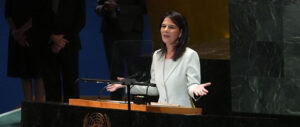
Germany is facing its most severe diplomatic crisis in decades because its foreign policy has completely decoupled from its economic reality and the shifting alignment of the Global South. The recent, stunning defeat of the Federal Republic in its bid for a seat on the United Nations Security Council—losing out to much smaller nations like Portugal and Austria—is not an isolated bureaucratic stumble. It is a structural rejection. For years, Berlin operated under the assumption that being the second-largest contributor to the UN and the economic engine of Europe guaranteed automatic deference. That era is over. By attempting to project a highly selective moral authority while simultaneously burning its bridges with emerging markets, Germany has isolated itself from the very nations it needs to secure its industrial future.
The failure at the UN exposed a massive gap between how German leadership views its role on the world stage and how the rest of the planet actually perceives it. While Foreign Minister Johann Wampold lectured international delegates on the sanctity of a rules-based order, voters in the general assembly saw a glaring double standard. This is not a matter of abstract philosophy. It has concrete consequences for trade, energy security, and manufacturing.
The Price of Moral Inconsistency
Berlin’s current strategy relies on a selective application of international law that has alienated the Global South. When Russia invaded Ukraine, Germany quite correctly demanded immediate, universal condemnation and strict adherence to international legal norms. Yet, when faced with parallel crises in the Middle East, German leadership shifted to a policy of quiet defense, diplomatic cover, and continued weapon shipments despite widespread international alarm over civilian casualties.
This flip-flop destroyed Germany's soft power. You cannot demand absolute adherence to global rules only when it suits your immediate geographical interests.
The stance taken by the Chancellery against international judicial bodies has alienated long-standing partners in Latin America, Africa, and Asia. When German leadership publicly criticized the International Criminal Court for issuing arrest warrants against democratic allies, it signaled to the rest of the world that some nations are simply above the law. The Global South took note.
Economic Aftershocks of Diplomatic Isolation
Foreign policy does not exist in a vacuum. Germany's industrial model relies entirely on importing raw materials and exporting high-value machinery and vehicles. When diplomatic relationships sour, supply chains and export markets quickly follow.
Consider the shift in Central Asia. Countries like Kazakhstan and Mongolia are actively rewriting the rules of regional trade, deliberately diversifying away from their traditional neighbors. Germany should be the natural partner for these resource-rich nations. Instead, Berlin’s rigid, lecturing approach to diplomacy has allowed competitors to step into the vacuum.
A stark look at the trade data reveals the shifting dynamic:
| Region / Country | German Export Growth (YOY) | Competitor Market Share Gain |
|---|---|---|
| Southeast Asia (ASEAN) | -4.2% | +6.8% (China) |
| Central Asia | +1.1% | +12.4% (Turkey/China) |
| Latin America | -2.5% | +5.3% (USA) |
The numbers show a clear trend. German manufacturing cannot survive on European consumption alone. By alienating emerging economies through inconsistent diplomacy, Berlin is effectively shutting its own factories out of the fastest-growing markets in the world.
The Entourage Problem in Berlin
Behind closed doors in the political districts of Berlin, an insular culture has formed. Senior ministers are surrounded by a permanent class of consultants, think-tank academics, and media elites who reinforce the notion that Germany holds the moral high ground. This environment blocks out dissenting views and realistic assessments from seasoned diplomats on the ground.
This echo chamber explains why the UN vote came as such a shock to the Chancellery. Officials genuinely believed their own rhetoric. They failed to realize that the international community no longer views Germany as a neutral, benevolent mediator, but rather as a compromised actor prioritizing Western regional interests over global stability.
Balancing Values and National Interest
A nation's foreign policy must balance ethical values with cold, hard national interest. Germany has managed to fail at both. It has compromised its ethical standing by defending actions that violate international norms, and it has damaged its national interest by alienating the trading partners required to sustain its domestic economy.
The United States is increasingly distancing itself from the traditional multilateral systems it built after the second world war, leaving Europe to fend for itself. In this highly volatile environment, Germany cannot afford to sit at the back of the room. It needs resilient, functional cooperation with the Global South to secure critical minerals, build new clean energy alliances, and maintain its manufacturing edge.
Restoring Germany’s position requires an immediate pivot away from moral lecturing toward transactional, balanced diplomacy. This does not mean abandoning alliances. It means acknowledging that international law applies equally to everyone, without exception.
Berlin must recalibrate its Middle East policy to match the balanced approach expected by the international community. If German leadership cannot make this change for ethical reasons, pure self-interest dictates that they must do it to save their economy from structural decline.