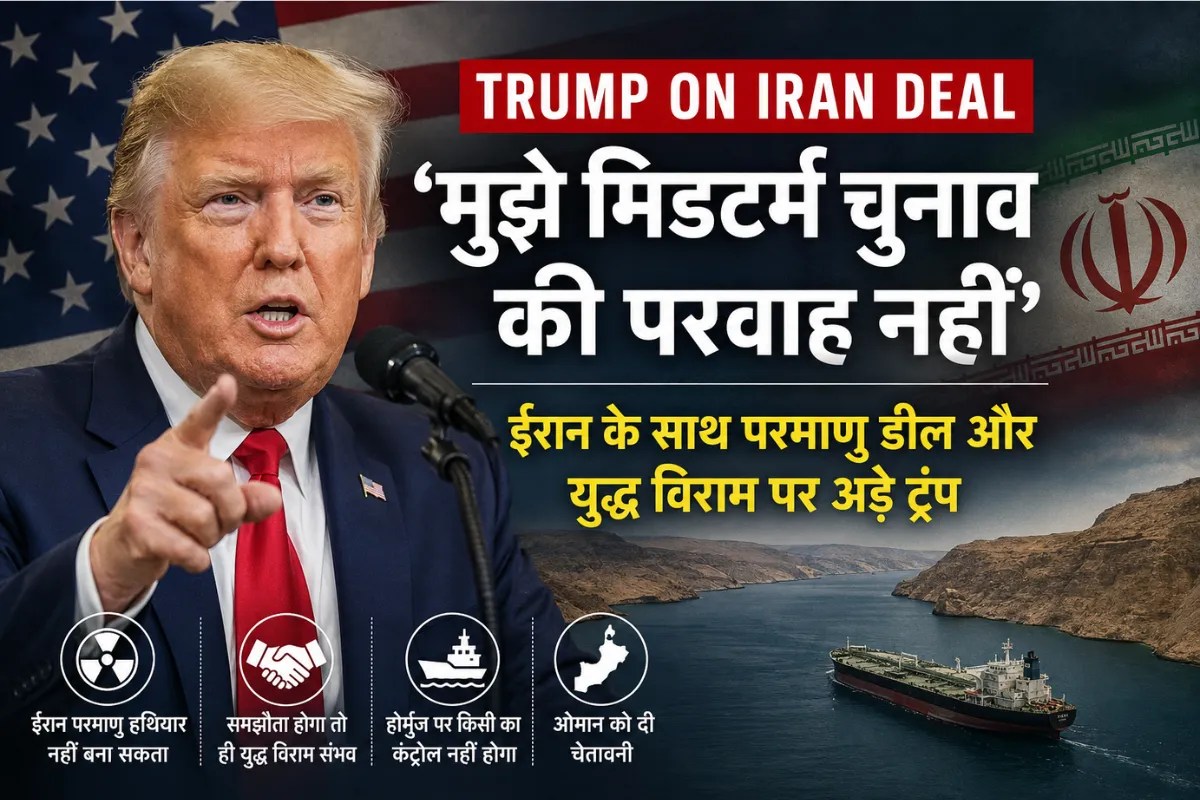
Donald Trump wants the world to believe he is operating entirely outside the gravity of American domestic politics. Facing an ongoing military conflict with Iran that has choked off twenty percent of the global energy supply, the American president used a late May Cabinet meeting to declare his total independence from the fast-approaching November midterm elections. Iran is negotiating on fumes, Trump asserted, claiming Tehran is deliberately stringing out ceasefire talks in the mistaken belief that electoral anxieties will force the White House to capitulate. "I don't care about the midterms," Trump stated plainly.
The reality behind the bravado is far more complex. The administration is currently trapped between a deteriorating domestic economy plagued by soaring fuel prices and fierce resistance from hardline congressional Republicans who view any negotiated settlement with Tehran as an outright surrender. While Trump claims a comprehensive peace deal is largely negotiated, his sudden shift back to maximum-demand rhetoric exposes a presidency struggling to balance global military leverage against a sinking domestic approval rating.
The Mirage of the Doha Breakthrough
Just days before the president’s public rhetorical pivot, the parameters of a potential breakthrough in Doha seemed tantalizingly close. Regional officials leaked details of a phased blueprint designed to unwind the three-month-old war. The baseline mechanism was straightforward. A fragile ceasefire enacted on April 8 would be extended for sixty days. During this window, Iran would begin clearing naval mines from the Strait of Hormuz, gradually restoring commercial shipping to prewar levels. In return, Washington would initiate a multi-stage unfreezing of roughly twenty-four billion dollars in Iranian assets held overseas.
Then the diplomatic machinery stalled on a single, massive point of friction: Iran's highly enriched uranium stockpile.
According to data from the International Atomic Energy Agency, Tehran currently holds over 440 kilograms of uranium enriched up to sixty percent purity. That is a brief, technical step away from weapons-grade material. Trump has insisted that Iran must surrender what he terms its nuclear dust before receiving a single cent of sanctions relief.
The mechanics of that extraction have created an administrative impasse. White House officials floated a plan to transfer the highly enriched stockpile to a third party for dilution or safekeeping. Trump, however, explicitly ruled out the two most logical destinations. "I wouldn't be comfortable" with Russia or China taking possession of the material, the president noted. By rejecting the only two global powers possessing both the technical infrastructure and the diplomatic ties to Tehran necessary to facilitate such a transfer, the administration effectively locked the negotiations into a holding pattern.
The Midterm Math and the Primary Echo
Trump's public dismissal of the midterm elections ignores the precise calendar governing his party's political survival. Capital markets are reacting poorly to the prolonged closure of the Strait of Hormuz. Energy costs are squeezing consumer sentiment, dragging the president’s economic approval ratings to second-term lows. For rank-and-file Republicans facing tough re-election campaigns in suburban districts, the economic fallout of an indefinite Persian Gulf blockade is an immediate threat.
To justify his political immunity, Trump pointed to internal party dynamics rather than national polling. He specifically cited the Texas Republican Senate primary outcome, where his endorsed candidate, Ken Paxton, defeated sitting Senator John Cornyn. In Trump’s view, this victory demonstrates that his populist base rewards geopolitical defiance far more than it punishes localized economic discomfort.
"They thought they were gonna outwait me," Trump told his Cabinet. "You know, 'We'll outwait him. He's got the midterms.' I don't care about the midterms."
This calculation assumes that the core electorate will continue to accept historic inflation levels in exchange for a perceived foreign policy victory. The gamble is immense. Tehran understands that every week the shipping lanes remain closed, the domestic political pressure on Washington intensifies. This forms the basis of the stalling strategy Trump publically denounced.
The Ghost of the Obama Agreement
The ghost of the 2015 Joint Comprehensive Plan of Action hangs over every draft agreement originating from the current talks. Republican heavyweights, including Senators Ted Cruz and Lindsey Graham, have already begun signaling deep skepticism regarding the emerging Doha framework. The primary fear among conservative hawks is that any deal allowing Iran to retain its domestic enrichment infrastructure—even under strict oversight—replicates the core architecture of the Obama-era accord that Trump famously dismantled during his first term.
To counter this narrative from his right flank, Trump has dramatically expanded his list of demands, effectively moving the goalposts mid-negotiation. He recently announced that any final deal must be contingent upon major Arab states, including Saudi Arabia, Qatar, and Kuwait, formally joining the Abraham Accords and normalizing diplomatic relations with Israel.
This condition complicates an already fraught bilateral negotiation. By tying a bilateral military ceasefire to a sweeping transformation of regional Middle Eastern diplomacy, the White House has made a swift resolution highly unlikely. Saudi Arabia and Qatar have their own complex security calculations regarding Iran; they are unlikely to alter their foundational diplomatic stances merely to help Washington exit a tactical corner before November.
Fumes Versus Freefall
The administration’s current strategy relies entirely on the premise that Iran’s internal economic collapse will outpace America's electoral clock. The president frequently highlights Iran’s catastrophic domestic indicators, pointing to an inflation rate hovering near 250 percent and a collapsing national currency. "Their whole economic system is broken down," Trump argued, concluding that Tehran simply lacks the structural stamina to sustain a prolonged conflict.
Yet history suggests that economic strangulation rarely produces immediate diplomatic capitulation. The Islamic Revolutionary Guard Corps retains tight control over domestic distribution networks, and the recent U.S. "defensive" air strikes on missile sites and minelaying boats in southern Iran have allowed hardline factions in Tehran to frame the conflict as an existential defense against Western aggression. Rather than forcing a concession, the tactical military exchanges have disrupted the diplomatic momentum, leading Iranian officials to label the American actions a bad-faith violation of the April ceasefire.
The current deadlock leaves the global economy exposed to ongoing instability. Trump’s insistence that he will either secure an absolute surrender or "finish the job" via direct military action sets up a high-stakes waiting game. The White House is betting that the Iranian regime will break before American voters head to the ballot box. If that calculation proves wrong, the administration will enter the final stretch of the election season carrying the double burden of an unresolved foreign war and an increasingly volatile domestic economy.