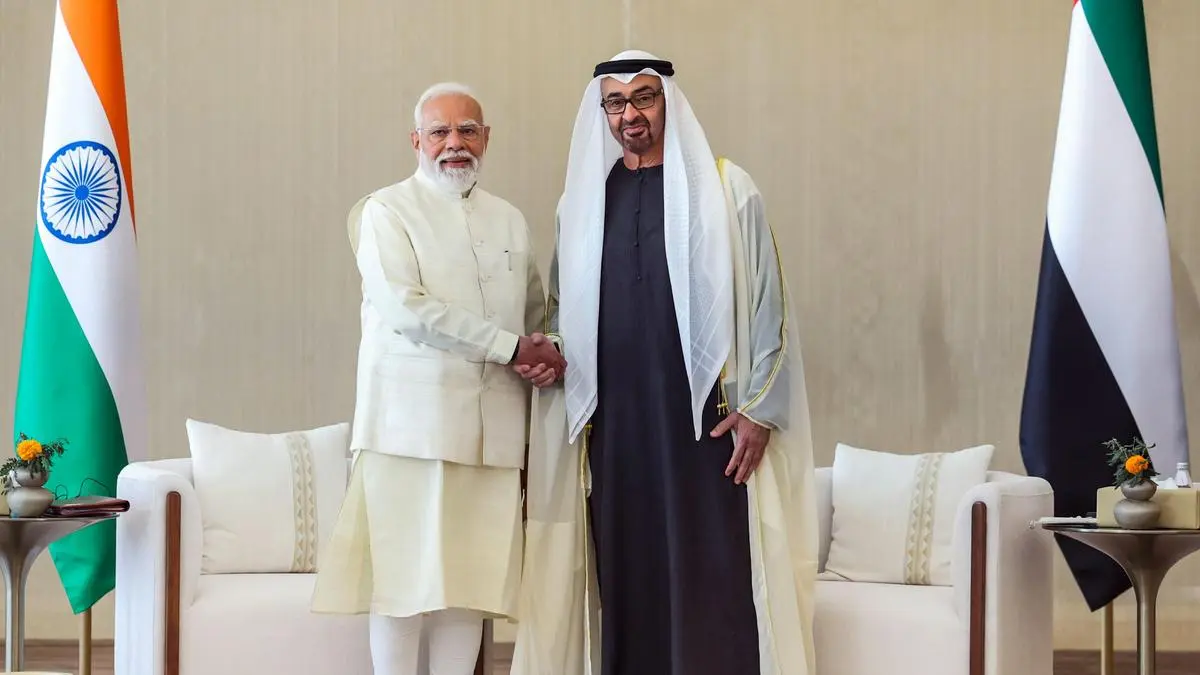
Prime Minister Narendra Modi’s recent visit to the United Arab Emirates signals a fundamental shift in how New Delhi views its responsibility toward the Middle East. While the official rhetoric emphasizes "all possible support" for peace, the underlying reality is a calculated expansion of Indian soft and hard power in a region historically dominated by Western and Chinese interests. India is no longer a passive observer of Gulf stability; it is now an active stakeholder driven by the urgent need to protect its energy security and the millions of Indian nationals working across the Peninsula.
The Strategic Pivot Beyond Energy
For decades, the relationship between India and the UAE was defined almost exclusively by the flow of crude oil and the remittance checks sent home by laborers. That era has ended. Today, the engagement is anchored in a sophisticated web of defense cooperation, food security corridors, and high-tech investment.
When Modi speaks of peace, he isn't just offering platitudes. He is protecting a massive economic engine. The Comprehensive Economic Partnership Agreement (CEPA) has already pushed bilateral trade toward the $100 billion mark. Any prolonged instability in West Asia—whether it involves the maritime choke points of the Red Sea or the volatile borders of the Levant—directly threatens the Indian economy’s growth trajectory.
The Maritime Security Equation
India has quietly increased its naval presence in the Arabian Sea. This isn't a coincidence. By positioning itself as a "net security provider," New Delhi is telling its Gulf partners that it has the muscle to back up its diplomatic overtures. The UAE sees this. Abu Dhabi is looking to diversify its security partners, moving away from a total reliance on Washington, and India fits the bill as a non-interventionist power with a massive, battle-hardened military.
The protection of trade routes is the silent priority. If the tankers stop moving, the lights go out in Mumbai. It’s that simple.
The IMEC Shadow Over Diplomacy
A major factor driving this diplomatic urgency is the India-Middle East-Europe Economic Corridor (IMEC). Announced with great fanfare, this project aims to link India to Europe via ship and rail through the UAE, Saudi Arabia, Jordan, and Israel.
The current conflict in Gaza and the surrounding regional tensions have placed a massive question mark over IMEC’s timeline. India’s offer of support for peace is, in many ways, an attempt to revive the momentum for this corridor. Without a stable Middle East, the "modern-day spice route" remains a theoretical map on a boardroom table rather than a functioning artery of global commerce.
Why the UAE is the Gateway
The UAE serves as the logistics hub for this vision. DP World’s massive investments in Indian ports are the flip side of the coin. We are seeing a total integration of supply chains. When the Indian Prime Minister visits a UAE president, they aren't just discussing regional stability; they are discussing the plumbing of the global economy.
The Diaspora as a Diplomatic Shield
There are over 3.5 million Indians in the UAE. This group represents roughly 35% of the country’s population. In the past, this was seen as a vulnerability for India—a massive group of citizens that might need evacuation during a crisis.
Now, the narrative has flipped. This diaspora is a potent tool of influence. They run the hospitals, manage the banks, and build the infrastructure. This "human bridge" gives India a level of domestic political leverage within the UAE that no other foreign power can match. It makes the UAE’s stability a domestic Indian issue.
Moving Beyond the Non-Aligned Mindset
India’s willingness to take a stand, however balanced, marks the death of the old "non-aligned" policy that used to paralyze Indian foreign outreach. New Delhi is now comfortable maintaining a strategic partnership with Israel while simultaneously being the largest provider of development aid and political support to the UAE and Saudi Arabia.
This balancing act is fraught with risk. The Middle East does not traditionally reward those who try to walk the middle path. However, India’s unique position—having no history of colonial baggage in the region and no desire to impose a specific political ideology—makes it a rare acceptable mediator.
The Realities of Peace Mediation
It is easy to offer support; it is much harder to deliver it. India’s "support" likely won't take the form of troop deployments or high-profile peace summits in New Delhi. Instead, expect a focus on "minilateralism"—small, functional groups like the I2U2 (India, Israel, UAE, and the US) that focus on specific projects like water security and food parks.
By solving practical problems, India hopes to create a climate where political peace becomes a necessity for economic survival. It is a "bottom-up" approach to diplomacy.
The Defense Trade Factor
Another overlooked element is the burgeoning defense trade. India is looking to export its indigenous hardware, including the BrahMos missile and Tejas fighter jets. The Gulf nations are looking to modernize their forces with equipment that doesn't come with the heavy political strings attached to American or European hardware.
This creates a cycle of dependency. If the UAE buys Indian tech, it requires Indian trainers, Indian maintenance, and a long-term strategic alignment. Peace is the prerequisite for these multi-decade contracts to bear fruit.
The Intelligence Connection
Behind the handshakes and the televised speeches lies a deep and growing cooperation in counter-terrorism and intelligence sharing. Both New Delhi and Abu Dhabi view radicalization as a direct threat to their sovereign stability. This shared threat perception has led to an unprecedented level of cooperation between their respective security agencies.
Extraditions that used to take years now happen in weeks. This isn't just about crime; it's about ensuring that the regional environment remains conducive to the massive capital investments both nations are making in each other’s futures.
The Currency Play
The move to trade in local currencies—Rupees and Dirhams—is perhaps the most aggressive move toward long-term autonomy. By bypassing the US Dollar for specific transactions, India and the UAE are insulating their trade from Western sanctions or shifts in US monetary policy.
This financial decoupling is a clear indicator that the partnership is built for a multipolar world. It is a hedge against the unpredictability of traditional global powers.
The Fragility of the Moment
While the optics of the visit were flawless, the obstacles remain immense. Regional rivalries are deep-seated and resistant to economic logic. India’s biggest challenge will be maintaining its "friend to all" status if the region further polarizes.
The pressure to choose a side will mount as tensions between major regional players fluctuate. So far, New Delhi has managed to keep its interests siloed, but a major regional conflagration would test the limits of this strategic autonomy.
The Investment Lag
Despite the high-level agreements, the actual flow of UAE sovereign wealth into Indian infrastructure has sometimes been slower than New Delhi would like. Bureaucratic hurdles in India still frustrate Gulf investors. The Prime Minister's visit is as much about clearing these internal bottlenecks as it is about external diplomacy.
The UAE wants to see "Red Carpet" treatment, not "Red Tape." If India wants the UAE to be its primary partner in peace and prosperity, it must ensure that the domestic environment in India is as seamless as the rhetoric suggests.
The Burden of Leadership
India is finding that as its global stature grows, it can no longer afford the luxury of silence. The Middle East looks to India not just as a market, but as a stabilizing force. This is a heavy mantle for a nation that still faces significant development challenges at home.
The pivot toward the UAE is the first real test of whether India can project power without losing its soul. It is a gamble that the road to global influence runs directly through the ports of Dubai and the oil fields of Abu Dhabi.
India’s offer of support for peace is a declaration of presence. New Delhi has decided that it is better to be at the table, with all the risks that entails, than to be on the menu. The success of this strategy will be measured not in the warmth of the joint statements, but in the physical construction of the rails and pipes that aim to bind the East and West together through an Indian lens.