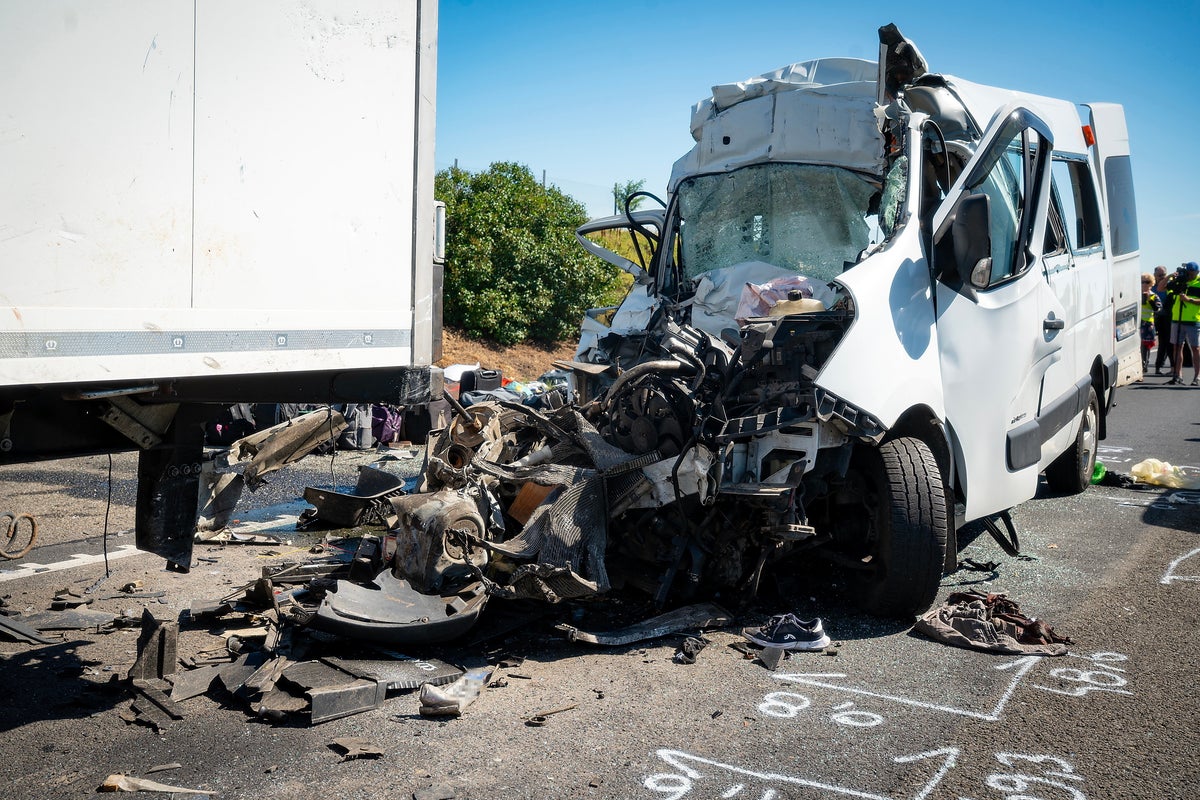
The asphalt on European route E75 doesn’t care about borders, time zones, or the quiet weight of human exhaustion. It simply stretches. On a sweltering midsummer night in southern Hungary, just miles from the Serbian border, that asphalt became a pressure cooker.
Highway driving is an exercise in collective faith. We hurtle past each other in metal boxes at ninety miles an hour, separated by nothing more than a painted yellow line and a mutual agreement not to die. We trust that the braking lights ahead will flash when they should. We trust that the driver behind us isn’t fighting a losing battle against sleep. But trust is a fragile currency when the temperature hovers in the sticky double digits at two in the morning, and the road ahead stalls into an unexpected, midnight parking lot.
A minor, routine traffic accident had occurred earlier on the northbound lane near the town of Kistelek. It was the kind of fender-bender that barely merits a local radio mention. Yet, highway traffic possesses its own cruel, fluid mechanics. One brake pedal tapped too hard ripples backward for miles, creating a ghost jam out of nowhere. Vehicles slowed, ground to a halt, and waited.
Among them was a small, Romanian-registered minibus. Inside were seven people. They were travelers, workers, perhaps family members heading home or venturing toward a new life across Europe. We do not know their private conversations from that night, but we know the atmosphere of a stalled vehicle on a long haul. The sigh of the engine cutting out to save fuel. The click of a hazard light. The roll of a window to let in the heavy, humid night air. They were sitting targets, trapped in the invisible wake of an accident they couldn't see.
Then came the truck.
Consider the physics of a fully loaded international freight transport. It is a rolling mountain. At cruising speed, it carries a momentum that defies easy arrest. When a driver’s attention flickers—even for the duration of a single heartbeat—the highway ceases to be a thoroughfare and becomes a zone of pure devastation.
The Turkish-registered semi-truck did not slow down. It tore into the stationary traffic with the terrifying force of a kinetic missile. It plowed directly into the rear of the Romanian minibus, pushing it forward into another truck ahead. The smaller vehicle was caught in a vice of unyielding steel.
The impact was instantaneous.
When the metal stopped screaming, there was only the hiss of ruptured radiators and the flashing red and blue strobe lights of the emergency services cutting through the Hungarian dark. Seven people entered that traffic jam looking at the taillights of the car ahead, waiting for the road to clear. None of them survived.
The driver of the Turkish truck crawled out of his cabin. He was injured, but alive, later taken to a hospital in Szeged under police guard.
To read the official police dispatches from Csongrád-Csanád County the following morning is to witness the clinical detachment we use to process horror. The authorities reported the facts with mechanical precision: the time of the crash, the nationalities of the vehicles, the closing of the motorway, the diversion of traffic to main road 5. They noted that the victims died at the scene.
But statistics are just numbers with the tears wiped off.
The true catastrophe of an accident like the Kistelek collision is the sudden, violent erasure of context. Seven households woke up to a ringing phone that morning. Seven lives, filled with mundane plans for the weekend, grocery lists, unresolved arguments, and deep affections, were instantly reduced to a paragraph in a regional news feed.
The tragedy exposes a systemic vulnerability in the way we move across the modern world. We have built high-speed transit networks that demand flawless human performance, yet we populate them with tired human beings. International freight drivers face brutal schedules, navigating thousands of miles across shifting time zones under intense corporate pressure. When fatigue sets in, the brain narrows its focus, tunnel vision takes over, and the ability to perceive a sudden hazard drops to near zero.
A stalled line of cars on a dark highway shouldn't be a death sentence.
Safety experts often talk about the "onion layer" approach to road safety—infrastructure, vehicle technology, driver behavior. When one layer fails, the others are supposed to hold. But on Europe's transcontinental corridors, those layers are wearing thin. The rise of cross-border commuting and heavy freight logistics has turned routes like the E75 into high-stakes endurance tests.
We look at autonomous braking systems and lane-assist technologies as the salvation for these human errors. We hope that code can replace vigilance. Yet, until every chassis on the road is governed by silicon instead of sinew, the ultimate responsibility rests on the eyes behind the wheel. The terrifying truth of the Kistelek crash is its sheer normalcy. It didn't require a natural disaster or a mechanical failure. It required only a moment of empty space where a driver's focus should have been.
By dawn, the wreckage had been hauled away. The shattered glass and twisted metal were cleared from the northbound lanes, and the Hungarian police reopened the motorway. The commuters returned. The trucks began to roll again, their tires humming over the exact spot where seven lives had ended just hours before.
The road swallows everything, erasing its own history the moment the traffic begins to move. But for those who understand the fragile nature of the journey, every red brake light in the distance is no longer just an inconvenience. It is a warning. It is a plea to look in the rearview mirror and watch the dark behind you.