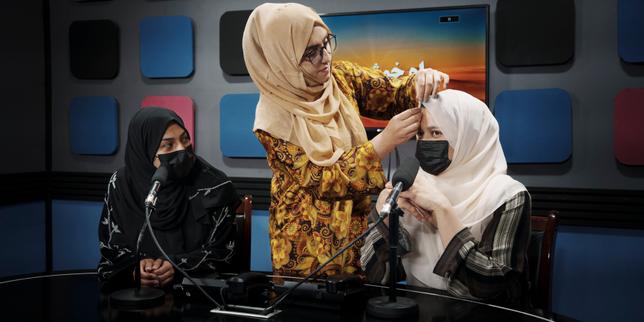
In the fractured landscape of modern Afghanistan, the act of speaking is an act of war. When the Taliban shuttered classrooms and effectively erased the public presence of women, they assumed silence would follow. They were wrong. Across the country, a quiet, high-stakes insurgency of the mind has taken root. It is not fought with artillery, but with battery-powered radios, hidden notebooks, and a digital network that operates in the shadows of a regime committed to total domestic erasure. This is not merely a story of survival. It is an account of a systemic, grassroots campaign to preserve intellect under an administration that views education as a direct threat to its authority.
The core of this resistance relies on the democratization of information. When you cannot walk into a school, the school must come to you. Radio Begum stands as the most prominent example of this transformation. By broadcasting educational programming, health advice, and emotional support directly into the living rooms of families who might otherwise be isolated, the station circumvents the physical checkpoints and gender-based restrictions that govern the streets. It is an end-run around the clerical apparatus of the state. These transmissions are not just broadcasts; they are lifelines, providing a sense of community to those who have been systematically stripped of their social, professional, and academic identities.
The Mechanics of Subterranean Education
The shift toward clandestine learning is not a centralized effort directed by international NGOs. Instead, it is a mosaic of hyper-local, high-risk initiatives. Consider a hypothetical example of how this functions in a Kabul neighborhood. A group of neighbors agrees to rotate secret classroom duties in private homes. The students arrive in small, staggered groups to avoid drawing the suspicion of local patrols. They carry no textbooks, which are easily identified as evidence of illicit activity. Instead, they use memory, oral tradition, and salvaged scraps of paper.
This model of clandestine education carries immense personal risk for everyone involved. If uncovered, the organizers face imprisonment, violence, or worse. The motivation here is not idealism alone; it is the grim realization that a generation of women denied basic literacy is a generation condemned to permanent poverty and dependence. By teaching mathematics, language, and science in secret, these women are effectively holding the floor of Afghan society together while the ceilings collapse.
Technology as a Double-Edged Sword
We often discuss the reach of the internet as an inherent good, yet in Afghanistan, the digital space serves as a dangerous paradox. Smartphone access has provided a bridge to global educational content, allowing young women to audit courses or access PDFs that were previously locked away in libraries or university halls. However, this same connectivity creates a surveillance trap. The Taliban have become increasingly adept at monitoring digital footprints, using social media activity and messaging apps to track dissent.
To survive, the resistance has had to iterate rapidly. Encryption is the new basic literacy. Women are learning to purge their devices, use burner accounts, and establish complex physical verification protocols to ensure that their digital work does not lead to physical raids. This is a cold, calculated game of cat and mouse. Every lesson delivered via a messaging app is a potential liability; every document shared is a potential smoking gun.
The Cost of Stolen Agency
Western observers often view these developments through a lens of heroic tragedy, focusing on the indomitable spirit of the survivors. While that spirit is undeniable, it obscures the crushing reality of what is being lost. Every hour spent hiding to learn basic literacy is an hour lost to the development of a career, the exercise of political rights, or the simple safety of a public life. The focus on underground strategies can inadvertently normalize the situation, making it seem as if the burden of reform rests solely on the shoulders of the oppressed.
The economic ramifications of this exclusion are staggering. By barring half the population from the workforce and higher education, the regime has effectively neutered the nation’s long-term economic prospects. This is not just a human rights crisis; it is a structural collapse. Brain drain has accelerated, with the country’s most talented women fleeing whenever possible, further weakening the local capacity for change. The remaining population is left to manage a society that is rapidly losing its medical professionals, its engineers, and its teachers.
Why the Traditional Narrative Fails
Most coverage of this issue relies on the binary of victims versus oppressors. That framework is insufficient. The reality on the ground is a fluid, grey area where parents, brothers, and husbands—some of whom may hold conservative views—nevertheless participate in the quiet facilitation of their daughters' or sisters' educations. It is a fragmented alliance of necessity. Men who have lost their jobs are finding that the income their wives could have earned is desperately needed, yet they are trapped in a system that forbids it.
We must also confront the limitations of international support. Aid, while necessary for basic food and medical security, rarely penetrates the level of private, clandestine instruction. The danger is that the global community will settle into a routine of humanitarian handouts while the intellectual capacity of an entire nation continues to wither. Sustained, long-term change requires more than just survival; it requires the restoration of a legitimate public sphere.
There is no elegant ending to this story. As long as the current regime holds power, the struggle will remain a desperate, daily grind. There will be no major breakthrough, no sudden capitulation of the authorities, and no easy victory. There is only the stubborn, relentless insistence that the lights stay on. The radio remains tuned. The front door remains locked. The books remain hidden in the floorboards. The battle for the Afghan mind continues in the dark, and it shows no sign of yielding.