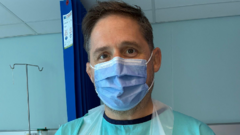
Imagine looking down at your hands and staring at the very organ that kept you alive for nearly three decades, completely severed from your body. It sounds like a scene from a medical horror movie. But for former Wales rugby international Rhys Thomas, it became a reality in Cape Town. After a grueling 14-year wait on the brink of death, the 43-year-old former prop finally underwent a life-saving heart transplant. Days later, he posed for a photograph holding his own severely scarred, removed heart.
It's a shocking image that quickly went viral. But if you only look at the shock value, you miss the actual point of his survival story. This isn't just about a grizzly medical photo. It's about a man who broke medical records, survived a catastrophic lifestyle, and beat odds that should've buried him over a decade ago.
The day a 29-year-old elite athlete collapsed
We think of professional rugby players as modern gladiators. They run through brick walls for 80 minutes, take brutal hits, and bounce back. Rhys Thomas was exactly that. A powerful prop forward, he earned seven caps for Wales and played at the highest level for Newport Gwent Dragons and Scarlets.
Then came January 2012. During a routine Scarlets training session, the absolute last thing anyone expected happened. Thomas collapsed on the turf. At just 29 years old, he was having a massive heart attack.
It wasn't his first warning sign. Six years earlier, he suffered a mild heart attack after a match. But this time, his heart didn't just stumble; it completely quit.
Medical staff at the ground and specialists at Swansea’s Morriston Hospital fought for seven hours during emergency open-heart surgery. They performed a quadruple bypass just to keep him on this planet. The damage was catastrophic. Thomas lost over 50% of his heart muscle. When he woke up, his rugby career was dead, and his own life hung by a thread. Doctors told him his only long-term shot at survival was a heart transplant.
Trapped in medical limbo with a machine in a man-bag
Getting a new heart isn't as simple as signing a piece of paper. Because of a complication called pulmonary hypertension, doctors initially declared Thomas's heart "un-transplantable." He was too sick to get a new organ, but too damaged to survive with his old one.
By 2014, his failing heart could no longer handle the load. To keep him alive, a team of three leading surgeons at Birmingham's Queen Elizabeth Hospital installed a Left Ventricular Assist Device (LVAD).
An LVAD is a mechanical pump wired directly into the heart's lower chamber. It literally does the heavy lifting of pumping blood to the rest of the body. But it comes with a massive catch. The machine requires constant power. Thomas had to carry batteries around in a man-bag everywhere he went during the day. At night, he quite literally had to plug himself into the house electricity mains to stay alive.
"This intervention bought him time, but not quality of life," noted Dr. Willie Koen, the cardiac surgeon who later treated him. "For someone who lived for sport, being tethered to batteries and unable to swim or shower normally is survival, not living."
The UK record for surviving on an LVAD was 11 years. The machine was designed to be a brief bridge to a transplant, not a permanent lifestyle. Yet Thomas carried that bag, plugged himself into walls, and kept ticking for 12 years. He blew past the medical statistics through sheer stubbornness.
The hidden battle with addiction and scar tissue
Living on battery power takes a massive toll on your mind. When you lose your career, your physical identity, and your independence all at once, your mental health tanks. Thomas didn't hide from this. He admitted that his early heart issues were heavily tied to alcohol abuse.
Losing rugby sent him into a spiral of depression and addiction. By 2019, his friends knew his self-destructive behavior would kill him before his mechanical pump failed. They stepped in, flying him to a dual-diagnosis rehab facility in Cape Town, South Africa—the country where he was born. Thomas got clean. He has now been sober for over seven years, an achievement he considers just as vital as surviving the operating table.
But time was running out for the hardware. By 2020, the LVAD started underperforming. When he asked British doctors for a replacement pump, they dropped a hammer on him. Because of the heavy scar tissue from his 2012 quadruple bypass and subsequent surgeries, he wasn't eligible for another machine in the UK.
So, he made a high-stakes gamble. In September 2024, Thomas and his fiancée, Keziah Green, relocated permanently to Cape Town to buy into the South African donor list. It was a race against a dying machine.
The 7 AM phone call and looking at his own heart
On April 22, the 14-year wait ended. Dr. Willie Koen called at 7:00 AM with the news that a matching donor heart was available. The transplant happened that morning.
When surgeons opened him up, they removed the old, failing muscle tissue and the mechanical pump that kept him breathing for over a decade. Days later, Thomas did something few humans ever do. He held that heavy, battle-scarred organ in his gloved hands. The machine that saved him was still sticking out of the tissue.
Honestly, looking at that photo forces you to realize how fragile life is. Thomas didn't view it as a gruesome trophy. He saw it as a moment of absolute surrender and gratitude. He survived the statistical cliff of the LVAD, overcame addiction, and finally broke free from the wires.
What you need to take away from this story
Rhys Thomas is currently recovering in South Africa, celebrating becoming a grandfather while preparing for a new baby of his own. His journey offers clear, hard lessons that go far beyond sports trivia.
- Don't ignore the early warnings: An elite fitness level doesn't make you bulletproof. If your body signals that something is wrong, get it checked by a specialist immediately.
- Have the awkward talk about organ donation: Thomas is alive today exclusively because a stranger's family said yes during their worst moment of grief. Talk to your family about your organ donor status so they don't have to guess your wishes in an emergency.
- Fix the mental health before the physical health: You can't heal a broken body if you're actively destroying your mind. Facing addiction or depression head-on is a prerequisite for physical recovery.
Thomas spent 12 years tethered to a wall socket just to see this day. Don't waste your own health waiting for a crisis to force your hand. Check your heart health, register as a donor, and check on your friends who might be struggling silently behind a tough exterior.