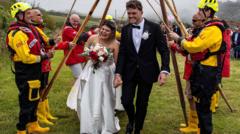
Every time a pair of newlyweds walks out of a church through an archway of yellow wellies, the internet swoons.
The Royal National Lifeboat Institution (RNLI) gets its viral moment. Local news outlets copy-paste the same fluffy press release. Commenters flood the feed with heart emojis, praising the dedication of volunteer crews celebrating one of their own. Meanwhile, you can read similar developments here: Why the India Seychelles Alliance Actually Matters Right Now.
It is a heartwarming spectacle. It is also a operational distraction that masks a growing systemic crisis within the UK’s voluntary emergency services.
We need to stop treating emergency service asset deployment as a backdrop for wedding photography. To understand the full picture, check out the excellent report by BBC News.
The lazy consensus tells us these moments are harmless community building. They are framed as essential for recruitment and public goodwill. But behind the scenes of these carefully staged photo opportunities lies a different reality. Having spent years analyzing operational readiness and emergency deployment structures, I see these "feel-good" stories for what they actually are: an optimization nightmare that blurs the line between public service and personal hobby.
The True Cost of Operational Friction
When a volunteer crew organizes a "welly guard of honour," they aren't just standing on a pavement. They are deploying active personnel, often utilizing station equipment, uniform assets, and pager-responsive individuals within a tight geographic radius.
Emergency response relies entirely on minimizing friction. Seconds save lives at sea. The mechanics of launching a Shannon-class or D-class lifeboat require absolute focus, specific launch site geometry, and crew members who are mentally and physically prepared to pivot from zero to one hundred miles per hour instantly.
Imagine a scenario where a pager goes off while eight crew members are mid-pose outside a church two miles from the station.
- The Transportation Bottleneck: Crew members must navigate wedding traffic, pedestrian congestion, and personal vehicle logistics to reach the boathouse.
- The Gear Transition: Volunteers are wearing ceremonial dress or partial kit over civilian clothing, complicating the rapid transit into full drysuits and lifejackets.
- The Psychological Shift: The cognitive load required to instantly switch from social celebration mode to high-stakes maritime rescue introduces unnecessary human error.
Proponents argue that crew members are "always on call" anyway, whether at work, home, or a wedding. This misses the point entirely. There is a fundamental difference between a volunteer going about their daily life distributed across a town, and a concentrated cluster of vital crew members bottlenecked at a single social event. By concentrating key personnel at a non-operational venue for a PR stunt, the station introduces a single point of failure.
The Retention Fallacy: Fluff Doesn't Stop Burnout
The standard defense for these public displays is that they boost morale and aid recruitment. This is a flawed premise.
Data from across the voluntary sector shows that superficial perks and public adulation do nothing to solve the root causes of volunteer attrition. People do not join the RNLI because they want a guard of honour at their wedding. They join to save lives.
What actually drives volunteers away?
- Surging Training Demands: The complexity of modern maritime assets requires hundreds of hours of rigorous, ongoing certification.
- Fundraising Pressures: Volunteers increasingly find themselves acting as street collectors rather than rescue technicians.
- Bureaucratic Overload: The administrative burden of compliance, health and safety logs, and post-incident reporting has skyrocketed over the last decade.
Celebrating weddings in full kit cheapens the gravitas of the uniform. It transforms an elite, highly trained rescue technician into a prop for local interest journalism. When organizations prioritize the aesthetic of volunteering over the harsh, unglamorous reality of operational sustainability, they attract the wrong people for the wrong reasons.
Dismantling the "Community Goodwill" Argument
Let’s address the inevitable defense: "But it generates free publicity and donations!"
Does it? Let’s look at the mechanics of modern digital media. A viral photo of a wedding guard of honour creates passive engagement. It generates "likes," not sustainable financial legacies. It builds a soft, romanticized view of coastal rescue that actively harms the public’s understanding of maritime danger.
+------------------------------------+------------------------------------+
| The Romanticized PR View           | The Operational Reality            |
+------------------------------------+------------------------------------+
| Local heroes celebrating community | Concentrated crew bottlenecked at  |
| bonds.                             | a single geographic point.         |
+------------------------------------+------------------------------------+
| Harmless, free publicity for the   | Dilution of the professional       |
| charity.                           | image required for emergency orgs. |
+------------------------------------+------------------------------------+
| Boosts morale and strengthens crew | Masking systemic retention issues  |
| retention.                         | with superficial perks.            |
+------------------------------------+------------------------------------+
When the public sees lifeboat crews smiling in sunshine outside a church, it reinforces the myth that the RNLI is a casual, neighborly club. It divorces the organization from the brutal reality of what they do: pulling hypothermic casualties out of pitch-black, freezing water in Force 9 gales.
If the RNLI wants to secure its financial future, it needs to market its professionalism, its cutting-edge engineering, and its raw utility. It should not market itself as a quirky coastal wedding service.
Professionalization Is the Only Path Forward
Amateurism is the enemy of safety. The RNLI has spent the last thirty years pushing heavily toward professionalization—and rightly so. The introduction of the systems like the Systems and Equipment Tracking, advanced simulation training, and standardized launch protocols have dragged maritime search and rescue into the 21st century.
Yet, these ceremonial deployments represent a stubborn hangover from a bygone era of casual, unregulated coastal volunteering.
To maintain the utmost trust of the public and ensure absolute operational integrity, the boundaries must be airtight.
- Absolute Asset Separation: Station property, including ceremonial gear or operational kit, should never leave the station grounds for private, non-operational events.
- Geographic Dispersion Rules: On-call crew members must maintain strict dispersion protocols to ensure that a single local event cannot compromise the launch capability of the station.
- The "Off-Duty" Mandate: If a volunteer is attending a wedding, they should be formally signed off-duty. No pagers at the altar. No half-measures.
This approach has downsides. It will upset traditionalists. It will anger local coordinators who love the easy press hits. It will make the organization look less "warm" to casual observers.
But warmth does not keep a lifeboat afloat when a commercial fishing vessel is sinking three miles off a rocky headland. Absolute, unyielding operational discipline does.
Stop clattering yellow boots together on church steps. Pack the kit back into the boathouse, sign off the pager if you want to drink champagne, and leave the lifesaving gear where it belongs: ready for the worst-case scenario. Anything less is a gamble disguised as a celebration.