The air at fourteen thousand feet does not welcome you. It strips the moisture from your lips in a single breath, presses against your chest like a cold hand, and leaves your thoughts spinning just an inch behind reality. Up here, in the shadows of the high Himalaya, the mountains look eternal. They are jagged teeth biting into a cobalt sky, capped in blinding white. They have stood as silent, unyielding guardians for millions of years.
Except they are not unyielding anymore. Meanwhile, you can explore similar stories here: Stop Pretending The United Nations General Assembly Matters.
To understand what is happening on the roof of the world, you have to leave the glass-walled conference rooms of New York and walk the slate paths of Langtang or the wind-scoured ridges of Solukhumbu. You have to sit with a farmer named Pemba on a morning that should be crisp with autumn frost, only to feel a greasy, unseasonal heat radiating off the bare earth.
"The glaciers used to be our grandfathers," Pemba told me once, pointing a calloused finger toward a receding river of ice that now looked like a dirty, gravel-choked scar high up the valley wall. "They gave us water when the rains forgot to come. Now, they are running away from us. And when they leave, what is left behind?" To see the full picture, we recommend the detailed article by The Guardian.
What is left behind is a slow-motion catastrophe that the rest of the planet barely notices until the floodwaters roar down the gorges, swallowing bridges, homes, and centuries of human history in a single, muddy gulp.
For decades, the global conversation about climate change has been anchored to coastlines and smokestacks. We talk endlessly about rising seas drowning low-lying atolls in the Pacific, and rightfully so. We watch the polar ice caps calve into deep blue oceans on evening news broadcasts. But a critical part of the planetary engine is seizing up three miles above sea level, and it is happening with terrifying speed.
The Hindu Kush Himalaya mountain system holds the largest volume of ice outside the polar regions. It is the Third Pole. It feeds ten of the greatest river systems on Earth—the Indus, the Ganges, the Brahmaputra, the Mekong—providing the lifeblood for nearly two billion people. That is a quarter of humanity drinking, farming, and surviving on meltwater.
And that ice is vanishing. Recent scientific assessments indicate that Himalayan glaciers could lose up to eighty percent of their volume by the end of this century if current emissions trajectories hold.
Think about that number for a moment. Eighty percent. It is not just a statistic to be filed away in a quarterly report. It is the death sentence of a hydrological rhythm that has sustained civilizations since the dawn of agriculture.
Yet, for a long time, the nations sheltering beneath these giant peaks felt like minor players on a global stage dominated by industrial superpowers. They were the victims of a crisis they did not create, pleading for help from the bottom of a very deep, very steep economic well.
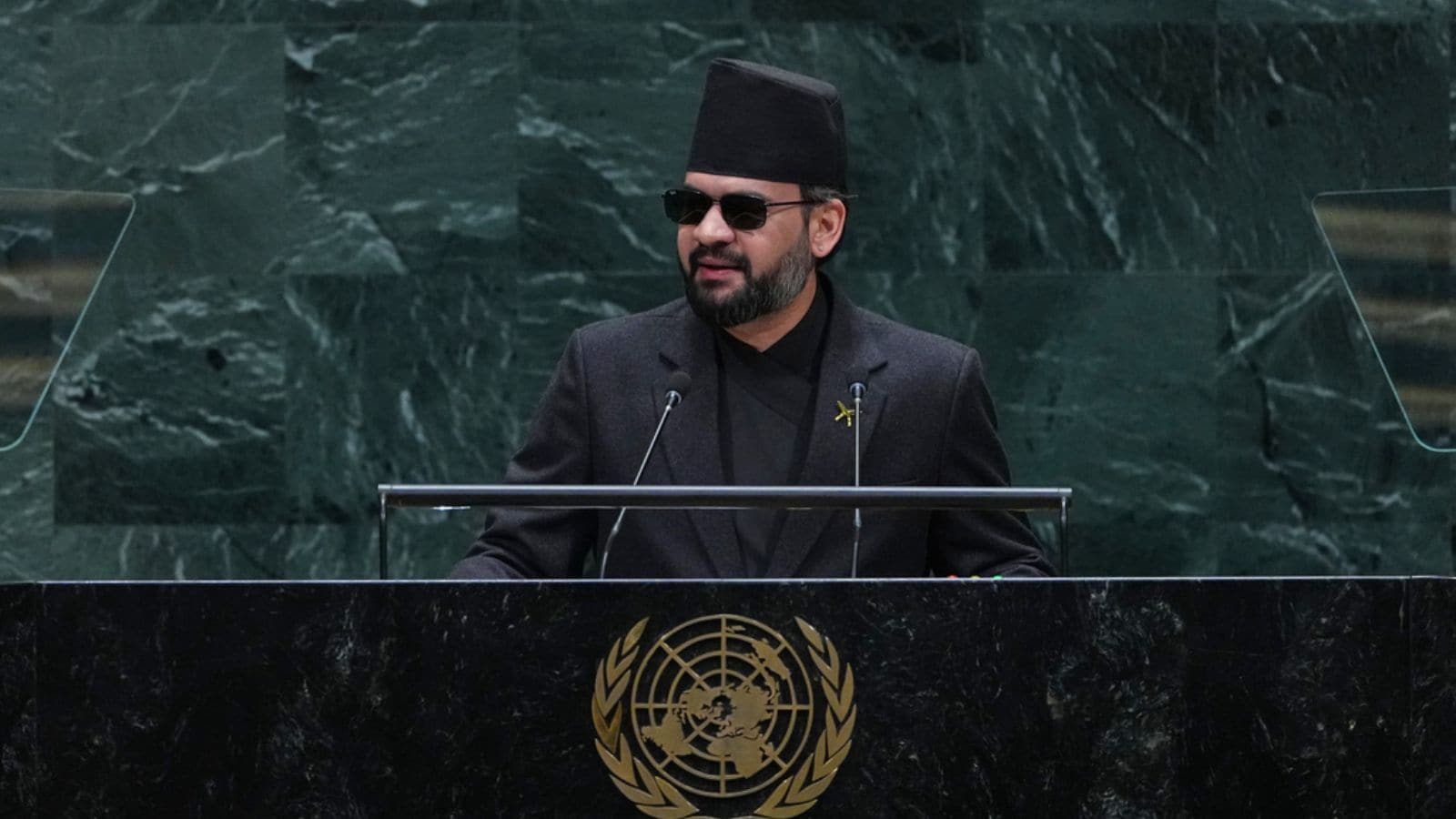
That dynamic shifted, if only slightly, when Nepal’s Prime Minister took the podium at the United Nations General Assembly and stopped asking for charity. Instead, he laid out a blueprint that sounded less like a diplomatic speech and more like an emergency broadcast: the Himalayan Climate Resilience Mechanism.
It was a bold proposal, cutting through the polite diplomatic murmurings that usually characterize UN gatherings. The core argument was brutally simple: mountain ecosystems do not respect international borders, and mountain crises cannot be solved by impoverished local governments working in isolation.
When a glacial lake outburst flood, known locally as a GLOF, tears down a valley, it does not pause to check if the downstream village belongs to Nepal, India, or Bangladesh. It destroys everything in its path. When unseasonal cloudbursts trigger massive landslides, they erase highways that link landlocked economies to global trade routes.
The proposed mechanism is designed to change the architecture of how the world responds to high-altitude climate shocks. It calls for targeted, cross-border financing, real-time early warning systems built on shared satellite data, and massive investments in climate-proof infrastructure that can withstand the wrath of an angry mountain.
But behind the diplomatic language and the bureaucratic acronyms lies a profound human struggle.
Consider what happens in a village like Khumbu when the water stops behaving. In the old days, the seasonal cycle was a predictable waltz. Winter brought snow; spring brought a gentle, measured melt; summer brought the monsoons. Farmers knew when to plant barley, when to move their yaks to higher pastures, and when to harvest.
Today, that waltz has turned into a chaotic, violent mosh pit.
Winter brings torrential rain instead of snow. The bare ground freezes, killing the seeds beneath it. Then, in the middle of summer, when the crops desperately need moisture, the glaciers upstream dump a massive surge of water all at once because a heatwave stalled over the peaks. The fields are washed away. The irrigation canals are choked with silt and boulders the size of delivery trucks.
Families who have worked the same terraced plots for six generations are packing up. They are leaving behind stone houses with slate roofs, walking down the mountain trails toward the crowded, humid sprawl of Kathmandu or even crossing international borders in search of work. They are climate refugees, though they rarely use that term. They just call it survival.
This is the invisible stake of the Himalayan crisis. It is not just about losing ice; it is about losing the social fabric of mountain communities. When the young people leave, the ancient knowledge of how to live in balance with a fragile, high-altitude environment dies with the elders who stay behind. The terraced fields crumble into dust. The ancient trails are reclaimed by alder scrub and rockfall.
The proposed resilience mechanism attempts to address this bleeding wound, but it faces a monumental uphill battle. Financing climate adaptation in remote, rugged terrain is breathtakingly expensive. Building a resilient bridge across a roaring Himalayan gorge costs ten times what it does on flat ground. Installing automated sensors on unstable moraine dams perched three miles up in the clouds requires technical wizardry and constant, grueling maintenance by local sherpas and engineers who risk their lives every time they climb up to check the batteries.
Furthermore, regional geopolitics in South Asia have historically resembled a cold war where environmental cooperation is often held hostage by national rivalries. Rivers cross borders, but trust rarely does. Getting nations that share these river basins to sit down and share real-time hydrological data with the same transparency as they share weather forecasts has proven remarkably difficult.
Yet, necessity is a harsh and effective teacher.
When the glaciers are gone, or reduced to miserable, gray stubs of stagnant ice, the rivers will not simply dry up overnight. Worse, they will flood furiously during the wet seasons and dwindle to a pathetic trickle during the dry months. Agriculture across the plains of South Asia will face an existential crisis. Food security for two billion people hangs in the balance.
This is why the proposal at the UN General Assembly was so important. It was a flare sent up from the dark. It was a reminder that the roof of the world is tied directly to the pantry of the world.
When you stand at high altitude, watching the clouds roll in below you like a white ocean, you realize how small human political boundaries really are. The atmosphere does not care about national sovereignty. The melting ice does not check your passport.
The people living in the shadow of the world's highest peaks are asking for something very basic. They are asking for the tools to adapt, the resources to protect their homes, and the recognition that their struggle is everyone's struggle.
The sun dips below the western ridge, painting the snowfields in shades of violet and burning copper. The temperature drops thirty degrees in a matter of minutes. Down in the valley, the river murmurs in the dark—larger, louder, and more restless than it was a decade ago, carrying away the mountains, one stone at a time.